
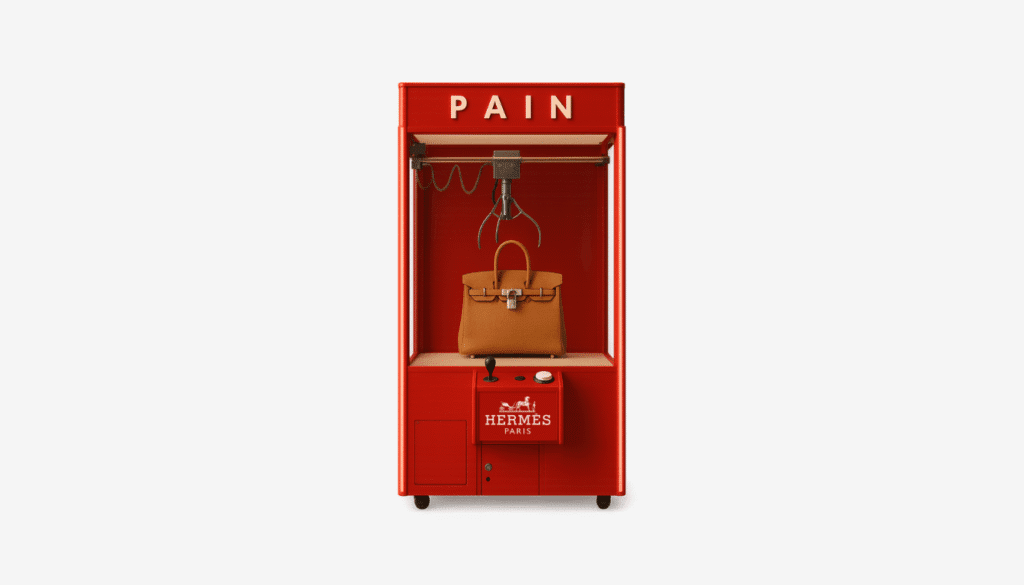
A claw machine sat in a SoHo storefront during New York Fashion Week, baited with a real Hermès Birkin that no one could actually claim. The catch wasn’t hidden; it was actually the concept. The claw was too weak, the bag was weighted, and the copy on the window told you as much. Yet for two days, a line curled down the block as hundreds queued to try their luck at a game designed to fail. The installation, conceived by Uncommon Creative Studio and titled “PAIN,” wasn’t sanctioned by Hermès. It didn’t need to be. It leveraged the most potent symbol in luxury and turned desire itself into the spectacle.
A Birkin in a Box
The setup was disarmingly simple, consisting of a glass case, an arcade claw, and a Birkin. The transparency, both literal and figurative, did the heavy lifting. By declaring the impossibility upfront, the piece inverted the usual near-miss psychology of carnival games and sweepstakes. There were no hidden odds, no fine print, no shock reveal, making the futility the headline. That honesty didn’t deter participation; it intensified it. People filmed, posted, and still paid to play, turning the unwinnable into a badge of having been there. In a week engineered around access and exclusivity, this was access without reward, and that paradox made it all the more irresistible.
Lines as Media
If fashion shows are theater, “PAIN” was street theater. The queue became a content engine, a visible metric of cultural heat, and a feedback loop, with lines attracting phones, which in turn attract more lines. The mechanic was universally legible, everyone knows how a claw machine works, and the prize was also universally readable. A Birkin compresses a decade of aspiration, waitlists, and whispered price tags into a single visual. That compression is why the activation spread beyond fashion diehards to mainstream feeds within hours. Even knowing there was zero chance of winning, roughly 600 people waited to take a turn, and countless more stopped to watch. It’s remarkable how many people still tried to beat it, despite the machine literally telling them they wouldn’t win, making participation the product and the campaign a genius setup.
Who Really Benefited
Hermès won by doing nothing. The brand’s mythology is built on scarcity ritualized through hoops and gatekeeping; here, scarcity was literalized as an impossible prize. The aura sharpened, and any backlash, such as accusations of elitism, cruelty, or performative denial, landed largely on the artifice of the installation rather than the house itself. For New York Fashion Week, the stunt became a mirror, as a commentary on the uneasy blend of aspiration and exclusion that underlies the entire event. For Uncommon Creative Studio, it was a calling card in the burgeoning field of anti-activation, work that rejects giveaways and access in favor of provocation and critique, while still generating massive earned reach.
Innovation by Refusal
What made this fresh wasn’t the claw machine itself; it was the refusal. Marketing is comfortable with rigged odds, but typically hides the rigging. “PAIN” made the luxury brand mythology a creative play. That radical transparency flipped the emotional valence from manipulation to mordant humor. The campaign also demonstrated a sophisticated form of borrowed equity, using a totemic object to tell a story without permission, partnership, or product tie-in, and still felt coherent. Rather than build a branded playground around a sponsor, it borrowed a symbol from the culture and turned context into the medium. In gallery terms, this was relational aesthetics applied to retail vernacular; the art was the behaviors, the groans, the near misses, and the onlookers narrating outcomes to their phones.
Why People Still Played
Scarcity, spectacle, and simplicity are a potent equation. The Birkin signals status; the public stage invites performance; the rules are instantly understood. That trifecta overwhelms rational expected value. Waiting in line became a way of opting into the joke, of participating in a live critique of the luxury chase while enjoying the thrill of proximity. There’s also a subtler pull at work: by making the zero-win odds explicit, the installation gave participants the freedom to act on desire without the insecurity of failure. No one could win, so no one lost; you could only belong to the moment, the crowd, the story.
The Cultural Aftertaste
The installation will linger because it captured the mood of a year in which consumers oscillate between irony and obsession. It showed that the most effective luxury messaging might be to withhold, rather than reward; to acknowledge the absurdity, rather than disguise it. It also suggests a creative template likely to spread when one iconic object, one brutally simple mechanic, one truth stated out loud. As brands chase “experiences,” the anti-experience, where the point is commentary, not access, may be the sharpest instrument left. The Birkin you couldn’t win.