
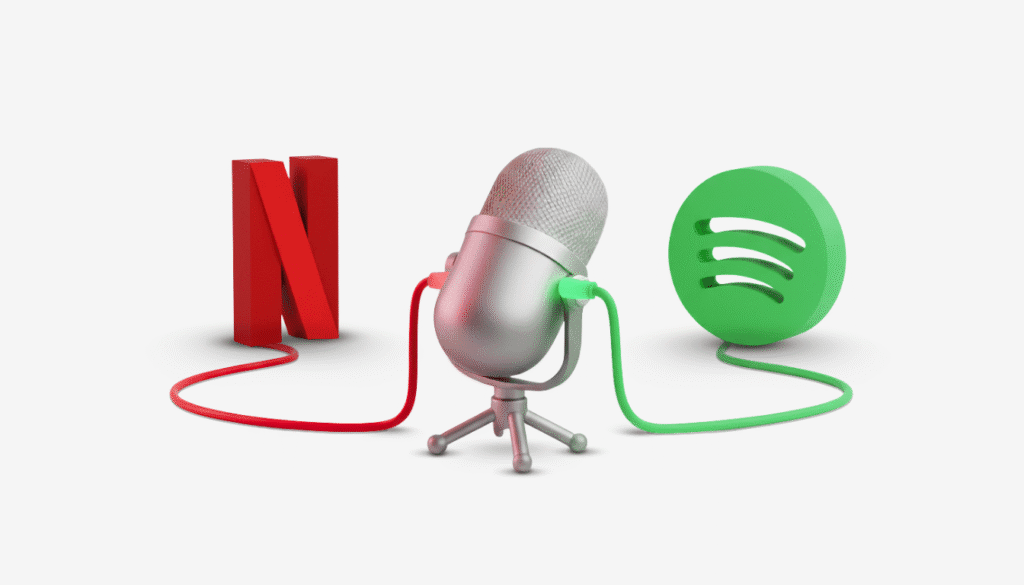
In early 2026, Netflix will add full video versions of select Spotify Studios and Ringer podcasts to its rows, beginning with titles like The Bill Simmons Podcast, The Rewatchables, and Dissect. For the first time, Spotify content will stream inside Netflix’s interface, with an international rollout expected later in 2026. It is a pragmatic alliance as Netflix gains durable, low-cost, high-frequency talk formats to keep subscribers engaged between tentpoles. At the same time, Spotify gives its creators a prestige window, introducing podcasts to audiences who rarely open an audio app. For brands, this is not a marginal distribution tweak but a new front door to attention on the biggest screen in the house.
Why it Matters for Marketers
For a decade, YouTube has been the primary home for video podcasts, optimizing discovery, search, and clips. Netflix’s participation doesn’t dethrone that dominance, yet it meaningfully diversifies where full-length conversations can be found and, crucially, how they are experienced. Living room, lean-back viewing changes the receptivity to host reads, product demos, and visual storytelling. If a show moves its full episodes from YouTube to Netflix while leaving clips on social, the upper-funnel becomes more cinematic and the mid-funnel remains snackable. That ladder lets brands buy the host, then orchestrate creative across platforms without reinventing assets each week.
Moreover, sponsoring a two-hour talk show shot on three cameras is not the same as buying a 30-second pre-roll. The inventory here is integrated, combining sustained presence, on-screen props, recurring segments, chapter cards, and lower-third prompts that can carry a vanity URL or a QR code. Because the programming cadence is weekly and evergreen, brands can build frequency and narrative over time —precisely what is getting harder on short-form feeds. The early slate leans into sports, pop culture, and true crime, categories that reliably over-index for engagement and conversation. That context allows for sharper category fits, such as apparel and betting around sports pods, consumer tech and entertainment around culture shows, CPG and security products around investigative formats.
Windowing Will Reshape the Funnel.
In that sense, the platform ladder in 2026 will look different. Teasers and highlights prime the feed on Shorts, Reels, and TikTok; full video episodes live on Netflix; audio remains wide for commuting and workouts; and YouTube keeps clips to feed search and long-tail discovery. Brands should map messaging to each rung. The hook happens in the first ten seconds of the episode, the mid-roll carries the demonstration or offer, and chaptered segments revisit the message without feeling repetitive. Meanwhile, creators will adjust pacing to Netflix norms, with clean cold opens, visual beats every few minutes, and graphics that reward pausing on a TV. The result is advertising that feels like part of the show rather than an interruption.
In addition, attribution has been the brake on podcast budgets. A Netflix window won’t magically solve that, but it will make disciplined testing worthwhile. Brands should triage three proof points: brand lift between exposed and holdout audiences; assisted conversions driven by show-specific URLs, QR codes, or offer codes; and attention metrics, such as average watch time and completion rates, if made available by partners. Geo-split testing during the U.S. rollout provides a clean design by treating a handful of DMAs as controls while buying integrations in matched markets, then validating with retail media or MMM. If the numbers hold, marketers can scale into late-2026 global expansion with confidence.
Creative That Earns the Big Screen
Long-form talk succeeds on Netflix when it looks like television without pretending to be television. Brands should insist on creative that uses the visual canvas, such as a physical product on the desk, cutaways to B-roll, side-by-side comparisons, and one memorable proof moment that justifies the segment’s existence. Lower-thirds should carry a human-readable URL and a scannable code, and the host should return to the message naturally after the break. For launches, negotiate a “chapter takeover” across multiple shows during a single week to concentrate impact. For evergreen performance, buy a recurring segment tied to an audience ritual—pre-game on Mondays, recommendations on Fridays, deep dives after awards shows.
The Global Runway
Because the partnership starts in the U.S. and expands later in 2026, brands have a built-in test-and-learn window. Pilot English-language creative against U.S. shows, confirm lift and retention, then localize with region-specific hosts, offer mechanics and compliance. Rights and clearances matter more on Netflix than on open platforms; plan music, archive, and international usage upfront to avoid re-edits that dilute the campaign’s timing.
There are real trade-offs. Full episodes moving off YouTube may thin long-tail search traffic; keep an aggressive clip strategy to maintain that discovery. Data sharing could be limited; negotiate a minimum viable telemetry package so you can price your buys. And not every audio-first show will translate to a TV room—low-visual formats need graphics, inserts, and guests that reward viewing. Yet for brands who pair integrated storytelling with disciplined measurement, the prize is significant: dependable reach in a premium environment, attached to voices audiences voluntarily spend hours with each week.
This alliance turns video podcasts into a mainstream streaming category just as marketers hunt for efficient, high-attention inventory. A good strategy is to treat it as a chance to buy depth rather than just impressions, to own a recurring moment rather than chase transient reach, and to prove that long-form conversation can move both brand and sales when it meets audiences where they actually watch.