
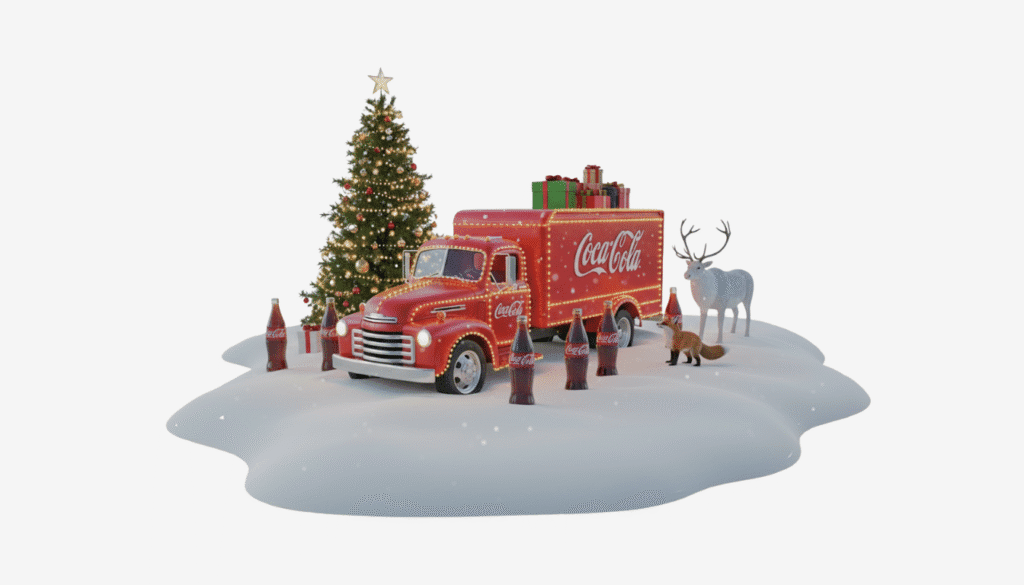
As the holiday season approaches, Coca-Cola has once again tapped into one of its most cherished marketing traditions, the “Holidays Are Coming” campaign. However, this time, the brand has brought something new to the table—artificial intelligence. In collaboration with AI studios like Silverside AI and Secret Level, Coca-Cola’s “Refresh Your Holidays” ad blends human creativity with machine innovation, updating its iconic ad with a new level of visual spectacle and technological efficiency.
This year’s campaign, featuring its signature convoy of light-wrapped red trucks cutting through snowy landscapes, aimed to invoke the same festive joy while introducing a modern touch with AI-generated visuals. Yet, what was meant to be an evolution of nostalgia soon became a battleground for debate within the advertising world and beyond.
Embracing Technology While Preserving Tradition
The ad, which debuted as a global campaign spanning North America, Latin America, and Asia-Pacific markets, was positioned as a harmonious collaboration between human imagination and cutting-edge AI. Coca-Cola’s creative team, led by the brand’s global vice president of creative strategy, Islam ElDessouky, emphasized that the holiday magic the brand is known for remains intact—enhanced, not replaced, by AI.
The ad’s visuals, crafted from over 70,000 video clips, boasted a hyper-real aesthetic that gave the familiar holiday scenes a cinematic sheen. The campaign’s narrative featured updated character designs, including mischievous squirrels and a variety of wildlife, alongside traditional polar bears and trucks. This fusion of AI and traditional elements was meant to bring a fresh perspective to a decades-old concept while still resonating with the emotional undercurrent that has made Coca-Cola’s holiday ads so successful for over 30 years.
But the praise quickly turned to criticism, as the ad began to provoke a mixed reaction from both audiences and industry professionals.
The Backlash: When Innovation Meets Tradition
What was initially celebrated as an innovative leap forward in AI technology soon became a source of public outrage. Critics took issue with what they saw as a soulless, overly polished depiction of the holiday season. Some perceived Coca-Cola’s attempt to update its classic commercial with AI-driven graphics as undermining the very emotional core that had made the ad so iconic in the first place.
For many, the connection to nostalgia—one of Coca-Cola’s most powerful brand tools—was lost in the shiny, high-definition visuals created by machines. The ad’s overly perfect, almost hyperreal aesthetic was seen by some as eroding the warmth and authenticity that the brand had so carefully cultivated over decades. Some viewers even pointed out glitches and oddities in the video, like rotating trucks that defied physics and a subtle dissonance in the way the characters moved, elements that detracted from the ad’s emotional appeal.
Even industry experts weighed in, many suggesting that Coca-Cola’s reliance on AI for such an important cultural touchstone was ill-advised. For a campaign so closely tied to human connection and warmth, the inclusion of AI seemed to many to undermine the spirit of the original vision.
The Industry’s Dilemma: AI’s Place in Creative Campaigns
Coca-Cola’s holiday ad campaign has become a microcosm of the broader advertising industry’s current dilemma—how to embrace technological advances while retaining the human touch that resonates with audiences. The backlash is not just a criticism of the ad itself, but a reflection of growing concerns over AI’s potential to replace human creatives. As more brands explore AI for its efficiency and scale, the question becomes: can technology truly capture the depth of human experience, especially in emotionally driven campaigns like those that dominate the holiday season?
While Coca-Cola has tried to frame its AI collaboration as a perfect blend of human and machine, many see it as a sign of more AI-generated content that sacrifices emotional resonance for technical efficiency. The question now is whether the benefits of AI—such as speed, scale, and cost—are worth the risk of alienating loyal consumers who expect more from their holiday ads than flawless visuals.
A Critical Moment for Brand Storytelling
For Coca-Cola, this campaign is a critical test of its ability to evolve without losing its core brand values. The company has long been associated with nostalgia, joy, and human connection, especially through its holiday campaigns.
For brands and marketers, the lesson here is clear: AI can be a powerful tool, but it should be used thoughtfully and with a deep understanding of the emotional triggers that connect consumers to a brand. While technology may offer new ways to tell stories, it cannot replace the emotional nuances that human creators bring to the table. As the industry continues to explore the potential of AI, Coca-Cola’s holiday ad serves as a reminder that innovation must always be grounded in authenticity.