
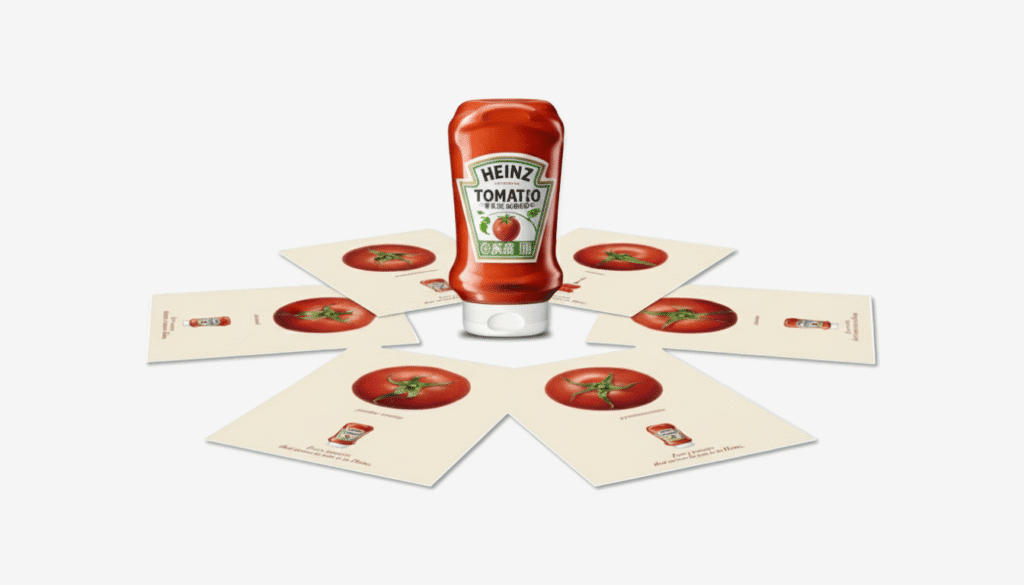
As China hosts its 15th National Games across Guangdong, Hong Kong, and Macao in November, Heinz found an inventive way to join the conversation. Since the brand lacked rights or rings, it partnered with Shanghai agency Heaven & Hell. Together, they transformed the green tomato stem—the calyx—into a suite of athlete pictograms, each posed to mirror one of the Games’ 34 sports. The campaign’s line, “Every tomato that strives to win is in Heinz,” bridges athletic excellence with ingredient pride, keeping the product at the heart of the idea while borrowing a visual language that fans recognize instantly.
Distinctiveness Over Decoration
What makes the work land is not just visual charm; it’s the strategic discipline underneath. Heinz has built years of equity around the quality and character of its tomatoes. Elevating the calyx—five leaflets and a stem—into human motion pushes a distinctive asset to its limit. At thumbnail size, the marks read as clever icons; at poster scale, they feel like elegant, reductive design. In a season flooded with patriotic graphics and medal-count memes, Heinz’s system is simple enough to be legible in a scroll and strong enough to be remembered offscreen.
There’s a spectrum between stealth ambush and full sponsorship. Heinz settles into a middle lane that feels like a tribute rather than a hijack. By avoiding protected emblems and calling the sports by their generic names, the brand stays onside while still tapping national attention. The tone helps, too: the athletes are tomatoes first, athletes second, so the brand celebrates the moment without pretending to be it. For marketers navigating event-adjacency without licenses, this is a template: claim a vernacular (pictograms), not a logo; speak with product truth, not borrowed valor.
Modular by Design, Built for the Feed and the Aisle
The 34-sport system invites serialized storytelling. Each icon can anchor a standalone post, a looping short, a sticker pack, or an aisle fin near complementary categories. For example, imagine a “spot-the-sport” carousel, or consider venue-adjacent OOH that swaps creative by daypart. In another case, QR-topped caps could unlock collectible cards and themed recipes. Since the asset is compact and repeatable, the media plan can flex from hyperlocal placements to national social, while maintaining the idea’s strength without dilution.
Turning Charm into Commerce
Design alone doesn’t move units; context and incentives do. Retailers could run micro-missions, such as collecting five sports to unlock a discount; scanning a swimmer to access a seafood ketchup pairing; or trading a completed set for a limited squeeze-bottle sleeve. In addition, creator collaborations can extend the visual language; bento artists might arrange “calyx athletes.”Calligraphers could render motion lines, and schools could use printable sheets for art hours tied to the Games calendar. Each tactic keeps the core mark simple while giving shoppers a reason to lean in.
The Small Print and Why It Matters
Two cautions temper the praise. First, clarity around rights remains essential; therefore, even if the work stays generic, copy and placements should be vetted to avoid any proximity that might imply official status. Second, minimalist systems can drift into design curios unless they lead to measurable outcomes. To prevent that, brands should track distinctive-asset recall —asking, “Which brand ran the tomato athletes?” — and monitor regional brand lift where Games buzz peaks, as well as velocity against geo-targeted displays. If those numbers move, Heinz has earned more than likes; in fact, it has banked memory that will pay back in the next seasonal moment.
Ultimately, a great marketing moment doesn’t require maximal spectacle; rather, it demands a truth only the brand can claim, then expresses it in the language of the moment. By doing so, and by letting a tiny piece of a tomato do the talking, Heinz demonstrates that the smallest asset, when used with discipline, can actually command a national stage.