
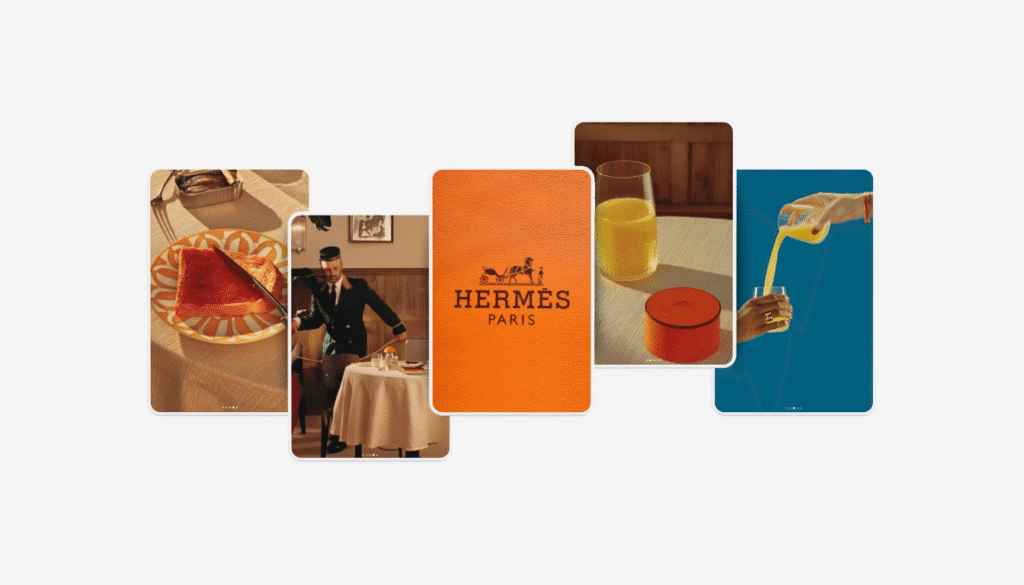
For decades, Hermès has been shorthand for discretion with restrained visuals, meticulous craft, and a tone that felt closer to a museum than a meme. The French house built its power on scarcity, heritage, and a deliberate distance from the marketing trends of the moment.
That is precisely what makes its latest creative move so striking. Scottie Cameron, the filmmaker behind some of Jacquemus’ most atmospheric campaign films, has been tapped to direct not one but three recent Hermès ad films. Known for romantic, playful, sunlit storytelling, Cameron has built a reel that runs from beachside vignettes to fashion films that feel like postcards from an endless summer.
In Hermès’ hands, that language translates into breakfasts bathed in morning light, citrus fruits that almost become characters, and short clips that feel closer to a summer story than a traditional luxury spot. The house itself has framed his work as adding “a spoonful of sun” to the table, extending a larger “Soleil” universe into films clearly designed to live in social feeds as much as in boutiques.
For a brand long associated with the line “we don’t do marketing” or with a highly controlled, art-first approach, this embrace of a recognisable, youth-coded director reads as more than a casting detail. It is a statement about how luxury wants to sound — and how close it is willing to get to its audience.
From Aloof Elegance To Emotional Proximity
The traditional language of high luxury has been built on distance. Products were framed almost as museum pieces, with minimal narrative and plenty of negative space. For legacy houses, that distance was part of the appeal: an implicit reminder that the brand lived above the churn of everyday life.
Cameron’s work pushes in the opposite direction. His Jacquemus campaigns are sun-soaked, flirty, and disarmingly simple, turning a dress, a bag, or a beach chair into the anchor of an accessible daydream. When that sensibility enters the Hermès universe, the result is a softer, more human register. Instead of a bag on a plinth, viewers see a morning routine, a landscape, a fleeting moment that could plausibly slot into their own lives — or at least their aspirational ones.
Luxury brands are grappling with audiences whose first contact with them often happens through short-form video, not print or runway reviews—reels, TikToks, and Shorts reward lightness, humour, and narrative hooks that land in seconds. In that sense, a playful film that can be sliced into multiple micro-moments is more likely to travel than a slow, reverential manifesto.
By commissioning three campaigns in a row from the same director, Hermès signals that this is not a one-off experiment but a deliberate attempt to move closer to that emotional bandwidth. The brand remains firmly in control of its objects and its framing; what changes is the temperature of the storytelling.
Whimsy Was Always There — Now It’s Louder
To treat this as a sudden pivot is to underestimate how Hermès has been communicating for years. Its visual world has long flirted with whimsy: horses running through surreal landscapes, scarves staged in dreamlike tableaux, objects appearing in playful, slightly impossible scenes. Campaigns that placed products inside colourful, almost theatrical compositions already hinted at a house comfortable with fantasy and play.
More recent seasons have leaned into this dreamlike quality, with accessories cast as protagonists in sunlit narratives that blur the line between art film and advertising. There are imaginary gardens, near-abstract interiors, and travel scenes that feel more like memories than commercials.
Cameron’s arrival, therefore, feels less like a revolution and more like an amplification. His style makes the existing Hermès codes — warmth, humour, subtle fantasy — explicit and instantly legible to a social-first audience. The brand’s long-standing preference for artists and scenographers over celebrity ambassadors finds a contemporary extension in a filmmaker whose visual language is already native to the platforms where luxury now competes for attention.
Why Risk Playfulness When Business Is Booming
The strategic stakes are high. Hermès is one of the few luxury houses consistently outpacing an industry slowdown, buoyed by disciplined pricing, ultra-wealthy clients, and a supply-driven model that keeps key products scarce. A brand in that position has little need to reinvent itself to chase clicks.
Yet its communication is a quiet pillar of that resilience. Hermès has managed to maintain desirability without overexposure, building a narrative universe that feels both consistent and surprising. Within that context, inviting a director like Cameron is less about chasing youth and more about future-proofing the Hermès tone of voice.
Younger affluent shoppers expect emotional proximity, even from the most rarefied brands. They are comfortable with the idea that a five-figure object can appear in a film that feels joyful, ironic, or gently self-aware. Luxury, in their eyes, is not diminished by humour; it is humanised by it. Cameron’s films allow Hermès to satisfy that expectation while still operating within the tightly controlled universe that maintains the brand’s aura.
The New Rules Of Luxury Speech
There are, however, clear limits to how far any house can push into playfulness. When luxury misreads the cultural moment, attempts to be “cute” or hyper-digital can quickly be criticised as off-brand or pandering. What delights one market can confuse another; what feels charming on Instagram can feel unserious in a flagship store.
Hermès’ collaboration with Scottie Cameron sits in a more controlled zone. The films remain anchored in physical product, tactile materials, and the house’s equestrian-sunlight universe, even as they borrow the pacing and warmth of contemporary fashion films. They suggest a new rule for high luxury speech: joy is allowed, even encouraged, so long as it is deployed with the same rigour as the stitching on a Kelly bag.
Across the sector, more brands are approaching this line. Quiet-luxury positioning coexists with looser, more narrative campaigns; independent-minded directors and artists are invited into heritage houses; short-form video becomes the primary script through which wealth, taste, and aspiration are performed. By repeatedly choosing a filmmaker whose name is already synonymous with modern, sunlit storytelling, Hermès turns up the volume on that shift.
The message is clear. Luxury no longer has to sound distant to stay exclusive. It just has to be the only one that can make a simple, playful moment feel like a world you want to live in, and, crucially, buy into.