
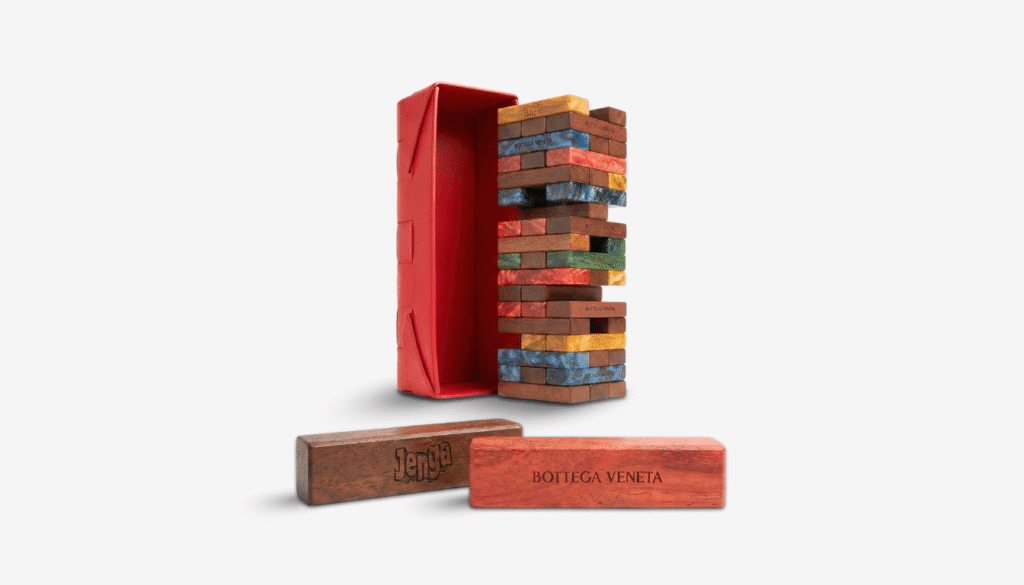
Bottega Veneta’s recent collaboration with Jenga has sparked conversations far beyond the novelty of a fashion house reinventing a family game. What appears at first like an extravagant collector’s item is, in reality, a masterclass in one of the most powerful yet underused creative skills in branding: the ability to identify structural similarities between everyday objects and a brand’s own design DNA. Through this lens, the collab becomes less of a playful accessory and more of a strategic study on how form, materiality, and meaning can be reimagined without breaking brand integrity.
At its core, Jenga is a precise arrangement of repeated rectangular blocks stacked into a geometric tower. These shapes are not just functional; they speak a visual language of order, rhythm, and controlled instability. And for a brand like Bottega Veneta, built on architectural silhouettes, modular weaving, and disciplined craft, those shapes are already familiar territory. The collaboration works because it doesn’t force a connection between fashion and a game; instead, it reveals one that already existed in the object’s anatomy.
How Form Translation Turns an Object Into a Brand Artifact
Rather than overhauling the game into a fashion statement, Bottega chose to refine its structure through elevated codes. The original Jenga proportions remain intact, but their meaning shifts through choices that signal luxury rather than play, including walnut wood replacing simple blocks, finely engraved logos introduced with restraint, and the iconic Intreccio leather reimagined as a storage case that borders on sculpture. The result is a set that retains the game’s identity while embodying Bottega’s signature precision and tactility.
This is the power of translating form instead of decorating it. In a market saturated with collaborations that rely on surface-level branding or viral novelty, Bottega’s approach feels intentional and anchored. The shapes stay true to the object, yet the materials, textures, and visual discipline pull it into the brand’s orbit. The Jenga tower becomes an extension of Bottega’s quiet luxury universe, not a deviation from it.
A Creative Method That Makes Brands More Intelligent
This attitude towards form does more than create beautiful objects; it strengthens the very logic of brand creativity. When creators learn to identify parallels in structure, silhouette, or repetition, they stop depending solely on color palettes, logos, or slogans to express identity. Instead, they build a deeper, more sophisticated language rooted in the brand’s essence.
For Bottega, the Jenga blocks echo the order of its woven leather. The vertical stack mirrors the architectural presence of its accessories. Even the tower’s tension — a moment away from collapse — reflects the controlled drama that often underpins luxury design. By working with these parallels, the brand expands into an unexpected category without diluting its DNA.
This approach also unlocks new creative possibilities. Brands can reinterpret furniture, packaging, digital interfaces, or even food objects simply by reading their shapes through their own codes. It’s a practice that makes creativity faster, more strategic, and more distinctive. Rather than inventing concepts from scratch, creators learn to recognize what already aligns with the brand’s world and elevate it through craft and storytelling.
Why Elevating the Ordinary Matters in Today’s Luxury Landscape
The collaboration also reflects a broader cultural shift. As luxury evolves beyond traditional categories, brands are experimenting with objects that once sat far outside their domain: playing cards, water bottles, ping-pong paddles, and even pet accessories. Yet the difference between gimmick and refinement lies in the quality of the translation. When form alignment is done well, as in Bottega’s Jenga, the object becomes a symbol of lifestyle, taste, and design intelligence.
Consumers today value objects that double as conversation pieces, artifacts that signal not only purchasing power but also aesthetic sensitivity, and a luxury Jenga set displayed on a coffee table perfectly cmines a small monument to the idea that good design can elevate the everyday without losing the joy of simplicity.
Where Creativity Goes From Here
Ultimately, the Bottega Veneta x Jenga set demonstrates how powerful it can be when creativity begins with observation. By studying shapes, patterns, and forms, brands can identify natural bridges between their identity and the world around them. This approach opens new territories while preserving cohesion, a balance increasingly necessary as brands expand into lifestyle, homeware, and cultural objects.
In this sense, the collaboration is less about a game and more about a mindset: one that treats design as a language, sees meaning in structure, and understands that even the simplest shape can become a luxury symbol when viewed through the right lens.