

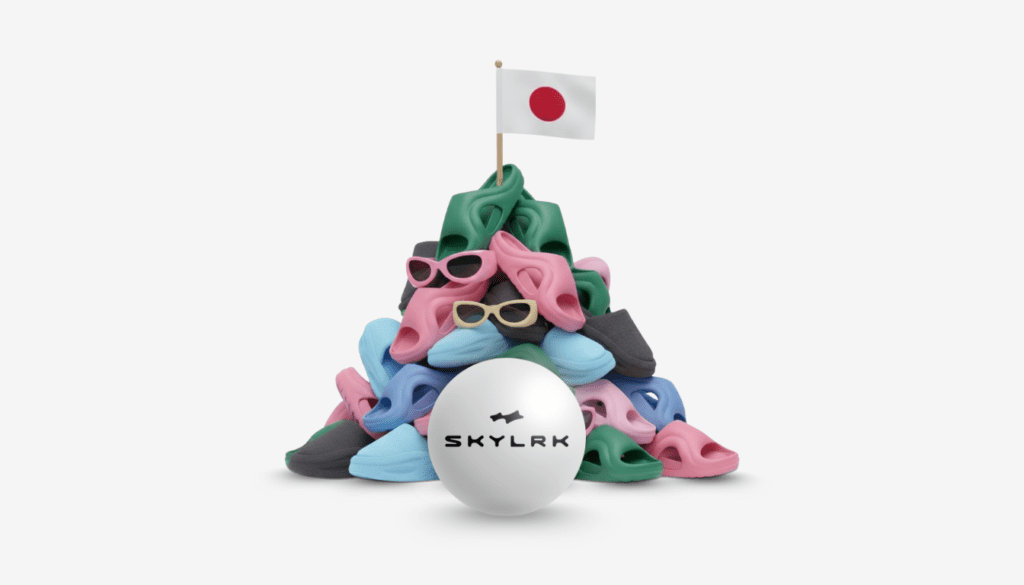
A New Brand Steps Into Streetwear’s Most Demanding Stage
When Skylrk opened its first physical space in Tokyo, the move felt less like a retail experiment and more like a declaration of intent. Justin Bieber’s new footwear and lifestyle brand chose Harajuku, a discerning fashion district, as its debut site. The choice underscores a clear ambition: to enter the culture not through volume or celebrity alone, but by competing on the very turf that shaped modern streetwear. Lines stretched for blocks. Fans documented every detail online. The pop-up became a case study in how geography can amplify global perception.
Tokyo’s fashion neighborhoods operate almost like cultural litmus tests. Brands that resonate there gain instant equity abroad, and those that fail rarely recover momentum. By positioning its first activation in Harajuku, Skylrk signaled that it intends to be evaluated by streetwear’s highest standards rather than rely solely on its star power. This calculated risk suggests a brand willing to perform in an arena where authenticity, design credibility, and innovation matter as much as fame.
Where Scarcity Turns Into Global Media
The four-day window for the Skylrk pop-up was engineered to compress demand into a concentrated burst. Consumers queued for hours, transforming the streets around the store into a visual symbol of hype. These lines, shared endlessly on social media, created an amplification loop that extended the brand’s reach far beyond Japan. Rather than a traditional store opening, the activation behaved more like a limited-time spectacle, a retail event built to generate cultural chatter.
Scarcity played an essential role. The Tokyo-exclusive items added a collector dynamic that resonated with local consumers and fans watching from afar. Each product purchase became a moment worth documenting. Every shared clip of the crowd gave the impression of a cultural happening. By turning foot traffic into content, Skylrk showed how physical retail can fuel digital storytelling—especially when the audience is already primed for participation.
Innovation as a Narrative Engine
What truly elevated the Tokyo debut was the introduction of Earth Bender, Skylrk’s first 3D-printed shoe. This technological centerpiece reframed the pop-up from a celebrity brand drop into an innovation story. The futuristic silhouette, echoing performance-sport influences, gave the brand a product capable of standing alongside established industry players. It also provided media with a headline that extended interest beyond fandom circles and into fashion, design, and tech publications.
Launching Earth Bender in Japan carried symbolic weight. Tokyo’s sneaker culture has long embraced experimental forms and material exploration, making it a fitting environment for unveiling a shoe that pushes the boundaries of manufacturing. The product became a proof point that Skylrk isn’t relying solely on Bieber’s name; it is attempting to stake a claim in design innovation. For a young brand, anchoring its identity in a breakthrough product creates credibility that celebrity ventures often struggle to achieve.
The Power of Couple Branding and Emotional Proximity
While innovation and scarcity shaped the retail narrative, the emotional layer of Skylrk’s brand story traveled globally through Justin and Hailey Bieber’s presence. Their appearances, behind-the-scenes content, and the introduction of a Hailey-designed colorway reinforced the sense that Skylrk is built from personal expression, not just commercial ambition. This relational angle humanized the brand and offered fans a gateway into its creative world.
In Japan, especially, where celebrity culture intersects strongly with fashion consumption, the blend of intimacy and aspiration proved potent. The couple’s image offered a soft aesthetic contrast to the bold shoe designs, allowing the brand to exist in both hype-driven and lifestyle-driven spaces. This dual appeal broadened its cultural reach and deepened the emotional stakes of the launch.
Japan as a Global Influence Machine
The Tokyo activation shows how a local event can scale globally when designed with cultural resonance in mind. Skylrk leveraged Japan not as a test market but as a symbolic stage—one where expectations are high, the fashion vocabulary is sophisticated, and consumer appetite for novelty is near-unmatched. By succeeding in this environment, the brand created a halo effect that now extends across markets, with its next move now under scrutiny.
Moreover, the pop-up revealed how product innovation, celebrity storytelling, and strategic geography can converge to shape early brand identity. In a saturated streetwear landscape, authenticity is no longer asserted; it must be earned. Skylrk’s choice to debut in Japan, supported by a narrative that blends design credibility, emotional intimacy, and limited-edition hype, suggests a brand intent on building longevity rather than chasing fast-cycle trends.
A Blueprint for the Next Wave of Celebrity Brands
Skylrk’s Tokyo moment illustrates a shift in how celebrity-led brands enter the market. Success no longer depends on broad distribution or mass visibility. Instead, it is built on meaningful cultural alignment, strategic physical touchpoints, and products that can sustain scrutiny beyond the spotlight. As other celebrities explore brand building, Skylrk’s move provides a roadmap: start where credibility is hardest to win and let the world come to you.