

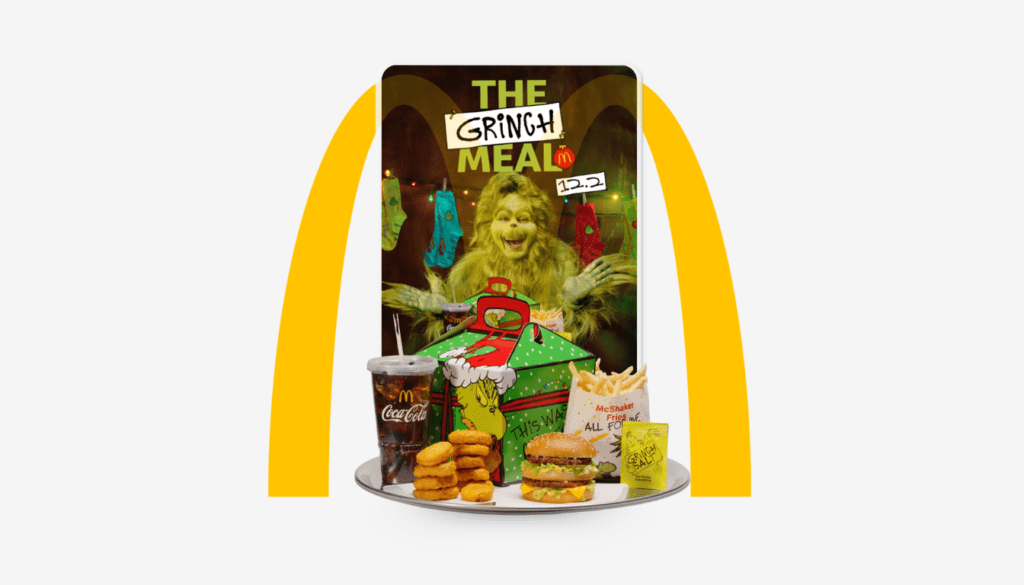
Across social platforms, from Reels to TikTok-styled edits, the Grinch returned this Christmas with the confidence of a character who knows he has outlived many marketing trends. McDonald’s positioned him not as a cameo but as a cultural anchor, building an entire seasonal narrative around his mischievous charm. In doing so, the brand reactivated a collective memory that younger adults still carry from childhood holiday films, while simultaneously tapping into the comfort of familiar rituals.
This return to a classic figure lands at a moment when brands feel pressured to chase constant novelty, often relying on AI-generated shortcuts or rapid-fire gimmicks. McDonald’s instead moved in the opposite direction, choosing a figure embedded in decades of holiday storytelling and remixing him into social formats built for today’s attention span. The result is content that feels new without feeling foreign, nostalgic without being sentimental, and familiar without slipping into predictability.
Where Childhood Memory Meets Modern Social Behavior
At the center of the campaign is the idea that nostalgia behaves differently on social media than it does in traditional advertising. Offline, nostalgia is sentimental and warm; online, it becomes participatory and performative. The Grinch reels circulating through Instagram embody that shift. These posts are edited like micro-trailers of a story people already know, but reframed with the fast rhythm, punchline timing, and aesthetically bold props demanded by social feeds.
When viewers watch the Grinch “hijacking” a McDonald’s billboard or mischievously unveiling his own overloaded meal, they experience two timelines at once: their childhood memories of holiday specials and their adult recognition of McDonald’s seasonal rituals. This duality makes the content instantly recognizable and emotionally rewarding in just a few seconds. It explains why these posts feel more like bite-sized cultural moments than brand placements.
Because nostalgia accelerates recognition, the campaign doesn’t have to explain itself. The character, the colors, the tone, the mischief, everything arrives pre-decoded. Social algorithms reward exactly that kind of instant comprehension, amplifying creative work that needs no introduction. McDonald’s essentially borrowed a narrative universe so familiar that users complete the story before the video ends.
Nostalgia as a Strategy for Participation, Not Just Memory
What makes the campaign strategically sharp is that nostalgia isn’t treated as a passive emotional trigger. Instead, it becomes a way to generate active participation. The Grinch socks, the shaker fries, the oversized meal box, and the green-washed visuals are all physical or visual artifacts designed for users to film, photograph, and remix.
This is nostalgia operating not as a sentimental nod, but as social currency. Posting a pair of mismatched Grinch socks is both a childhood callback and a modern flex. Recording an unboxing of the seasonal meal echoes the excitement of opening a Happy Meal toy, but repackaged for adult creator culture. Even the out-of-home pieces are framed like Instagram backdrops, encouraging passersby to document their encounter with the Grinch as if stumbling onto a real-life holiday movie set.
By placing a classic character inside social-native formats, McDonald’s bridges emotional comfort with contemporary behavior. Nostalgia gives the content warmth; social platforms give it speed, humor, and spread. Together, they form a hybrid storytelling structure that feels both timeless and fully built for the 2025 feed.
Why Nostalgia Still Cuts Through Modern Holiday Chaos
The campaign also reveals an undercurrent shaping this year’s holiday landscape: audiences are craving emotional simplicity. As AI-generated content floods the season, often uncanny, overly polished, or emotionally hollow, the reappearance of a hand-drawn, imperfect, universally known holiday figure becomes a relief. The Grinch may be mischievous, but he is unmistakably human in his tone, humor, and presence.
McDonald’s leaned into this contrast. Instead of competing with the hyper-slick visual language of AI, the brand embraced a character with rough edges, expressive quirks, and a narrative rooted in human emotion. This decision framed nostalgia as a form of authenticity, offering a counterbalance to the digital fatigue many consumers quietly feel. The campaign suggests that in a year defined by synthetic content, the most effective move is to return to stories that carry cultural truth.
Ultimately, the Grinch campaign works not because it tries to innovate Christmas, but because it restores it. It reminds users of a simpler emotional universe while offering new ways to engage with it. And in an era where social feeds grow more fragmented each year, that shared cultural shorthand becomes a powerful connective tissue.