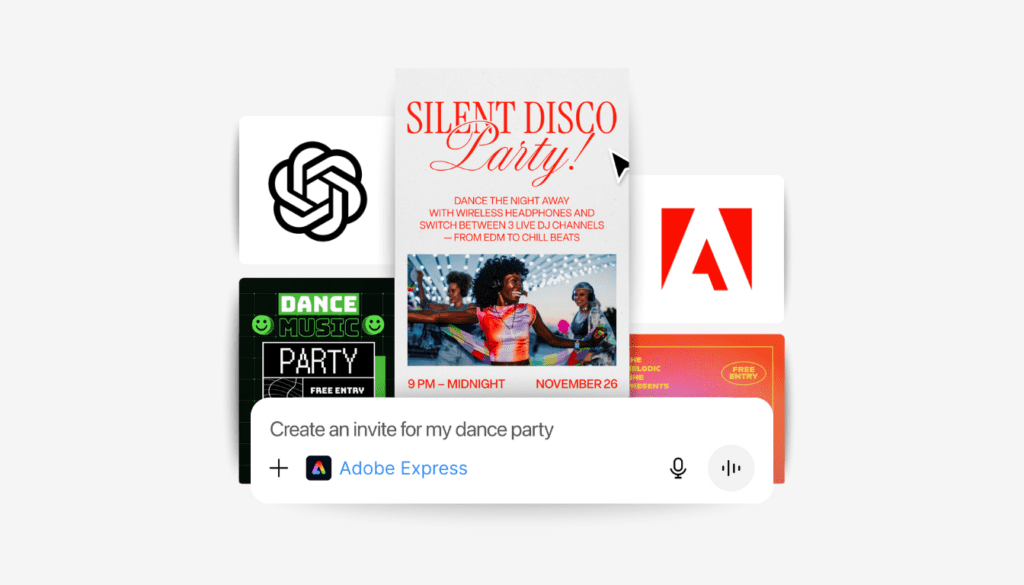
For more than three decades, Photoshop symbolized creative mastery, a tool learned through layers, shortcuts, and patience, a rite of passage that separated professionals from amateurs. This week, that logic fractured. Adobe’s decision to integrate Photoshop, Express, and Acrobat directly into ChatGPT marks a pivotal shift: design is no longer something you open, but something you ask for.
Inside an AI-powered conversation, users can now edit images, generate layouts, adjust documents, and refine visual assets simply by describing what they want. No file hopping. No steep learning curve. The interface is language, not panels. And that subtle change signals something much larger than a convenience update.
This is not Photoshop becoming simpler. It is Photoshop becoming invisible.
From Tool Mastery to Intent Mastery
What changes first is not output quality, but who gets to participate. When professional-grade tools respond to natural language, creative power moves upstream, away from technical execution and toward intent, taste, and direction. The value is no longer knowing how to do something, but knowing what should be done.
For creators, marketers, and founders, this collapses the distance between idea and execution. A campaign concept can become a visual asset at the same moment it is being discussed. Edits become conversational rather than procedural. Iteration speeds up, not because teams are working harder, but because friction quietly disappears.
Yet this democratization comes with a paradox. As more people gain access to “good enough” creative, differentiation becomes harder. When everyone can generate competent visuals, originality, coherence, and judgment become the true creative currency.
Marketing Enters Its Velocity Era
For brands, the implications are immediate. Creative speed has always mattered, but now it becomes structural. Campaign variants, localized visuals, seasonal adaptations, and platform-specific formats can be produced within the same thread that defines the strategy. Content supply expands, not through larger teams, but through tighter loops.
This integration also nudges personalization closer to reality. If copy, layout, and format adaptation happen in one place, segmentation stops being an operational headache and starts feeling achievable, especially for smaller brands that previously lacked design resources.
There is another, quieter shift happening alongside this. With Acrobat folded into the same environment, documents, decks, and proposals now live next to campaigns and visuals. Marketing stops being divided between “creative” and “operational” work. Everything becomes editable, improvable, and conversational.
A Platform Power Play Disguised as a Feature
Strategically, this move says as much about platforms as it does about creativity. ChatGPT positions itself as the front door to work, the place where thinking, creating, editing, and deciding converge. Adobe, in turn, evolves from a destination product into an embedded capability, present wherever ideas begin.
Instead of asking users to come to Photoshop, Adobe meets them in conversation, which might reframe distribution. The brand captures creators at the moment of intention, then scales with them as needs grow more complex.
The Risks Hiding Beneath the Ease
Speed, however, has consequences. When creation becomes effortless, consistency becomes fragile. Brand systems built on strict visual codes risk erosion if they are not translated into prompts, templates, and guardrails. “On brand” becomes subjective unless brands actively define how AI should interpret them.
There is also the growing tension around authenticity. When advanced retouching and manipulation are one prompt away, industries built on realism, trust, or representation will face sharper scrutiny. Transparency will matter more precisely because manipulation becomes easier.
And behind it all sits governance. Who can edit what? Where do files live? What happens when client workflows flow through conversational tools? These are no longer technical questions. They are leadership decisions.
Why Judgment Becomes the Ultimate Creative Skill
As execution costs fall, discernment becomes more valuable. The winners in this new landscape will not be those who generate the most assets, but those who know when to stop, what to refine, and what truly deserves to exist.
Adobe’s tools didn’t lose power by entering the ChatGPT space. They gained reach. And reach always reshapes markets. Creativity, once defined by access to tools, is now defined by clarity of vision.
The question is no longer who can use Photoshop, but if those who can still stand out when everyone can.