
The collaboration between Jacquemus and Duolingo is not anchored in audience overlap or seasonal hype, but in a deeper alignment around behavior. Both brands operate in global contexts where language, interpretation, and cultural literacy matter. One sells fashion rooted in French identity; the other has turned language acquisition into a daily habit for millions. Their meeting point is not aesthetic; it is functional.
At the center of the campaign lies a simple insight: pronunciation is a form of power. Knowing how to say something correctly is often the difference between feeling included and feeling exposed. By making pronunciation the creative core, the collaboration elevates learning from a private activity into a public, shareable experience.
Duolingo as a Creative System, Not a Supporting Act
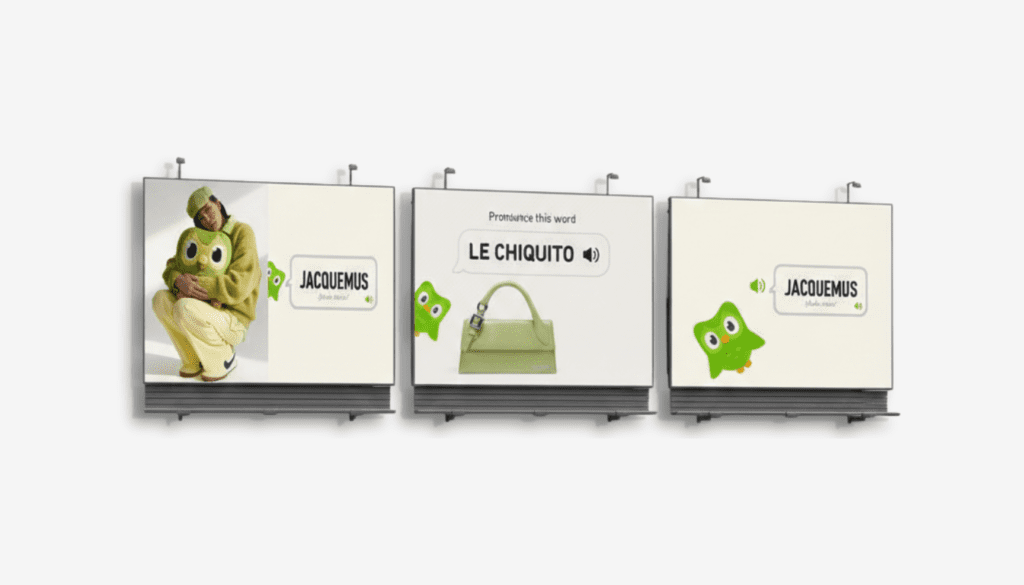
Rather than appearing as a logo or a mascot cameo, Duolingo takes on a more substantial role: it provides the campaign’s entire creative grammar. The visual language of the billboards—prompts like “Pronounce this word,” speaker icons, quiz-style layouts—mirrors the app’s interface so precisely that the ads feel less like fashion communication and more like frozen app screens placed in the city.
This is a critical creative choice. Duolingo is not adapting to luxury; luxury is adapting to Duolingo’s teaching style. The app’s core promise—learning through repetition, simplicity, and play—becomes the campaign’s organizing principle. The audience is not asked to admire the brand; it is asked to engage with it in the same low-pressure, confidence-building way Duolingo teaches languages.
Jacquemus Enters the Lesson
Within that framework, Jacquemus does not dominate the message; it becomes the subject matter. The brand name is introduced as a word to pronounce, while product names like Le Chiquito appear as vocabulary items rather than status symbols. This reframing subtly shifts the brand’s relationship with the public.
Instead of positioning luxury as something to decode through exclusivity, the campaign positions it as something to learn through familiarity. Saying the name correctly becomes a small achievement, a moment of mastery that mirrors the satisfaction of completing a Duolingo lesson. In this context, fashion becomes cultural literacy rather than aspiration alone.
Creativity Rooted in UX, Not Spectacle
What makes the campaign feel contemporary is its reliance on interface thinking rather than visual excess. Creativity is expressed through structure, timing, and recognition. The moment a passerby sees the prompt, the brain understands what to do—even if no action is required. That instant comprehension is the creative hook.
Duolingo’s long-standing success lies in turning learning into a habit through clear cues and emotional rewards. By translating those cues into physical space, the campaign transforms outdoor advertising into a mental interaction. The viewer completes the work internally, and that completion creates memory.
Humor, Discipline, and Brand Balance
Despite Duolingo’s reputation for internet humor, the campaign maintains a careful tonal balance. The humor is implicit, emerging from the contrast between luxury fashion and language exercises, rather than from overt jokes. Jacquemus’s minimalist aesthetic remains intact, while Duolingo’s playfulness operates within clear boundaries.
This discipline ensures that neither brand overshadows the other, as Duolingo gains cultural elevation by entering the fashion world without abandoning its educational core, and Jacquemus gains approachability without compromising its visual authority. The collaboration feels additive, not parasitic.
Designed for the Street, Built for Sharing
Although the executions live in physical spaces, their creative logic is unmistakably digital. The layouts resemble phone screens, the prompts feel screenshot-ready, and the message is instantly legible without explanation. The campaign anticipates its own redistribution, designing outdoor media that naturally migrates to social feeds.
Here again, Duolingo’s influence is clear. The brand understands that learning today is often performed publicly, shared as proof of effort and curiosity. By borrowing that dynamic, the campaign turns cultural learning into content.
A Signal of Where Brand Creativity is Heading
At a broader level, the collaboration reflects a shift in how brands think about creativity. The most effective ideas are no longer those that shout the loudest, but those that align with existing behaviors. Jacquemus and Duolingo meet audiences where they already are scrolling, learning, repeating, and elevate those behaviors into brand experiences.
The idea feels obvious only in hindsight, which is often the mark of a strong creative strategy. It does not invent a new ritual; it reframes a familiar one.
What the Campaign Ultimately Reveals
Beyond fashion or language, the collaboration points to a cultural truth: fluency is the new form of access. In a world where brands compete for relevance rather than attention, helping people understand—how to say a name, how to feel confident using it—can be more powerful than telling them to desire it.
By merging luxury with learning, Jacquemus and Duolingo suggest that the future of brand communication may not be about mystique or memorability alone, but about making culture easier to enter.