
When Romance Stopped Being the Main Character
For decades, Valentine’s advertising followed a recognizable formula, one built on candlelit dinners, sweeping declarations, and carefully staged intimacy designed to universalize the experience of love. Yet in 2026, that script felt increasingly insufficient for audiences navigating a world shaped by digital intimacy, economic uncertainty, and evolving definitions of partnership and self-worth. The brands that commanded attention this year understood that romance, while still central, could no longer function as a one-dimensional narrative.
Instead of presenting love as fantasy, they treated it as context, something refracted through identity, community, nostalgia, and financial reality. Valentine’s Day became less a sentimental ritual and more a cultural stage upon which brands projected their broader worldview. The campaigns that rose above the noise did so not because they were louder, but because they were sharper in their reading of the moment.
Confidence Over Cliché
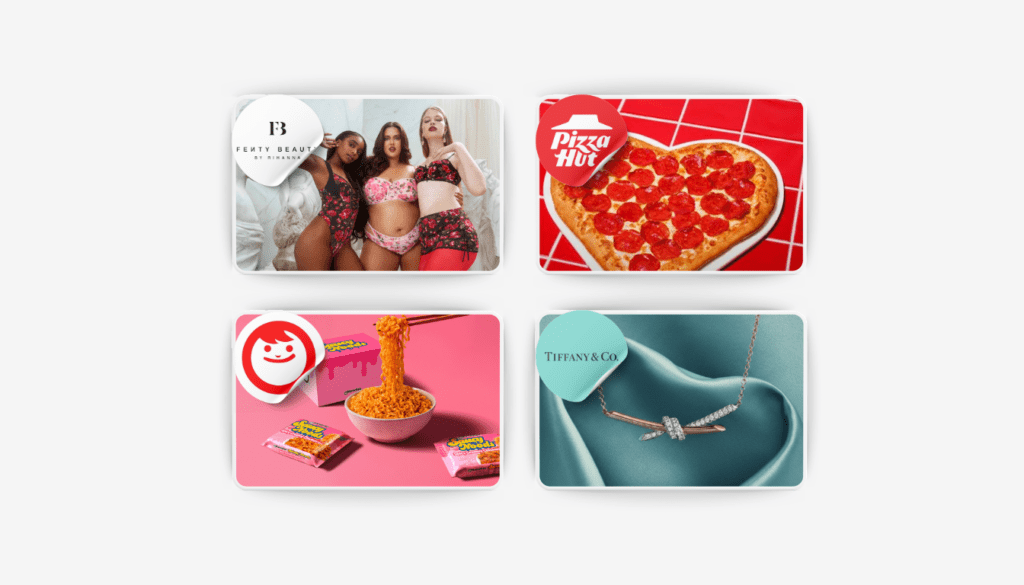
Few campaigns illustrated this recalibration more effectively than Savage X Fenty, which approached the season not as a celebration of coupledom but as an affirmation of self-assured sensuality. Anchored by Rihanna’s enduring cultural authority, the campaign reframed Valentine’s as an opportunity for self-expression rather than validation, positioning intimacy as something owned rather than bestowed.
What distinguished the effort was not simply its aesthetic boldness, but its refusal to conform to the traditional emotional codes of the holiday. In an environment saturated with predictable romantic imagery, Savage X Fenty chose to foreground autonomy and body confidence, aligning the brand with a broader conversation about empowerment that extends far beyond February 14. The result was a campaign that felt not reactive to the holiday, but expansive within it.
Heritage Reimagined for a New Generation
If Savage X Fenty embraced disruption, Tiffany & Co. leaned into continuity, crafting a cinematic narrative that underscored its historical depth while carefully translating that legacy for contemporary audiences. By framing its Valentine’s message around enduring love stories and generational memory, the jeweler reminded consumers that luxury, at its most persuasive, is less about immediacy and more about permanence.
The campaign’s visual language evoked tradition without appearing static, blending archival resonance with modern casting and polished storytelling. In an era defined by speed and scrollable content, Tiffany’s approach suggested that timelessness itself can be a differentiator. Rather than chasing virality, the brand invested in emotional durability, positioning Valentine’s not as a fleeting sales spike, but as a reaffirmation of its place within life’s most consequential moments.
Humor as Cultural Currency
At the same time, 2026 made clear that seriousness is no longer a prerequisite for impact. Maruchan, operating far outside the traditional romance category, demonstrated how humor can function as a powerful form of cultural literacy. By leaning into playful innuendo and digital-native wit, the brand engaged audiences who approach Valentine’s with as much irony as sincerity.
This strategy proved especially resonant in a year marked by economic caution, where indulgence is frequently tempered by practicality. Maruchan’s positioning subtly acknowledged that not all celebrations require extravagance, and that relatability, when executed with precision, can generate both attention and consideration. In doing so, the brand transformed affordability into an advantage, using tone and timing to embed itself within the social conversations that increasingly define seasonal relevance.
Nostalgia and the Power of Collective Memory
Mass-market players also found strength in shared cultural memory. Pizza Hut’s collaboration with the Backstreet Boys revived heart-shaped pizzas through 1990s nostalgia, blurring the boundaries between entertainment and advertising. By tapping into a generation’s collective soundtrack, the campaign transformed a limited-time product into a communal experience that extended beyond the dinner table and into digital feeds.
Nostalgia in this context was not mere aesthetic revival; it operated as emotional shorthand, enabling the brand to connect instantly across age groups who share the same cultural references. In a fragmented media environment, such shared memory offers rare unity, and Pizza Hut’s execution underscored how effectively that unity can be monetized.
Love in an Age of Economic Awareness
Even confectionery brands acknowledged that contemporary romance unfolds within financial constraints. Updated messaging from classic Valentine’s candies incorporated economic realities with subtle humor, reflecting a consumer base increasingly candid about cost and value. Rather than preserving an illusion of carefree indulgence, these brands folded economic awareness into their creative expression, signaling empathy rather than escapism.
This shift reveals a broader recalibration within seasonal marketing. Valentine’s 2026 did not deny aspiration, but it anchored aspiration within realism, recognizing that authenticity now demands acknowledgment of context.
The Real Shift Behind the Spectacle
Taken together, the season’s most influential campaigns illuminate a deeper transformation. Valentine’s Day remains commercially significant, yet it is no longer a guaranteed formula for success. It has become a proving ground for strategic nuance, where success depends on a brand’s ability to interpret culture rather than merely decorate it with hearts.
The companies that prevailed this year did so because they understood that love, as a marketing theme, must evolve alongside the audiences who experience it. Whether expressed through empowerment, heritage, humor, or nostalgia, the most resonant campaigns treated Valentine’s not as a static ritual but as a living conversation. In 2026, the brands that won recognized romance as only part of the story—and culture as the rest.