
When Listening Becomes a Commercial Moment
Spotify has long occupied a distinct and somewhat insulated position within the digital ecosystem, one defined not by the rapid churn of scrolling feeds but by a more continuous, immersive form of engagement, where users surrender attention to music, podcasts, and curated soundtracks that accompany their daily routines; yet its latest advertising rollout suggests that the company is no longer content to remain a passive layer in that experience, and is instead seeking to transform listening itself into a more active and commercially meaningful moment.
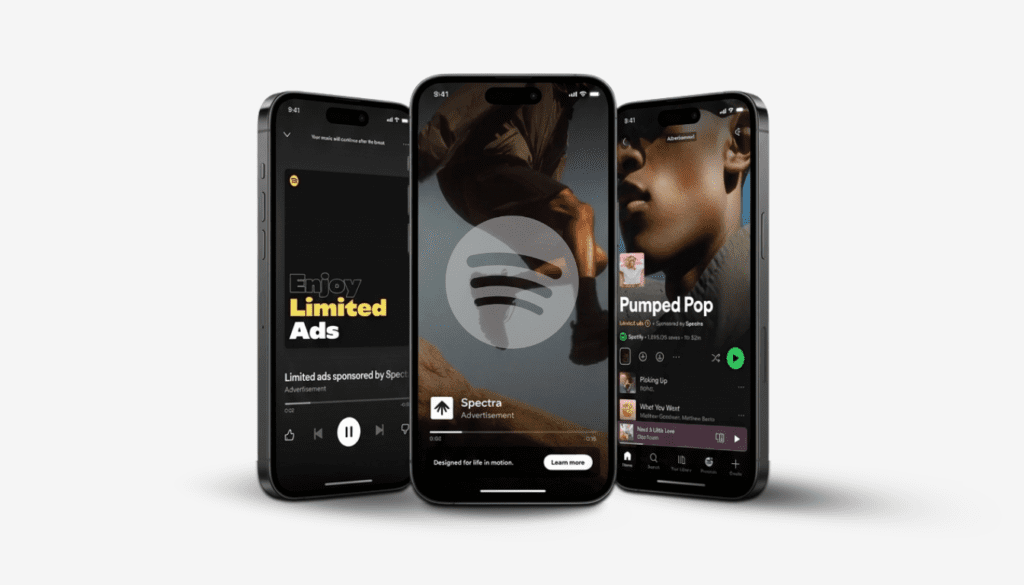
With the introduction of interactive carousel ads embedded directly within the Now Playing interface, Spotify is carefully inserting visual storytelling into an environment historically dominated by sound, allowing brands to present multiple products in a swipeable format where each frame carries its own imagery, messaging, and pathway to purchase, thereby creating a subtle but profound shift in how advertising operates within the platform. Rather than interrupting attention, these ads attempt to inhabit it, appearing at a moment when users are already engaged and, crucially, less distracted than they might be in other digital contexts.
From Awareness to Action
For much of its history, audio advertising has been understood primarily as a vehicle for awareness, valued for its ability to reach audiences at scale while reinforcing brand recall, yet rarely credited with the capacity to drive direct action; Spotify’s new formats, however, reflect a deliberate attempt to challenge that assumption by introducing layers of visual interactivity that extend the medium’s role deeper into the marketing funnel, effectively collapsing the distance between discovery and decision.
This ambition becomes even more evident in the introduction of branded playlist takeovers, which allow advertisers to assume exclusive presence within some of Spotify’s most culturally resonant playlists, placing their identity at the forefront of the listening experience while simultaneously reducing the frequency of ad interruptions, a balance that signals an awareness of the delicate relationship between monetization and user satisfaction. In doing so, Spotify is not merely selling inventory but offering a form of cultural alignment, positioning brands not as intrusions but as participants within the environments audiences already value and trust.
A Platform Repositioning Itself
The timing of these developments reflects a broader competitive reality: the battle for advertising budgets intensifies across a landscape dominated by platforms that have successfully integrated performance capabilities with massive reach, prompting Spotify to evolve from a channel primarily associated with upper-funnel engagement into one that can credibly claim relevance across the entire customer journey. Enhancements to its Ads Manager, including the introduction of A/B testing and automated bidding powered by machine learning, reinforce this shift, bringing its offering closer to the expectations set by more established digital advertising ecosystems.
In this context, Spotify’s repositioning places it in more direct competition with companies such as Meta Platforms, TikTok, and Google, whose dominance has been built on their ability to connect user intent with measurable outcomes, yet Spotify’s counterargument lies not in parity of tools alone but in the distinct nature of its engagement, where users spend extended periods within the platform as part of habitual, often daily routines, creating a form of attention that is less fragmented and potentially more receptive to well-integrated messaging.
The Role of AI in Scaling the Vision
Underlying this strategic evolution is a growing investment in artificial intelligence, which is steadily reshaping Spotify’s advertising mechanics by enabling automated campaign creation, optimization, and delivery at a scale difficult to achieve through traditional means. The introduction of generative tools for audio ad production, combined with machine learning systems that refine targeting and bidding in real time, signals a move toward a more self-sustaining advertising ecosystem, where barriers to entry are lowered, and experimentation becomes both faster and more accessible.
As these capabilities mature, they are likely to play a central role in determining whether Spotify can successfully position itself as more than a complementary channel, instead becoming a primary destination for advertisers seeking both creative flexibility and measurable performance.
Balancing Monetization and Experience
Yet, as with any transformation of this scale, the strategy carries inherent risks, particularly in relation to the user experience that has long defined Spotify’s appeal, rooted in its ability to provide seamless, uninterrupted listening, in contrast to the often fragmented, interruption-heavy nature of other digital platforms. The introduction of more visually driven and interactive ad formats raises the question of whether this balance can be maintained, or whether the pursuit of greater monetization will gradually erode the qualities that have made the platform distinctive.
Spotify’s current approach suggests an attempt to navigate this tension with precision, concentrating ads in high-attention moments while leveraging formats such as playlist takeovers to reduce overall ad load, thereby shifting the emphasis from quantity to quality and ensuring that advertising enhances, rather than detracts from, the broader experience.
Redefining the Role of Audio
Taken together, these developments point toward a broader redefinition of audio’s role within the digital marketing landscape, as Spotify moves to demonstrate that listening can function not only as a medium for awareness but as a pathway to action, capable of guiding users from initial exposure to eventual conversion without requiring them to leave the environment in which their attention is already anchored.
If this vision proves successful, it will mark a significant evolution in how marketers think about performance, expanding it beyond the confines of visual feeds and search interfaces to include moments of sustained, immersive engagement, where the line between content and commerce becomes increasingly fluid.