
For decades, television advertising has revolved around a familiar ritual in which networks gathered advertisers, unveiled their most valuable programming, brought celebrities onto polished stages, and transformed cultural anticipation into media commitments months before audiences had watched a single episode, match, or season premiere. The upfront was never just a sales event; it was a performance of confidence, a marketplace built on scarcity and spectacle, and a reminder that television, even as viewing habits fractured, still had the rare ability to organize mass attention around a shared cultural calendar.
That ritual is not disappearing. Sports, fandom, franchises, talent, and live events remain central to how media companies sell their value, and advertisers still understand that premium video can create an emotional scale difficult to replicate elsewhere. Yet beneath the surface of the upfront’s traditional theater, the business’s machinery is beginning to change. This year, one phrase kept surfacing across presentations, product announcements, and executive conversations: agentic TV buying.
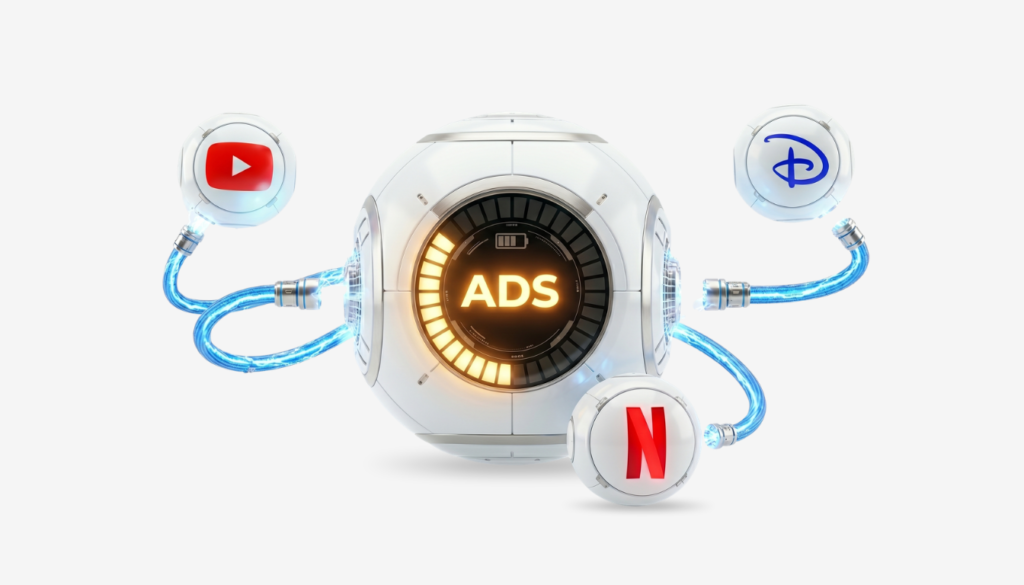
The term may sound like the latest piece of advertising jargon, and in some cases, it is still being used broadly enough to mean several things at once. But the concept behind it is important because it signals a shift in how television advertising may be planned, bought, and optimized. Agentic TV buying refers to the use of AI agents not merely as assistants that summarize data or generate recommendations, but as active systems that can help interpret campaign goals, identify audiences, select inventory, adjust delivery, optimize performance, and, eventually, execute purchases with less direct human intervention.
In other words, AI is no longer being positioned as a tool that sits beside the media plan. It is being invited into the transaction itself.
From Buying Spots to Managing Systems
The most meaningful change is not simply that artificial intelligence may make television advertising faster, although speed is certainly part of the appeal. The deeper transformation is that major media companies are trying to turn their advertising businesses into intelligent operating systems, where data, inventory, creative, measurement, and optimization no longer function as separate parts of the process but as connected components inside a more automated marketplace.
Fox’s AdStudio reflects that direction. By bringing audience intelligence, activation, and measurement closer together across Fox and Tubi, the company is preparing for a market in which advertisers no longer want to navigate disconnected buying systems or stitch together performance signals after the fact. Its planned agentic planning and buying capabilities suggest a future in which AI does not simply surface possible campaign options, but increasingly guides the campaign through the buying process itself, helping advertisers move from objective to execution with fewer manual steps.
NBCUniversal is pursuing a similar ambition, though with a more explicit emphasis on automation across the entire “pitch to pay” lifecycle. The company’s vision points to a future in which AI agents could help compress a process that has long depended on proposals, negotiations, spreadsheets, audience guarantees, platform-specific reports, and post-campaign analysis into something more continuous, responsive, and intelligence-led. Its proof-of-concept with partners including RPA, FreeWheel, and Newton Research offered a glimpse of how agent-to-agent buying might work across both linear and digital video, including premium inventory such as live sports.
That detail matters because live sports and linear television have historically been among the hardest parts of the media business to automate. Their value is tied to scarcity, timing, pricing complexity, and advertiser demand, making them resistant to the kind of fluid optimization that defines much of digital advertising. If agentic buying can begin to operate across those environments, it challenges one of the TV business’s oldest assumptions: that premium inventory is too complex or too valuable to be managed by automated systems. The new argument is that automation does not necessarily weaken the premium nature of television advertising; it may make that value easier to prove, allocate, and optimize.
Netflix Wants to Build the Ad Stack Without the Old Baggage
Netflix’s role stands out. It is not updating a decades-old TV sales machine, but building an ad business in real time. With fewer legacy constraints, Netflix can make streaming ads feel both premium and performance-driven from the start.
The company has already been pushing its ad-supported tier as a scale story, but the more consequential development is how quickly it is surrounding that scale with technology. Netflix is testing AI tools that can help advertisers develop and optimize media plans based on campaign objectives, while also exploring AI agents that could eventually manage, optimize, and purchase ads on the platform. At the same time, it is using AI to adapt advertiser assets into new formats, including vertical video and pause ads, while experimenting with more personalized approaches to frequency and ad load.
That matters because Netflix faces a specific advertising challenge. It has enormous cultural influence, strong viewer attention, and a reputation for premium content, yet it still needs to convince marketers that it can operate beyond being a glossy, upper-funnel environment. Agentic buying gives Netflix a language for that ambition. It allows the company to present itself not simply as a place where advertisers can buy premium streaming inventory, but as a system capable of connecting business objectives, audience signals, creative formats, and optimization in a more automated and measurable way.
The strategic message is increasingly clear. Netflix does not want to be treated as an elegant add-on to a larger television plan. It wants to become one of the systems that help decide how that plan is built.
YouTube’s AI Advantage Comes From Its Marketplace
YouTube’s version of the agentic future looks different because the platform already operates with a deeply algorithmic advertising engine. Unlike traditional television companies, YouTube does not need to convert a legacy sales process into a digital one. Its challenge is to persuade advertisers that it can absorb budgets from television, creator marketing, social video, search-driven discovery, and performance media simultaneously.
For YouTube, AI is less about making automated TV buying possible and more about making its enormous video marketplace easier to understand, organize, and monetize. The platform’s advantage is not only reach, but the range of signals it controls across creators, Shorts, long-form video, fandoms, search behavior, cultural moments, and audience intent. In that environment, AI can help advertisers identify relevant creator ecosystems, assemble packages around emerging moments, and connect brand objectives with formats that would be difficult, if not impossible, to organize manually at scale.
That makes YouTube’s agentic opportunity especially powerful. The platform can use AI to move beyond the traditional idea of buying channels, demographics, or broad content categories and toward something closer to buying momentum. A brand may not know exactly which creators, fan communities, viewing behaviors, or video formats matter most to a campaign, but an AI-driven system can increasingly recommend where attention is gathering and where the brand might enter with relevance.
This is why YouTube’s upfront pitch increasingly feels less like a conventional television presentation and more like a claim over the future of video advertising itself. It is not merely selling programming. It is selling an intelligent marketplace that organizes culture, creators, and performance signals for advertisers in real time.
Context Is Becoming Machine-Readable
For Disney and Warner Bros. Discovery, the agentic conversation points to another important transformation: context is becoming a more precise and machine-readable layer of targeting. In the past, television was often bought around programs, genres, dayparts, or broad audience assumptions. Digital advertising then introduced greater precision through behavioral and demographic signals. Now, AI is beginning to make the content itself more legible at a granular level.
Warner Bros. Discovery’s work around scene-level contextual targeting and dynamic creative reflects this direction. Instead of placing an ad only because a viewer belongs to a certain audience segment or because a program fits a broad category, AI can increasingly interpret the content’s environment, including tone, mood, subject matter, scene composition, and emotional context. That opens the door to a model in which advertisers think not only about who is watching, but what they are watching, what kind of moment they are entering, and how that moment may shape the viewer’s receptivity.
Disney’s opportunity is rooted in a different kind of strength. The company’s advertising power comes from the depth of its ecosystem, spanning sports and family entertainment, franchises, streaming, live events, and fandom. As agentic systems become more sophisticated, Disney can connect that emotional and cultural architecture with smarter planning and buying tools, creating an environment where audience intelligence and content context reinforce each other rather than functioning as separate selling points.
This may become one of the most important implications of agentic TV buying. The future of television advertising will not be about reaching the right viewer alone. It will be about reaching the right viewer in the right content environment, at the right moment, with creative that adapts to the situation rather than simply interrupts it.
The Upfront Is Becoming a Performance Conversation
The reason agentic buying gained so much attention is that it speaks directly to the pressure facing the television industry. Streaming has fragmented audiences, linear viewing continues to face structural decline in many categories, and advertisers are under growing pressure to justify every major budget decision. Marketers still want the prestige, safety, and cultural weight of premium video, but they also want clearer proof that it can drive measurable business outcomes.
That is why the new language of the upfront increasingly centers on optimization, automation, outcomes, and intelligence. Media companies are still selling emotion, fame, fandom, and cultural scale, but they are also trying to prove that their platforms can operate with the accountability and responsiveness of digital performance media. Agentic AI provides a bridge between those two worlds, enabling them to argue that television can maintain its premium value while becoming easier to plan, optimize, and measure.
For advertisers, the promise is obvious but not uncomplicated. Agentic systems could reduce friction, improve pacing, uncover better inventory opportunities, make creatives more contextually relevant, and help marketers move beyond static media plans toward campaigns that respond more quickly to performance signals. Yet the same systems could also make the marketplace more opaque if every platform builds its own proprietary agent, its own optimization logic, and its own definition of success.
That is the hidden tension in the agentic TV race. Every company wants to make buying easier within its own ecosystem, but marketers do not buy media within a single ecosystem. They have to compare performance across Netflix, YouTube, Disney, Fox, NBCUniversal, Warner Bros. Discovery, and a growing field of streaming, retail media, and digital video platforms. If agentic buying becomes a collection of closed systems, the industry may reduce friction within individual platforms while increasing complexity across the market as a whole.
The New Power Layer in TV Advertising
The biggest question is not whether AI will play a larger role in television advertising. That is already happening. The more consequential question is who will control the intelligence layer that decides where money flows.
Historically, media power came from owning the audience, the programming, or the distribution. In the agentic era, power may increasingly come from owning the system that interprets a brand’s objective and translates it into action. The platform that can understand the brief, recommend the audience, select the inventory, adjust the creative, optimize delivery, and report outcomes is no longer just a media seller. It becomes a decision-making partner and, potentially, a gatekeeper between advertisers and the market they are trying to reach.
That also changes marketers’ roles. Buyers may spend less time manually assembling campaigns and more time setting constraints, defining business goals, evaluating recommendations, and auditing outcomes. The human role does not disappear, but it shifts from execution to governance. Marketers will need to understand not only what an AI system recommends, but also why it recommends it, what data it uses, what trade-offs it makes, and whether its definition of success actually aligns with the brand’s business objective.
This is where the next phase of competition will likely unfold. The companies that win will not be the ones that simply attach the word “agentic” to existing ad products or use AI as a more fashionable name for automation. They will be the ones who make these systems useful, transparent, and measurable enough for advertisers to trust them with meaningful budget decisions.
For now, agentic TV buying is both a buzzword and a genuine structural shift. It reflects the television industry’s attempt to reinvent itself for a market in which premium content still matters deeply, but intelligence increasingly determines how that content is bought, valued, and measured. The upfront may still feature celebrities, trailers, and stagecraft, but the real negotiation is moving to a less visible, far more consequential space: the systems that decide what advertisers should buy next.