
The Turquoise Arches of Sedona
Sedona, Arizona, is one of the few places in the world where McDonald’s has swapped its famous golden arches for turquoise ones, a concession to local regulations protecting the visual character of the red rock landscape. For most people, it is a curiosity worth a photograph. For Devin Booker, the Phoenix Suns guard who made the Sedona McDonald’s a regular stop during his years playing in the desert, it became the central image of his second signature shoe.
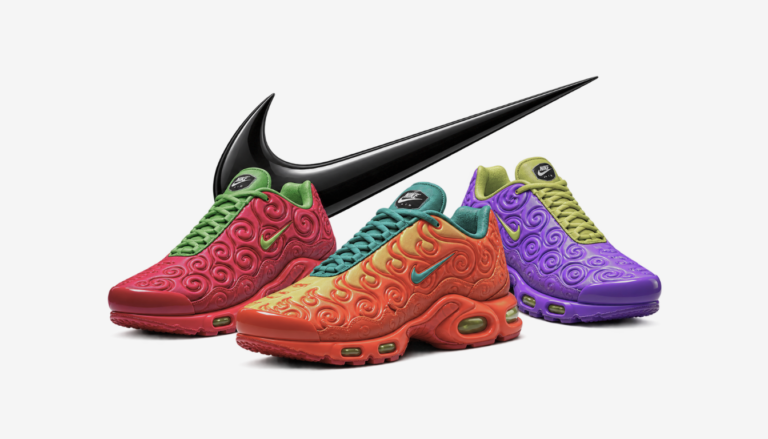
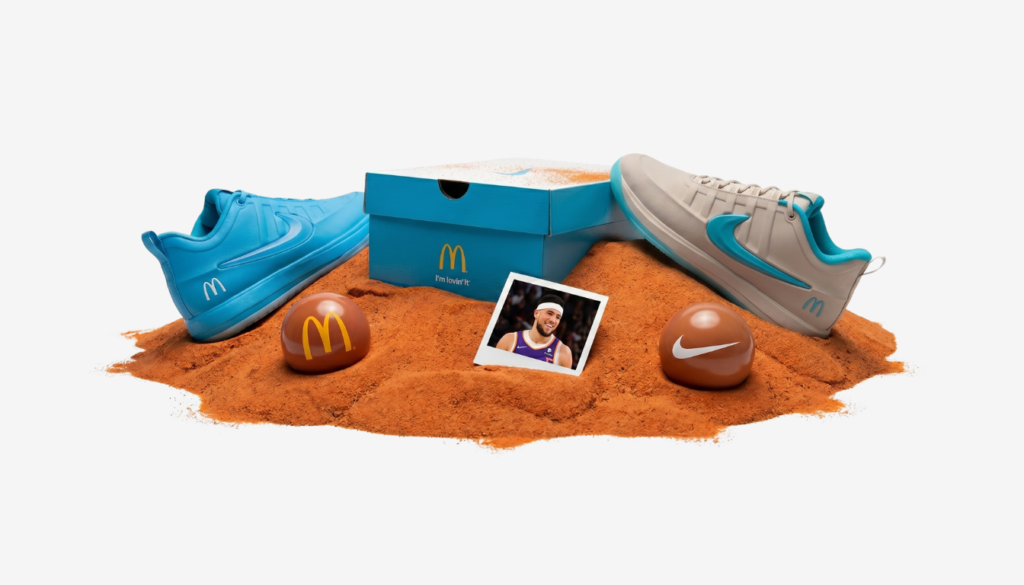
The Nike Book 2 McDonald’s is a white basketball sneaker with a turquoise Swoosh and a golden arch. It is, on paper, a straightforward athlete-brand collaboration of the kind that fills the sneaker calendar every season. What made it something else entirely was the decision, made by Wieden+Kennedy New York — the agency behind both Nike and McDonald’s — not to launch the shoe in the conventional way. Instead, the campaign leaned into a habit that Booker had already developed organically: hiding signed, unreleased sneakers in public places for fans to find. The shoe was not announced. It was hidden. And the hunt was staged across the Arizona desert in a way that felt less like a marketing campaign and more like a mystery that had been waiting to be solved.
Cryptic Clues and an Eerie Ronald
The campaign unfolded in stages across social media, each one deliberately ambiguous. The first film, shot on a vintage camcorder in a found-footage style that felt both nostalgic and unsettling, showed a classic Ronald McDonald statue — the kind that populated restaurant playgrounds from the 1970s through the 2000s — sitting on a bench at the edge of a desert cliff, wearing a pair of distinctive turquoise shoes. The post read simply: “Ronald?” No explanation. No product announcement. Just an image, strange enough to generate immediate conversation.
A second post followed, asking: “Do you seek the turquoise arches?” In it, Booker hikes through the Sedona landscape as a turquoise basketball falls from the sky, and he comes upon Ronald on the bench. Sharp-eyed fans soon found coordinates embedded at the end of one of the camcorder-style videos — coordinates that led to the Sedona McDonald’s, where an early-access activation allowed fans to buy the limited-edition Friends and Family version of the shoe before its official June 2 release. Booker himself handed out pairs through the drive-thru.
The Friends and Family edition — a second, fully turquoise shoe exclusive to the activation and a sweepstakes tied to McCafé drink orders — gave the campaign multiple entry points and reward structures, meaning that fans who found the coordinates early got the rarest version, but fans who simply ordered a drink in the app had a chance to win. The scarcity and the mystery worked in layers.
Why Authenticity Is Not a Marketing Strategy
The campaign’s creative team at Wieden+Kennedy was explicit about what made this collaboration different from the standard playbook. “Most brand collaborations start with a product and then try to build meaning around it afterward,” the copywriter and art director behind the campaign wrote in a statement. “This one already had a point of view.” The point of view existed because Booker’s connection to Sedona and to McDonald’s was not manufactured for the launch. It was a real part of his biography, which gave the campaign a shape before anyone had to invent one.
That distinction matters more than it might appear. The sneaker collaboration market is saturated to the point where individual drops struggle to generate genuine cultural attention without either an enormous celebrity name or an unusually compelling story. The Nike Book 2 McDonald’s featured a moderately famous NBA player — not a global superstar — and a fast-food chain. What it had in place of scale was specificity: a real place, a real habit, a real object of personal meaning. The turquoise arches of Sedona are not a symbol invented by a marketing team. They exist. Booker actually went there. The shoe actually means something to him. And the campaign was structured to make that specificity legible rather than smoothing it out into generic brand language.
Jennifer “JJ” Healan, McDonald’s VP of US marketing, described the partnership as rooted in what she called “brand love, creativity, and co-creation” — phrases that are so often used in marketing communications that they have nearly lost their meaning. In this case, they are accurate. The love was pre-existing. The creativity followed from it. And the result was a campaign that felt like it belonged to the world it was describing, rather than being placed on top of it.
The Lesson That Keeps Not Being Learned
What the Nike Book 2 McDonald’s campaign demonstrates is not complicated, but it is consistently underexecuted across the industry. The conditions that made this work — a genuine prior relationship between the athlete and the brand, a specific and visually distinctive geographical detail, an activation format rooted in the athlete’s own behavior rather than imposed from outside — are all preconditions that require patience and genuine curiosity about who the athlete actually is before the contract is signed.
Most sneaker and athlete collaborations skip those preconditions. They start with the name, reach, and demographic alignment, then work backward to find a story that could plausibly belong to the person. The result tends to be a product that is commercially competent and culturally forgettable. The campaigns that generate lasting attention — that become things people tell other people about — almost always have a moment early in their development where someone noticed something true and decided to build toward it rather than away from it. In this case, that moment was when a junior team member asked whether the Sedona McDonald’s could be more than a detail. It turned out to be the whole story.