
The Setup: A Director Losing Control of His Own Production
The film opens on a Hollywood mega-studio production set. A director — whiny, controlling, increasingly frantic — is trying to shoot a Nike football commercial. He is complaining about Kylian Mbappé’s “theatrics.” The stars are milling about, waiting. The production is precisely what Nike football advertising has always been: a carefully managed, scripted, controlled representation of the game.
Then something happens. The ball starts moving. The players stop listening. What was meant to be a controlled shoot becomes something the director cannot stop, predict, or contain — and the film that results from that loss of control is six minutes of orchestrated chaos that passes through action movies, arthouse cinema, live television studios, and a black-and-white avant-garde film sequence in which Eric Cantona plays a fisherman with the dignity and composure of a man who has never once done what anyone asked him to do.
The premise is self-aware to the point of being meta-critical. Nike is making a film about the impossibility of scripting football while making the most scripted, produced, and precisely engineered football film in years. The director being overthrown is both the fictional character in the film and a stand-in for every convention of sports advertising that Nike is simultaneously invoking and dismantling. The joke is layered. The execution is immaculate.
The Cast as Strategy: Every Name Is a Different Doorway
The most immediate and striking quality of “Rip The Script” is its cast — more than 30 people, spanning current players, retired legends, entertainers, musicians, athletes from other sports, and cultural figures whose connection to football ranges from lifelong obsession to affectionate adjacency. The list runs: Cristiano Ronaldo, Kylian Mbappé, Erling Haaland, Vinícius Júnior, Cole Palmer, Jamal Musiala, Virgil van Dijk, Bruno Fernandes, Alexia Putellas, Nico Williams, Fede Valverde, Estêvão, Tyler Adams, Alphonso Davies, Raúl Jiménez, Kerolin. Then the legends: Ronaldinho, Zlatan Ibrahimović, Eric Cantona, Didier Drogba, Jorge Campos. Then the cultural cast: LeBron James, Kim Kardashian and her son Saint, Travis Scott, LISA from BLACKPINK, Young Miko, Central Cee, Channing Tatum, Jason Sudeikis as Ted Lasso, Kate Scott, Serena Williams, Clint 419, Mateo Alcántara.
Enrico Balleri, Nike’s VP and creative director of Global Brand Voice, described the casting philosophy with unusual directness: “We were intentional in choosing every cast member in the film, and we had fun and leaned into the playfulness of their roles.” The specificity matters. Kim Kardashian appears as a “soccer mom” — a role rooted in the actual biographical fact that she takes her son Saint to football — and the film builds an entire persona around it, with the campaign’s 185 follow-up shorts deepening that character across the coming weeks. Channing Tatum appears wearing an Erling Haaland haircut before the real Haaland materializes beside him. The joke works because both Haaland’s haircut and Tatum’s willingness to be ridiculous are culturally legible. Nothing in the casting is accidental.
What DesignRush’s analysis identified with precision is the commercial logic underlying the star density: “The casting is the distribution strategy. Each name is a different algorithm’s entry point.” LISA brings the campaign into K-pop fandoms that have no prior Nike football relationship. Young Miko carries it into Latin trap communities across Puerto Rico and the United States. Central Cee delivers it to UK street culture. LeBron James opens it to basketball audiences and the broader American sports consumer who is only beginning to develop a relationship with football as the World Cup arrives on home soil. Travis Scott takes it to music and lifestyle culture. Ted Lasso — Jason Sudeikis reprising a character that introduced football to millions of American streaming subscribers — is both a joke for the initiated and a genuine entry point for the newly curious.
The film is not trying to speak to one audience at maximum volume. It is trying to speak to twenty audiences simultaneously, each one through a character whose cultural resonance is precisely calibrated to the community it is meant to reach.
The Scenes: A Careful Chaos
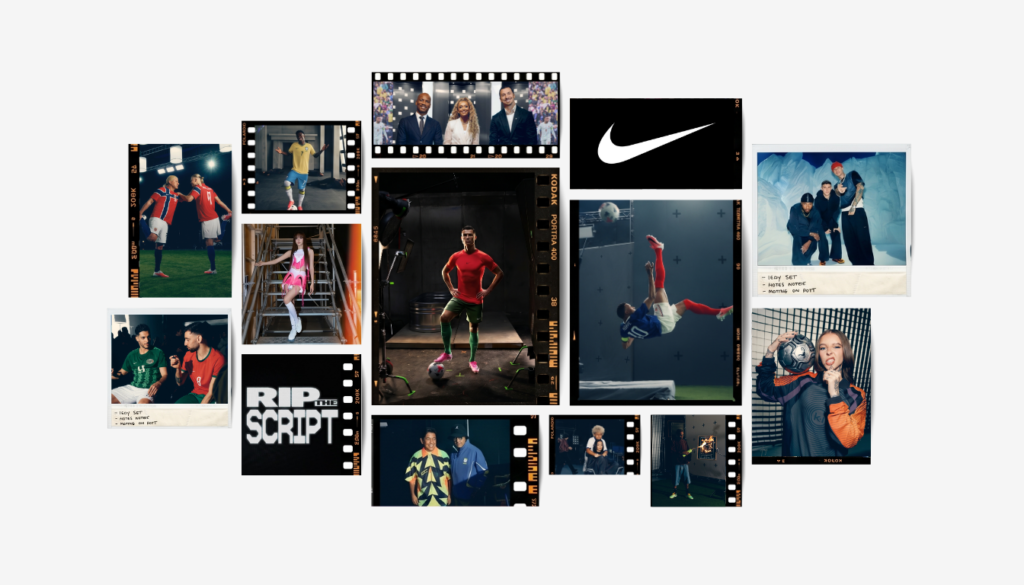
The chaos the film portrays is, on inspection, not chaotic at all. Every scene and sequence has been engineered with a specific intent, and the details embedded within them reward multiple viewings in ways that create organic conversation online.
Mbappé launches into a bicycle kick in an action movie sequence, his movement rendered in slow motion against a visual grammar borrowed from blockbuster cinema. The choice is deliberate: Mbappé’s combination of technical perfection and expressive flair maps naturally onto the action hero archetype, and the sequence gives his skill a cinematic weight that a straightforward football highlight never achieves. Vini Jr. smiles his way through a series of dribbles, his joy so genuine and so consistently itself that it becomes its own statement about what football should feel like. Haaland is shown being mindful — a joke about his well-documented interest in wellness and recovery that lands as affection rather than mockery because it is specific enough to be true.
The Ronaldo and LeBron James scene is the film’s most precisely aimed cultural moment. The two men — both still active athletes, both still central to the “greatest of all time” debates in their respective sports, both operating at the peak of their cultural influence decades into their careers — are shown sitting in a director’s meeting reviewing the concept for a film titled “The GOAT’s Goodbye.” Both reject it. Neither is ready to be retired. The joke plays on something real and universally understood about these two specific people, which is why it doesn’t feel like product placement. It feels like a conversation the two men would actually have.
Eric Cantona as a fisherman in a black-and-white avant-garde sequence is the film’s purest act of self-aware absurdism — a nod to the Frenchman’s post-football career as an actor and artist, his famous philosophical inscrutability, and the tradition of Nike football campaigns featuring Cantona as the elder statesman of the game’s most irreverent spirit. He appeared in Nike’s original 1998 Secret Tournament. His presence here is both continuity and comedy.
The film also contains details designed to generate second-watch conversation and extend its organic life online. An unreleased music track is buried in the audio. The PSG 2026-27 away kit appears on screen before its official release date. Germany and Portugal appear in blank national team kits that their respective federations never formally approved. None of this is accidental. Each embedded detail is a gift to the most attentive fans — something to notice, to screenshot, to post, to argue about — and the discovery of each one extends the film’s earned media life without requiring any additional paid distribution.
The 185 Shorts: The Film Is the First Episode
The element of “Rip The Script” that most distinguishes it from any previous Nike World Cup campaign — and from most sports advertising at any scale — is what surrounds the hero film rather than what is in it. Nike has produced approximately 185 follow-up short films, each one extending, deepening, or exploring a specific character or moment from the six-minute anchor piece. Kim Kardashian’s soccer mom persona gets its own extended storyline. Individual player vignettes develop the personalities glimpsed in the film. Cultural cameos are expanded. New combinations of cast members are explored.
DesignRush’s structural analysis of the campaign described this with the most precise framing available: “The 185 additional shorts are not bonus content. They are the infrastructure.” The six-minute film is not the campaign. It is the first episode of a content universe that Nike intends to run across 12 weeks of World Cup football — a narrative architecture built on the logic of serialized entertainment rather than advertising. Every week of the tournament offers a new chapter. Every chapter gives the most engaged fans a reason to return, to discover, to share something new. The cast is not merely a collection of famous people assembled for a commercial. They are characters in an expanding story.
This structural choice connects “Rip The Script” to something Helena Thornton, Nike’s VP of brand management, articulated in the campaign’s making-of documentation: “We made this film to meet football communities exactly where they are, not just on a screen, but in their world and deeply ingrained into their subcultures.” The 185 shorts are the mechanism through which that ambition becomes operational. A single film, however large its cast, reaches a peak audience and then decays. A content universe that keeps generating new material across 12 weeks does not decay. It compounds.
The Creative Lineage: Airport to Rip The Script
The historical reference point that the campaign’s creative team invoked explicitly is Nike’s 1998 Airport film — the legendary spot in which the Brazilian national team played keep-away through an airport terminal, Ronaldo and Ronaldinho and Roberto Carlos turning a departure lounge into a playground, bossa nova underneath, pure effortless joy. The Airport film is remembered not for production value but for emotional truth: it captured what football looked like when the best players in the world were simply enjoying it, unselfconscious and free.
“Rip The Script” is, in its director’s own description, an heir to Airport — Nike reaching back to the formula that worked so well in the 1990s and rebuilding it for 2026. The Hollywood studio is the 2026 airport terminal: a contained, recognizable space that the players take over and make their own. The instinctive, attacking, creative football that the film celebrates is the same uninhibited joy that the Brazilian players radiated in 1998. The lineage is structural, not merely nostalgic.
What separates “Rip The Script” from the original is not the quality of the football or the emotion it generates but the scaffolding that surrounds it. The 1998 film was a piece of broadcast advertising that became a cultural touchstone by accident — it was so good that people sought it out, recorded it on VHS, showed it to their friends. “Rip The Script” is designed to replicate that quality of cultural propagation deliberately, through a cast that spans 20 different audience algorithms, a detail density that rewards multiple viewings, a serialized content structure built for 12 weeks of sustained engagement, and a surrounding ecosystem of X2 capsule collections, product drops, and grassroots youth activations that give the film commercial roots as well as cultural ones.
What Nike Built, Taken as a Whole
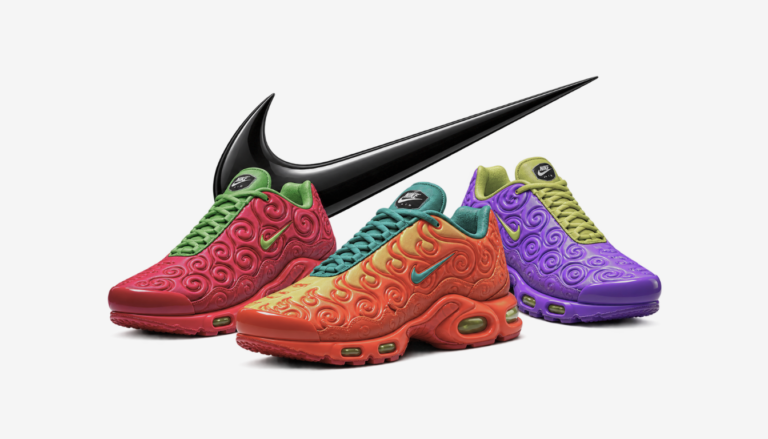
The “Rip The Script” film does not exist in isolation. It is the visible peak of a campaign architecture that Nike has been constructing for months — the Polaroid announcement, the seven-nation X2 capsule collection with NOCTA, Palace, Jacquemus, Patta, Slawn, PEACEMINUSONE, and the Virgil Abloh Archive, the Cryoshot sneaker line, the Toma El Juego grassroots youth tournament, and now the film and its 185 extensions. Each component serves a different function in the same argument: that football belongs to culture at large, that culture at large belongs to football, and that Nike is the brand that has always understood and expressed that relationship most completely.
The argument is not new. Nike has been making it since the Airport film. What “Rip The Script” represents is its fullest, most expensive, most multi-layered articulation — a campaign that combines the distributed logic of a 12-week cultural rollout with the concentrated impact of a hero film, using the former to prime the audience and the latter to detonate the feeling that the audience has been primed to receive. It is, as Nike VP Helena Thornton was right to call it, a blockbuster. It is also something the blockbuster format has rarely been: a system.