
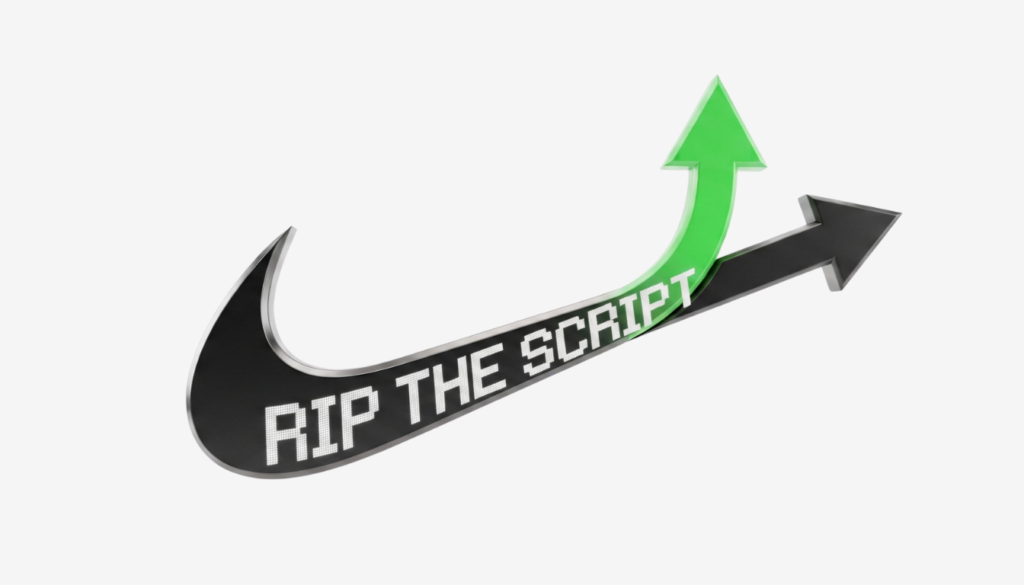
Nike’s World Cup marketing pivot is starting to bear fruit, and its executives are treating the tournament as a proving ground for the company’s wider turnaround. In June, the sportswear giant rediscovered the creative swagger that made it famous with “Rip the Script,” a six-minute film that became its most-shared social post of all time, generating more than 1.5 billion views in the first week across Nike and partner platforms. It is now the brand’s most-viewed Instagram post and YouTube video, with more than 78 million YouTube views against 7.8 million for rival Adidas’ World Cup spot, “Backyard Legends.” The reach is not in question. What it converts into is.
A Film Built as a Doorway, Not a Destination
“Rip the Script,” created by Wieden+Kennedy and directed by Dan Streit, is an open heir to Nike’s 1998 “Airport” classic, rebuilt for 2026. It follows a chaotic film set that falls apart when an overbearing director tries to control a game that lives in unscripted moments, with a cast running more than 30 deep: Cristiano Ronaldo, Kylian Mbappé, Erling Haaland, and Vini Jr. alongside legends like Ronaldinho and Zlatan Ibrahimović, plus cultural cameos from LeBron James, Kim Kardashian, Travis Scott, and LISA of BLACKPINK.
The film is the centerpiece of a 12-week “Universe of Nike Football” platform rather than a standalone moment, backed by roughly 185 follow-up short films designed to run through every upset and viral turn of the tournament. Nike executives describe the film as a doorway, not a destination, built with layered casting and Easter eggs meant to be remixed and reinterpreted by fans in real time. Kim Kardashian’s “Soccer Mom” persona, spun into its own storyline, is the model working as intended. The strategic wager is that a single deep cast, spread across a 39-day window, becomes dozens of separate cultural entry points instead of one expensive burst of attention.
The Turnaround Behind the Campaign
The campaign is the most visible expression of CEO Elliott Hill’s “Sport Offense,” a sport-led operating model at the center of Nike’s effort to restore growth after a difficult stretch. The urgency is real. Nike closed a sobering fiscal 2026 with essentially flat full-year revenue, and profit growth leaned heavily on a one-time US tariff refund rather than football momentum. Because the fiscal fourth quarter ended May 31, before the tournament began, none of the World Cup effect has yet reached reported sales.
So Nike has directed investor attention to leading indicators, and several are moving. The company has sold roughly 2.5 times as many national team kits as at the same point before the 2022 World Cup. Its latest Mercurial boot became the fastest-selling cleated footwear launch in Nike Direct history. More than 5,000 football retail doors have been elevated globally around the tournament, and the company expects the World Cup halo to drive high-single-digit demand growth in the first quarter. “When we lead with sport, we win,” Hill has said, framing the tournament as a lever to reshape the business rather than a single marketing event.
Adidas Counters on Its Own Terms
The competitive backdrop keeps the pressure on. Adidas entered the tournament with commercial wind at its back, posting mid-teens constant-currency growth and the advantage of being the only global sportswear partner of FIFA, dressing 14 teams to Nike’s 12. Its “Backyard Legends” film earned weeks of praise before Nike opened its own floodgates, and Adidas apparel spending surged around 70 percent in May year over year.
The head-to-head splits along a clear line. Nike optimized for ubiquity and cultural reach, while Adidas concentrated closer to the game itself, yielding a higher rate of engagement on a smaller base. Across total activity, the two brands landed close on estimated impressions, near 3.6 billion for Nike and 3.4 billion for Adidas. Nike also secured a symbolic blow, taking over as Germany’s national team kit partner next year on Adidas’ home turf. Reach favored Nike; commercial momentum, at least before the tournament’s decisive stages, tilted toward Adidas.
Reach Is Not Yet Revenue
The open question is the one every viral campaign eventually faces. Nike has manufactured extraordinary attention, but its own guidance for the first half of fiscal 2027 stays muted, and it has not baked World Cup fever into those numbers. The gap between 1.5 billion views and flat revenue is the space in which the turnaround will be judged. Broad reach among a mass audience is not the same as conversion among the soccer enthusiasts who buy boots and kits, and Nike’s next earnings report will offer the first real read on whether the splash translates.
For marketers, the campaign is a case study in structure over spectacle. Nike treated a tentpole moment as a system, moving product, brand, and marketplace together and designing content to be remixed rather than merely watched. The approach demands rolling production and a content team fast enough to match a tournament’s pace, a far heavier operational load than a single hero film. If it holds, Nike buys three months of cultural presence for the cost of one production cycle. The lesson for any brand chasing a big moment is that the film is the easy part. Keeping the spark alive after the final whistle is the work.