
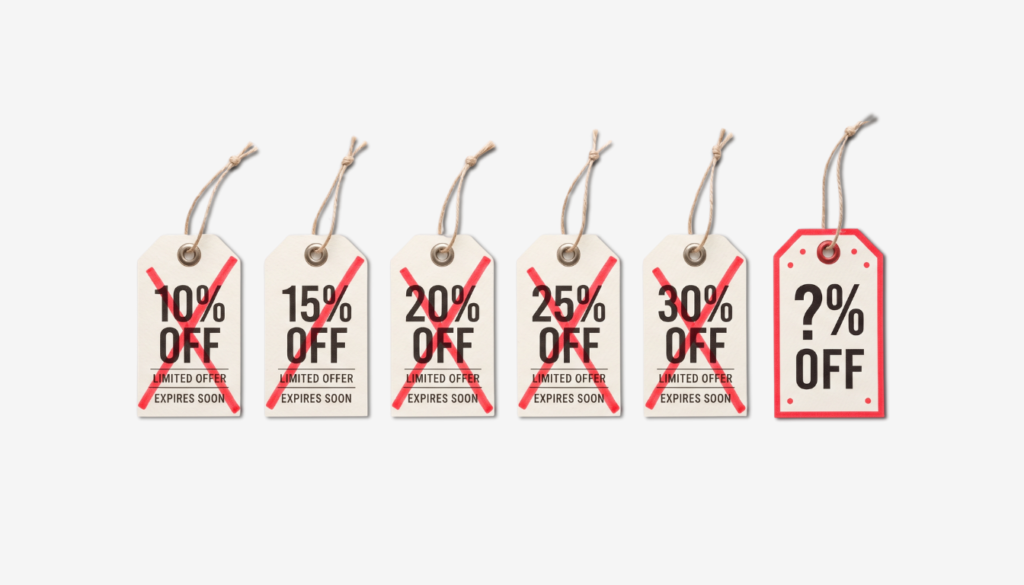
The fashion industry’s most reliable marketing tool may also be its most corrosive. A new report from incentives platform Talon.One, “Creative Currencies in Promotions,” argues that brands have leaned so heavily on discounting that they are training their own customers to stop paying full price. Business of Fashion, which published extracts alongside its own analysis, frames the shift bluntly: the era of the reflexive markdown is ending, and the brands that thrive will be the ones that learn to reward customers with something other than a lower number.
The Discount Death Spiral
The scale of the dependency is hard to ignore. Markdowns can account for as much as 30 to 40 percent of a fashion company’s revenues, a figure that underscores how structurally reliant the industry has become on price cuts. Talon.One calls the resulting dynamic the discount death spiral, a cycle in which otherwise strong brands condition customers to wait for the next promotion, eroding margin and premium perception with every repetition.
The consumer data backs the diagnosis. In a Censuswide survey of 2,000 UK shoppers, more than half described the promotions they receive as generic or predictable, and nearly half found them irrelevant. Almost one in three could not recall a single memorable promotion. Most damning for the balance sheet, 55 percent said that when brands discount constantly, they become reluctant to pay full price at all. The short-term revenue spike that a markdown delivers comes with a long-term tax on brand equity that rarely appears in the same quarter.
Eight Currencies Beyond Price
The report’s central idea is a reframing of value itself. Price is one form of value, but so are exclusivity, recognition, play, purpose, and belonging. Talon.One organizes these into eight creative currencies, distinct categories of non-financial value a brand can offer, ranging from gamified mechanics and cultural moments to social recognition, aspirational rewards, and purpose-driven initiatives.
The framework maps cleanly onto rewards brands already understand. A straight monetary discount is utility currency. A special upgrade for a valued customer is aspirational currency. Early access to a launch is social currency. The point is not that discounts are wrong, but that they are one lever among eight, and most brands pull the same one every quarter. As the report puts it, the brands winning on promotions are not asking how much to discount. They are asking what their customers actually care about.
Why Games Outperform Discounts
The strongest evidence sits behind gamification. Talon.One‘s research found that 41 percent of UK consumers enjoy a game or challenge in a brand promotion, and 66 percent are aware of or have taken part in McDonald’s Monopoly, a figure that climbs to roughly 80 percent among 18-to-34-year-olds. Separate testing by System1 Group across 1,800 consumers in six markets found that gamified mechanics consistently outscored flat discounts on the dimensions that build long-term brand value: uniqueness, excitement, and memorability. A simple roll-a-dice mechanic ranked highest of all offers tested on uniqueness.
The practical lesson is subtle. Gamification does not require abandoning the discount. Wrapped inside a game structure, a price cut becomes something customers anticipate, engage with, and remember, rather than a number that steadily resets their expectations downward. The mechanic changes the meaning of the same underlying incentive. That is why a collect-to-get campaign or an instant-win draw can rival a flat discount on participation while outperforming it on everything that compounds over time.
Creativity Needs Infrastructure
The report is candid about the constraint that separates the idea from the execution. Creativity in promotions is not only about the concept; it depends on having the infrastructure to deliver that concept consistently, quickly, and across every channel where customers appear. A clever mechanic that takes weeks to build or breaks between the app and the store never reaches the customer in a form that works.
That operational reality is visible in how brands are deploying these ideas. Talon.One counts Adidas, Sephora, and Carlsberg among its clients, and UK fashion retailer River Island recently adopted its engine to run omnichannel promotions across touchpoints. The commercial upside can be concrete. Eddie Bauer increased units per order by 135 percent after running a buy-more-save-more campaign, a structure that rewards larger baskets rather than simply shaving the price. The through-line is that creative promotions succeed when the mechanic, the reward, the audience, and the timing are designed together rather than bolted on.
What Marketers Should Take From It
For marketers outside the enterprise tier, the report’s value is less in the specific tooling than in the reframing. The best promotions match the right currency to the right customer, which means the work starts with understanding what a given audience responds to, not with deciding how deep to cut. A loyal customer may value early access more than a coupon, a lapsed one may need a game to re-engage, and a new one may respond to a sense of belonging. Treating each of those as a separate creative decision is what closes the gap between promotional spend and promotional return.
For fashion specifically, the stakes are sharpened by that markdown dependency. An industry that relies on discounting for a third of its revenue also has the most to lose from the discount death spiral, and the most to gain from breaking it. The report’s closing framing is the useful one to carry forward. Price is one lever. There are seven others, and the brands that learn to use them are the ones building relationships that outlast the next sale.