
Few global retailers get a second chance at a market that defeated them. Sephora is making the most of one.
The LVMH-owned beauty retailer exited the United Kingdom in 2005, closing its stores after five years of high rents and fierce competition from entrenched players. Nearly two decades later, it returned with a different philosophy, and the results have been strong enough that the UK operation is now functioning as a laboratory for Sephora’s expansion strategy worldwide.
The Retreat That Taught a Retailer to Listen
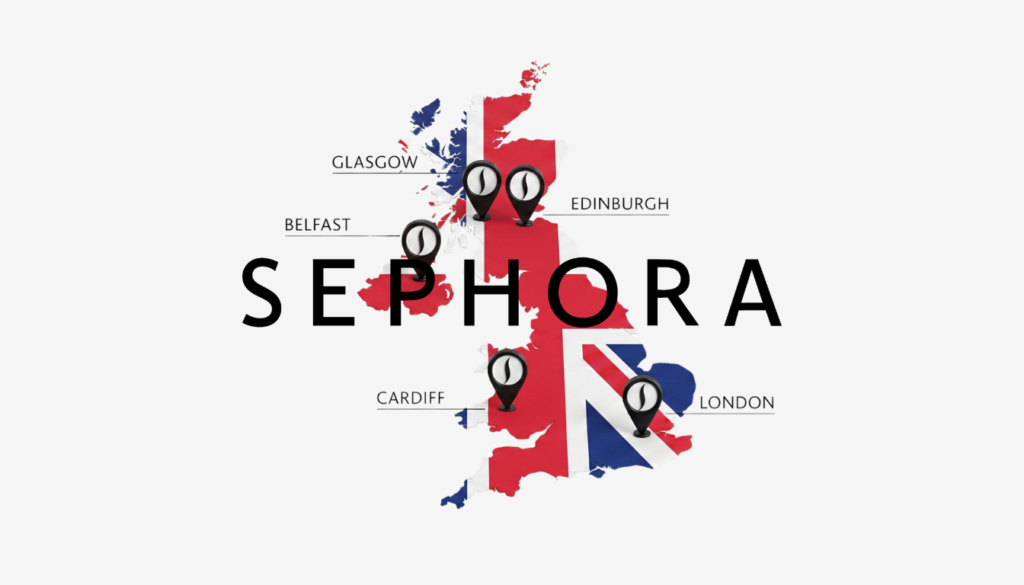
Since re-entering the market in 2023, Sephora has opened 15 stores across the UK, stretching from London to Bristol, alongside a rapidly built digital presence. Speaking to Adweek from its newly opened Edinburgh store, UK managing director Sarah Boyd described the approach as earning its place in each city before cutting a single ribbon.
That framing is more than corporate language. Boyd, who spent 15 years in Asia and previously ran Sephora’s Asia Pacific business, has structured the UK comeback around a principle that inverts the standard playbook of global retail. Rather than treating the country as a single market anchored in its capital, Sephora treats each city as its own beauty community with its own codes, rivalries, and expectations.
A Deliberate Detour Around London
The clearest expression of that principle is where Sephora chose not to grow. After opening its first two stores on the outskirts of London to learn the market, Boyd made a deliberate call to prioritize major cities across the rest of the country. Cardiff and Belfast came before any deepening of the London footprint. Scotland followed, with Edinburgh’s St James Quarter and Glasgow’s Silverburn opening in close succession, a sequencing Boyd insisted on so that neither coast felt like an afterthought.
Boyd has been blunt about the trap she is avoiding. Many brands, she has argued, arrive in London and consider the UK done, a mindset that does not reflect how British consumers actually relate to brands. Sephora’s stated goal is to be accessible to roughly 80 percent of the UK population within a commute of about an hour and a half, a target that forces the company out of the capital and into regional retail destinations.
Glasgow Got a Traffic Cone, and That Is the Point
The hyperlocal posture shows up in Sephora’s marketing gestures as much as its real estate map. Ahead of the Glasgow opening, a Sephora-branded traffic cone appeared on the head of the Duke of Wellington statue, a wink at one of the city’s most beloved and irreverent traditions. It is a small activation, but it signals cultural fluency in a way that a generic launch campaign never could.
That fluency appears to be converting. Membership in the MySephora loyalty program has grown 49 percent since the UK launch, according to figures Boyd shared with Cosmetics Business. The retailer’s own-brand line, Sephora Collection, ranks as the top-selling brand in each new store during its opening period and typically settles into the top three afterward, evidence that the retailer is building affinity for its own equity rather than merely renting traffic from the prestige brands it stocks.
The Numbers Behind the Acceleration
Demand has outpaced the original plan. Sephora is targeting 20 UK stores by the end of 2026, a goal it pulled forward by a full year on the strength of the market’s response. Beyond the large-format beauty playgrounds of roughly 5,000 square feet, the company is introducing a boutique concept this summer, with intimate stores on Carnaby Street and at Old Spitalfields Market designed for the lunch-break shopper rather than the destination visit. In October, Sephoria, the company’s immersive beauty event, will make its UK debut in London after editions in Los Angeles, New York, Paris, Milan, and Dubai.
Each format decision responds to observed behavior rather than imported assumptions. The boutique concept, for instance, emerged directly from customer feedback asking for premium beauty that fits into everyday routines, a shopping culture rooted in the British high street.
From Test Market to Template
What makes the UK story consequential beyond Britain is how Sephora is treating the knowledge it generates. The company describes its method as taking the best of Sephora from around the world and executing it in a distinctly British way, and the reverse flow is now happening too: the hyperlocal entry model refined in the UK is informing how the retailer approaches new markets globally.
For marketers, the lesson sits in the balance Sephora has struck. Global scale and instantly recognizable branding remain intact; what changes is the sequence and the posture. The brand asks for cultural permission before claiming commercial space, invests in understanding regional identity down to the level of a statue’s traffic cone, and lets loyalty data validate the approach before accelerating. A market that once represented Sephora’s most public failure has become the clearest articulation of how it intends to win everywhere else.