
The End of the Periodic Table
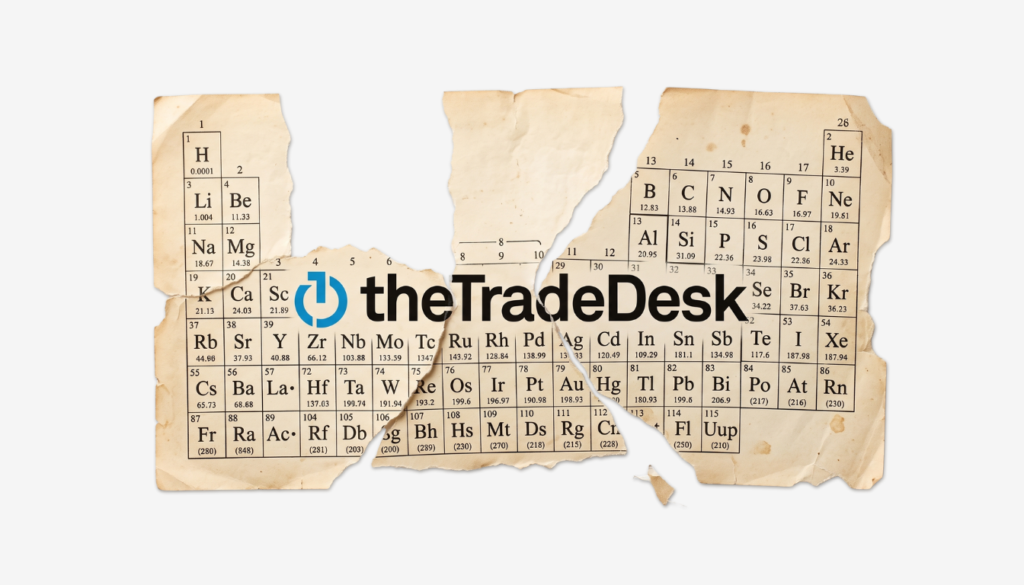
The Trade Desk built its reputation on Kokai, and Kokai was built around a periodic-table interface that arranged the levers of a programmatic campaign into a grid of elements. Media buyers never warmed to it. In its latest redesign, the company is removing that table from the advertiser and campaign views and keeping it only at the ad-group level, replacing the default with an interface organized around the settings a buyer actually applies. Adweek, which obtained the pitch deck, framed the change as a concession, and the company’s own leadership described the shift as a response to buyers’ complaints. For a product that had made the table its signature, retiring it is an admission that a design meant to signal sophistication had become a source of friction.
From Interface to Conversation
What replaces the grid is a conversation. The centerpiece of the refresh is Ask Koa, a single conversational entry point that routes buyers to a set of AI agents capable of handling pieces of the programmatic workflow, from audience building and campaign creation to insights, troubleshooting and search. Around it sits a broader agentic layer the company calls Koa Agents, designed to automate large chunks of the buying process and to connect with whatever AI model a partner already uses, including Anthropic’s Claude, through an interoperability layer named Open Agentic Kit. The Trade Desk has begun showing these capabilities to agency executives and has named Stagwell among early clients, and a leaked deck reported by Adweek lays out an agentic roadmap for the second half of 2026. The pitch is that a buyer will soon describe an outcome and let agents assemble the campaign, rather than fill in a grid by hand.
A Comeback Under Pressure
The redesign does not arrive from a position of strength. The Trade Desk’s stock has fallen more than 60 percent in 2026 and roughly three-quarters over the past year, after quarterly revenue growth decelerated from the 20 to 30 percent range the company once posted to about 12 percent in the first quarter and guidance near 8 percent for the second. The proximate cause is Amazon. Amazon’s demand-side platform has become the fastest-growing large DSP, expanding around 24 percent year over year to roughly 14 percent of the market, while The Trade Desk holds close to 19 percent of global DSP spend and a disproportionate share of premium connected-TV and open-internet inventory. Analysts have marked down the stock accordingly, with MoffettNathanson cutting its price target to $45 from $75 and citing Amazon competition directly. In that context, the Kokai refresh is less a routine update than a defensive move by a leader trying to remind the market why it still matters.
The Control Question
Agentic buying solves a real problem and creates a new one. The problem it solves is complexity, because programmatic campaigns have accumulated so many settings that the interface itself became a barrier, and letting an agent handle the assembly promises speed and lower operational cost. The problem it creates is control. When a buyer fills in a table, every choice is visible and auditable, but when a buyer asks an agent to build a campaign, the reasoning behind the settings moves inside a model. Agencies, already scrutinizing where their clients’ money goes, will want to know how an agent chose an audience, why it set a bid, and whether the system optimizes for the advertiser’s outcome or the platform’s. The Trade Desk’s decision to make Koa interoperable with outside models, rather than lock buyers into its own, reads as an early answer to that concern, an attempt to keep the platform open at the moment buyers are most worried about the box closing.
What It Means for the Buy Side
For agencies and in-house teams, the refresh is a preview of how media buying will feel within a year. The skill that defined the trade, the ability to navigate a dense interface, is being devalued in favor of the ability to brief an agent well and to interrogate its output. That shift rewards teams that can define outcomes precisely and audit results rigorously, and it pressures the buyers whose value came from operating the machine by hand. The larger signal is competitive. The Trade Desk spent years selling transparency and independence as its advantage over the walled gardens, and it is now wagering that agentic AI can extend that pitch rather than undermine it. Whether the market rewards the move will depend less on the elegance of Ask Koa than on whether The Trade Desk can slow Amazon, because a cleaner interface does not win back inventory, and the buy side ultimately follows the audience.