

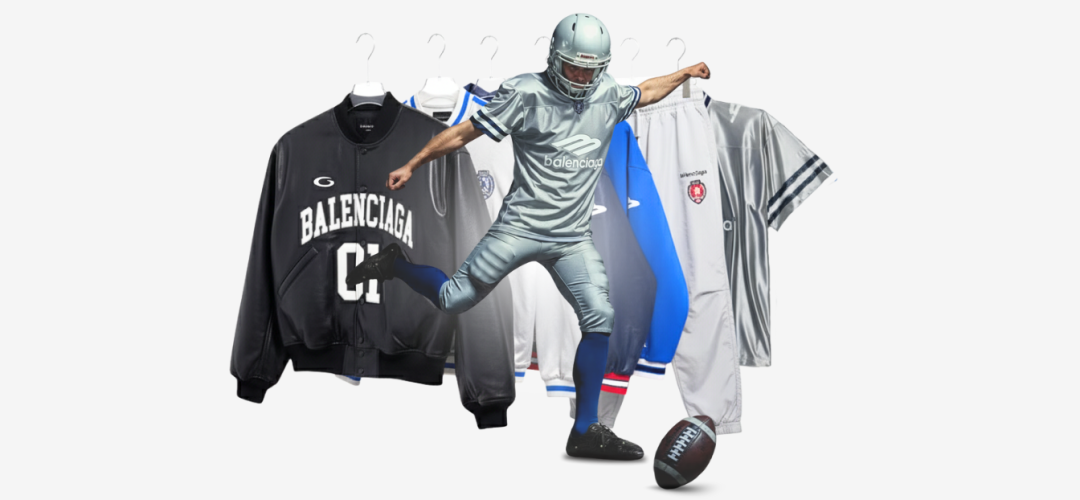
Balenciaga’s latest experiment in cultural alchemy arrives not on a catwalk, but on an imaginary football field. The Football Series, a Spring 2026 capsule of ready-to-wear and accessories, translates the visual intensity of American football into the house’s signature avant-garde language. At first glance, it may look like another sports-inspired collection in a market already saturated with jerseys and varsity jackets. Look closer, however, and it reveals a sophisticated strategy for how a luxury house can tap into mass fandom while deepening its own distinct codes.
The silhouettes set the tone immediately. Padded shoulders, exaggerated proportions, and glossy V-neck jerseys call to mind the protective gear of the gridiron. Yet, they arrive in high-end materials more familiar to couture ateliers than to locker rooms. Extra-supple sheep leather varsity hoodies and techno poplin tracksuits give the pieces weight and gravitas, framing them as objects of craft rather than mere fan merchandise. By blending the rough architecture of sports equipment with couture-level finish, Balenciaga manages to keep its avant-garde DNA intact while making the story legible to anyone who has watched a game-day broadcast.
Fictional Teams, Real Brand Power
Crucially, the Football Series does not lean on existing franchises, leagues, or licensing deals. Instead, it invents its own universe. The capsule deploys fictional team branding, officiating patches, a newly introduced Balenciaga Lion Crest, and reworked House symbols configured like field markings and jersey numbers. The familiar 3B sports icon and a spiral-style sportif logo reappear as if they were part of a long-running league, even though this “league” exists only within Balenciaga’s world.
This choice is more than aesthetic. By creating a fictional competition, Balenciaga retains full control over the narrative, design, and expansion. No legal constraints, no dependence on the fortunes of a real team, no need to abide by heritage colorways that belong elsewhere. The house is effectively creating new brand assets that can be reused, remixed, and extended for years to come: the Lion Crest as a recurring emblem, the 3B football icon as a shorthand for sporty rebellion, the field-stripe graphics as a recognizable framing device. In a category where many brands print a club badge next to their own logo, Balenciaga opts to become the league itself.
A New Route Into Sports Culture
Football, as a reference, is particularly telling. The sport is one of the strongest cultural forces in the United States, with rituals that extend far beyond the stadium: tailgates, watch parties, Sunday uniforms, and a visual ecosystem instantly understood by millions. By channeling this universe rather than, say, a vague notion of “athleticism,” Balenciaga positions itself inside a specific, emotionally charged context: gameday.
This matters for business as much as for image. It sharpens the brand’s relevance in North America, one of luxury’s most important growth markets. It gives Balenciaga a credible angle into a male-dominated fandom without abandoning its experimental edge. The padded silhouettes and bold graphics are as theatrical as any runway look, yet they sit on archetypes—jerseys, hoodies, tracksuits, caps—that men and women already wear. For a house often associated with extreme proportions and uncompromising shapes, aligning those signatures with a familiar sports narrative softens the entry point for new customers while keeping loyal followers engaged.
Couture Sensibility Meets Everyday Uniform
The commercial logic of the Football Series is equally clear. Rather than anchoring the capsule on a handful of unwearable statement pieces, Balenciaga builds the story around high-frequency items: jerseys that can be styled with denim or tailoring, hoodies that can live in an off-duty uniform, and tracksuits that move easily between the airport, the street, and the tunnel walk. The couture sensibility, with its advanced materials and meticulous construction, sits beneath silhouettes that are already cultural staples.
This positioning allows the house to operate in an attractive sweet spot, building high-priced “basics” that feel elevated enough to justify their tags, yet rooted in everyday contexts where they can be seen repeatedly. A Balenciaga football hoodie does not need a runway slot to work; it requires a bar on Sunday afternoon, a stadium concourse, a social post from an athlete or musician. Each of these touchpoints reinforces the brand as the author of this fictional league and embeds the capsule’s codes in the rhythms of real life.
A Campaign Built for the Scroll Era
If the products tell one part of the story, the campaign finishes the job. The visuals center on a staged Balenciaga field, where equipment and jerseys morph into football-centric shapes in slow motion. The imagery is intentionally surreal, operating somewhere between sports broadcast and experimental film. For social feeds crowded with literal sports content, this strangeness becomes an advantage: the eye catches the familiar outlines of a helmet or a yard line, then pauses as the object twists into something more abstract, more Balenciaga.
This approach gives the brand a flexible visual system to deploy across platforms. Close-ups of embroidered crests and textured leather for luxury detail; wide shots of the field for atmosphere; team-style portraits for editorial. The fictional league can spawn fictional rivalries, mock standings, even invented rituals, all raw material for short-form video, brand-owned content, and collaborations with athletes, creators, and stylists who understand that the story being told is less about winning games and more about owning an aesthetic space.
Testing the Future of Luxury and Fandom
The Football Series lands at a moment when the lines between fashion, entertainment, and sport are blurring faster than ever. Tunnel walks have become runway shows in their own right; athletes are brand storytellers, not just endorsers; fans are as interested in pre-game fits as in post-game stats. Against this backdrop, Balenciaga’s decision to treat the football field as an experimental lab rather than a mere licensing opportunity is quietly radical.
Instead of borrowing equity from existing teams, the house is asking a different question: what does a luxury-owned sports universe look like? The answer, for now, is this capsule—padded, polished, fictional yet strangely familiar. If the concept takes hold, it could easily evolve into a recurring franchise, spawning new colorways, “home” and “away” uniforms, regional spins, or collaborations with personalities who straddle fashion and sport. In that sense, the Football Series is not just a Spring 2026 story; it may be the pilot episode for a longer saga in which Balenciaga treats fandom itself as a medium.
What emerges is a blueprint for how high fashion can sit closer to popular culture without diluting its aura. By embracing the rituals and visuals of American football while inventing its own teams, symbols, and narratives, Balenciaga has quietly expanded the territory of what luxury can own. The field may be invented, but the stakes for the brand are very real.