
A Product That Will Not Sit Still
Canva spent a decade being known as the place where people made wedding invitations and brand style guides. That description is now several product cycles out of date. Analysis from the venture firm a16z placed Canva as the third most-used generative AI consumer product by monthly visits, behind only ChatGPT and Google Gemini, a position the company reached without ever calling itself an AI company.
The pace behind that shift is the operational story. Canva introduced Canva AI 2.0, folding visual creation together with workflow automation and agents that respond to conversational prompts. In June, at Cannes Lions, it launched Canva Grow 2.0, a control layer that lets marketing teams create, publish and measure advertising across Meta, TikTok and LinkedIn without leaving the platform. The company has assembled that capability partly by acquisition, absorbing the creative analytics firm MagicBrief, the customer data platform Ortto and the agentic infrastructure startup Simtheory.
For Zach Kitschke, Canva’s chief marketing officer and its fifth employee, the consequence is procedural. When the product changes every few weeks, the traditional sequence of build, brief, launch stops functioning.
The Weekly Meeting as an Operating System
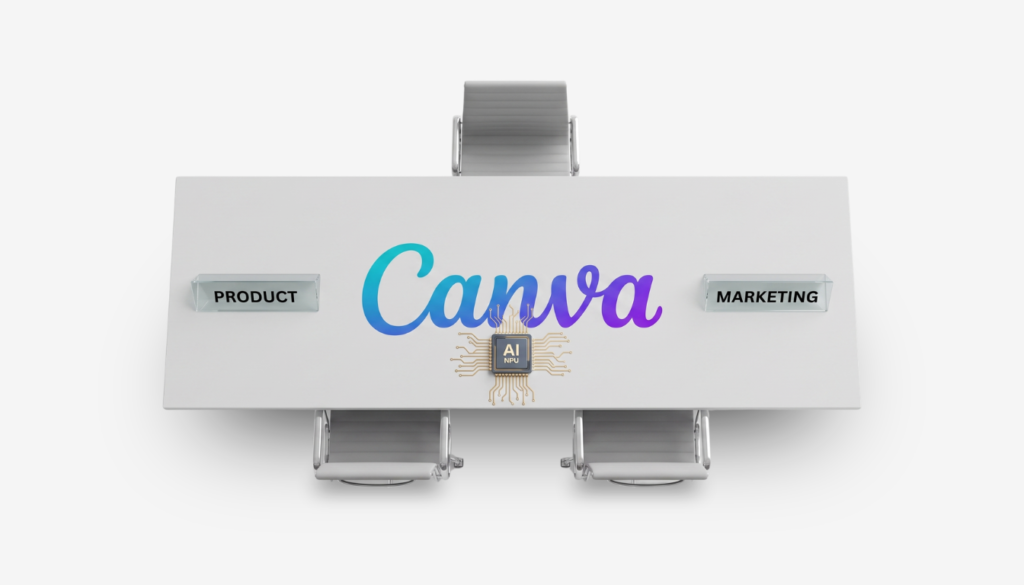
Kitschke told ADWEEK that his team now takes a seat alongside developers at roadmap meetings, a standing weekly check-in that keeps marketing and product on the same timeline. The mechanism is unglamorous, which is the point. It is not a task force, an innovation lab or a transformation program. It is a recurring meeting with the people who decide what ships.
The value shows up in three places. Marketing learns what is coming while the roadmap is still editable, which means positioning informs the feature rather than trailing it. Product hears what customers are actually asking for through the channel that collects the most unfiltered demand signal, which is usually marketing. And launch timelines stop being a negotiation, because both sides watched the same slip happen in real time.
None of that requires a company of Canva’s size. It requires the marketing lead to be invited and to show up prepared with something other than a campaign calendar.
Why the Old Handoff Broke
The conventional model assumes stable products. A feature is finished, a brief is written, an agency builds the campaign, the campaign runs. That model works when the interval between releases is measured in quarters. It fails when a company ships an AI capability that changes what the product fundamentally does, and then changes it again six weeks later.
The failure is not only about speed. It is about accuracy. Marketing teams working from a brief describe the feature that existed when the brief was written. In AI product cycles, that version is often obsolete on arrival, and the gap between the promise and the interface is where trust erodes. Canva is asking roughly a quarter of a billion users to trust it with advertising budgets, not just design files. The distance between what the marketing says and what the software does has to be close to zero.
The Cost of Sitting in the Room
Embedding marketing in product decisions carries a real risk, and it deserves saying plainly. Marketers in roadmap meetings tend to advocate for what is easy to announce. Features that demo well, that fit a keynote, that produce a headline. The pull toward launchable increments and away from unglamorous infrastructure work is strong, and it has damaged plenty of product organizations.
The defense is role clarity. Marketing in the room as a demand signal and a distribution constraint is useful. Marketing in the room as a second product manager is not. The distinction is whether the contribution is evidence about customers or opinion about features.
There is a second cost. A weekly meeting that includes marketing leadership is expensive in a currency most companies undercount, which is senior attention. It only pays back if the meeting has decision authority. A briefing session with the same attendees produces the same slides and none of the alignment.
The Version a Smaller Team Can Run
Most marketing teams do not sit next to developers, and many work with product roadmaps they see once a quarter, if that. The transferable structure is simpler than Canva’s. It is a recurring, short, standing meeting between whoever decides what gets built and whoever decides what gets said about it, held on a cadence that matches the release cycle rather than the reporting cycle.
For a subscription business, that might be a weekly conversation between marketing and whoever controls the product backlog. For a consumer brand, it is the same meeting with operations or merchandising. The principle holds regardless of category: the further marketing sits from the decision about what is being made, the more of its budget goes to explaining choices it had no part in.
Canva’s answer to an accelerating product cycle was not a new department or a new agency. It was a calendar invitation that nobody skips.