
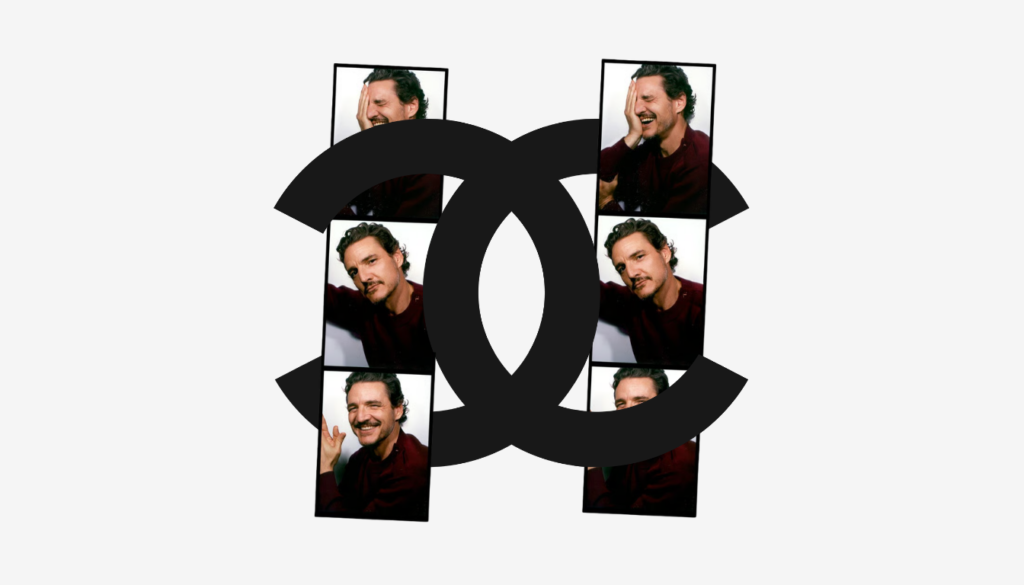
The decision by Pedro Pascal to join Chanel as a global ambassador unfolds as something far more consequential than a conventional celebrity endorsement, revealing instead a carefully calibrated shift in how one of fashion’s most storied houses defines its relevance in a rapidly evolving cultural landscape. For decades, Chanel cultivated an image rooted in precision, distance, and an almost untouchable ideal of elegance, constructing a world in which desirability was sustained by separation, yet in selecting Pascal, the brand appears to move deliberately toward a new form of proximity, one that privileges emotional resonance over immaculate perfection.
Pascal’s appeal rests precisely in this departure from tradition, as he embodies a form of charisma that feels unforced, grounded, and widely accessible, shaped less by rigid fashion codes than by a cultural presence that spans screens, platforms, and audiences with remarkable fluidity. In an environment where consumers are increasingly disinterested in unattainable ideals, his persona offers a different proposition, one that invites identification rather than aspiration, subtly reframing the relationship between luxury and its audience.
A Deliberate Shift in the Language of Status
Luxury has long relied on distance as a mechanism of desire, carefully preserving an aura that separated the brand from everyday life, yet that distance has become increasingly difficult to sustain in a social media ecosystem defined by immediacy, exposure, and constant interaction. Chanel’s decision, therefore, signals not a rejection of its heritage but an evolution of its language, suggesting that status today is as much about cultural presence as it is about visual perfection.
Within this context, Pascal’s appointment emerges as a strategic alignment with a broader transformation in how influence is constructed, as he brings with him a form of cultural capital rooted not in traditional fashion authority but in narrative relevance, shaped by roles and public appearances that resonate across generational and digital boundaries. Rather than imposing a rigid image of luxury, his presence allows the brand to inhabit a more fluid space, where elegance is no longer defined solely by polish but by the ability to remain meaningful within contemporary discourse.
This recalibration becomes particularly significant as luxury brands seek to engage younger audiences whose expectations have shifted away from static ideals of prestige toward experiences that feel authentic, dynamic, and emotionally aligned with their own realities. In this sense, Chanel is not merely adapting to change but actively participating in the redefinition of what luxury signifies in the present moment.
The Rise of Emotional Masculinity in Luxury
Beneath this strategic repositioning lies a deeper cultural shift, reflecting evolving perceptions of masculinity and its place in luxury. Where the industry once favored controlled, distant male archetypes defined by authority and restraint, Pascal represents a markedly different model, characterized by openness, vulnerability, and a form of confidence that is expressed through ease rather than dominance.
This transformation is neither incidental nor superficial, as it aligns with broader cultural narratives that have reimagined strength as something more nuanced and emotionally complex, particularly within film, media, and digital culture. By embracing this shift, Chanel extends its influence beyond aesthetics, participating in a broader conversation about identity and representation while simultaneously expanding its symbolic territory.
The absence of a historically dominant menswear category within Chanel’s business does not diminish the significance of this move; rather, it underscores the idea that in contemporary luxury, meaning is constructed as much through cultural associations as through product offerings. In this context, Pascal functions not simply as an ambassador but as a bridge, allowing the brand to explore new dimensions of relevance without the immediate need for structural expansion.
Why Controversy is Part of the Strategy
The divided response that has followed Pascal’s appointment reveals less about misalignment and more about the inherent tension within a sector undergoing transformation, as traditional expectations of exclusivity and perfection encounter a new paradigm centered on relatability and cultural immediacy. For some, his presence disrupts the carefully maintained distance that has long defined Chanel’s allure, raising questions about whether accessibility risks diluting the brand’s identity, while for others, it represents a necessary evolution that aligns the house with the realities of contemporary culture.
This polarization, however, is not an unintended consequence but a reflection of the strategic space Chanel has chosen to occupy, one in which heritage and innovation coexist in productive tension. By allowing this debate to unfold publicly, the brand not only amplifies its visibility but also reinforces its role as an active participant in shaping the future of luxury, rather than a passive guardian of its past.
From Campaigns to Conversations
Perhaps the most defining aspect of this partnership lies in its implications for how Chanel engages with the social media environment, where traditional campaign structures are increasingly insufficient to capture sustained attention. Pascal’s presence operates not as a static image but as an ongoing narrative, capable of generating organic engagement that extends beyond conventional advertising.
In a landscape where audiences are less receptive to interruption and more responsive to integration, this approach allows Chanel to embed itself within cultural conversations, transforming visibility into participation. The brand is no longer confined to orchestrated moments of communication but becomes part of a continuous dialogue, shaped as much by audience interpretation as by its own creative direction.
This shift from controlled messaging to participatory storytelling reflects a broader reconfiguration of luxury communication, in which meaning is co-created rather than dictated, and where a brand’s strength lies in its ability to remain relevant across an ever-expanding network of cultural touchpoints.
A New Definition of Luxury
Ultimately, the appointment of Pedro Pascal does not signal a departure from Chanel’s identity but rather its ongoing evolution, as the house translates its legacy into a language that resonates with a contemporary audience increasingly attuned to authenticity and emotional depth. Luxury, once defined by distance and perfection, is being reimagined as something more fluid, more human, and more responsive to the cultural dynamics that shape modern life.
In choosing Pascal, Chanel positions itself not merely as a participant in this transformation but as one of its authors, embracing the complexity and, at times, the controversy that accompany any meaningful shift. In doing so, the brand suggests that the future of luxury will not be determined by how closely it adheres to tradition, but by how effectively it can reinterpret that tradition in ways that feel both relevant and resonant.