

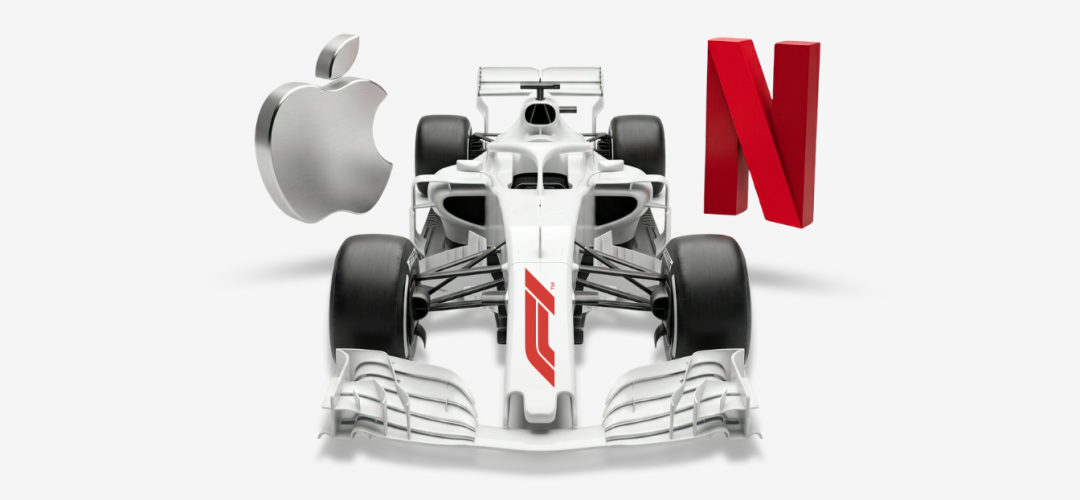
When Formula One confirmed that Apple would assume the U.S. broadcast rights beginning in 2026, replacing ESPN under a five-year agreement valued at roughly $150 million per year, the immediate interpretation was that yet another major sports property had migrated from traditional television to a technology platform eager to expand its presence in live programming. Yet the details embedded in the agreement reveal a far more nuanced strategy, one that quietly reconfigures the traditional dynamics of media rights.
Under the arrangement, the next season of Drive to Survive—the documentary series widely credited with catalyzing Formula 1’s modern surge in American popularity—will also become available on Apple’s streaming service in the United States. At the same time, Netflix will broadcast the 2026 Canadian Grand Prix live exclusively for American audiences.
In an industry historically governed by rigid exclusivity clauses designed to prevent precisely this kind of overlap, Formula 1 has instead orchestrated an unusual alignment between two platforms that might otherwise compete directly for viewers. What emerges from this arrangement is not merely a redistribution of rights but a deliberate attempt to synchronize storytelling, distribution, and live spectacle within a broader ecosystem of engagement.
From Broadcast Rights to Cultural Architecture
To understand the strategic significance of the deal, it is necessary to recognize that Formula 1’s expansion in the United States has never been driven solely by the mechanics of broadcasting. Rather, the sport’s renaissance has been fueled by a carefully constructed cultural narrative that transformed motorsport from a distant European spectacle into a serialized form of entertainment capable of capturing the imagination of a new audience.
Drive to Survive played a central role in that transformation by reframing the sport through the lens of character and drama, elevating drivers from athletes into protagonists and races into climactic episodes within an unfolding narrative. In doing so, the series created an emotional entry point for viewers who were previously unfamiliar with the sport’s technical complexities.
By enabling the series to circulate within Apple’s ecosystem while maintaining Netflix’s role as its original narrative home, Formula 1 effectively aligns two complementary engagement layers. The documentary format cultivates emotional investment and curiosity, while the live broadcast delivers the spectacle that converts that curiosity into sustained viewership. Instead of forcing audiences to migrate from one platform to another abruptly, the arrangement creates a continuous pathway between discovery and participation.
In an era of increasingly fragmented media consumption, this kind of architectural thinking may prove more valuable than exclusivity itself.
Apple’s Bet on Premium Live Sports
For Apple, the acquisition of Formula 1 rights represents another decisive step in the company’s gradual expansion into live sports programming. This category has become increasingly central to the competitive positioning of streaming platforms seeking to maintain subscriber loyalty in a saturated entertainment environment.
Formula 1 offers a rare combination of attributes that align closely with Apple’s broader brand identity: global prestige, a technologically sophisticated audience, and a calendar that delivers consistent programming throughout much of the year. Unlike seasonal leagues that run for a few months, the Formula 1 schedule provides a steady cadence of events that can sustain ongoing engagement.
Equally significant is the sport’s compatibility with Apple’s technological ambitions. The data-rich nature of Formula 1—where telemetry, strategy, and real-time performance metrics are integral to the spectacle—creates opportunities for enhanced viewing experiences that extend beyond traditional broadcast formats. Interactive overlays, multiple camera perspectives, and immersive viewing features could allow Apple to transform the act of watching a race into something closer to a participatory experience.
Seen through this lens, the investment in Formula 1 is not merely about acquiring content but about securing a flagship property capable of demonstrating what technologically augmented sports broadcasting might look like in the streaming era.
Netflix and the Evolution of Live
For Netflix, whose identity has long been anchored in on-demand storytelling, the opportunity to broadcast the Canadian Grand Prix represents another incremental step into the realm of live programming, a frontier the company has approached cautiously yet increasingly with strategic curiosity.
The platform has spent years cultivating a deeply engaged Formula 1 audience through Drive to Survive, effectively functioning as the narrative engine behind the sport’s cultural expansion in the United States. By hosting a live race within that ecosystem, Netflix can test its technical and commercial capabilities in the live sports environment while capitalizing on a fan base it helped create.
At the same time, the arrangement allows Netflix to participate in the economics of live sports without assuming the enormous financial commitments typically associated with full-season broadcasting rights. The platform remains the storyteller that shapes the sport’s mythology while temporarily stepping into the role of live distributor for a moment of high global visibility.
In doing so, Netflix demonstrates that its evolution toward live programming may not require abandoning its storytelling strengths, but rather extending them into new formats.
America as the Strategic Battleground
Underlying the partnership is a broader strategic objective that has quietly guided Formula 1’s global expansion in recent years: the consolidation of the United States as one of the sport’s most important commercial markets.
Once considered a difficult territory for Formula 1 to penetrate, the American landscape has been transformed through a combination of cultural storytelling, high-profile race events, and increasingly sophisticated digital distribution. New races in cities such as Miami and Las Vegas have elevated the sport’s visibility, while streaming platforms have introduced it to audiences far beyond the traditional motorsport community.
The new media rights agreement reflects this momentum, reinforcing the idea that the United States is no longer a secondary market but a central pillar of the sport’s global strategy. By aligning two of the world’s most influential streaming platforms within a single ecosystem, Formula 1 ensures both reach and prestige, combining Netflix’s narrative influence with Apple’s premium broadcast infrastructure.
A Blueprint Beyond Racing
What ultimately distinguishes this partnership is not simply the redistribution of rights but the conceptual shift it represents for the broader sports media landscape. For decades, the value of sports broadcasting was defined by exclusivity, with leagues auctioning rights to the highest bidder and platforms guarding those rights as competitive fortresses.
Formula 1’s approach suggests a more flexible model, one in which different platforms contribute distinct capabilities within a shared ecosystem of audience development. Storytelling platforms cultivate cultural relevance, broadcast platforms deliver the spectacle, and together they expand the overall scale of engagement.
If the experiment proves successful, it may offer a glimpse into the future of sports rights negotiations, where collaboration can sometimes be more valuable than isolation.
For Formula 1, however, the objective remains clear. The sport is no longer selling races to broadcasters, but is actually building a cultural presence capable of sustaining attention across multiple platforms, narratives, and media. In the intensely competitive American entertainment market, that layered approach may prove to be its most powerful competitive advantage.