
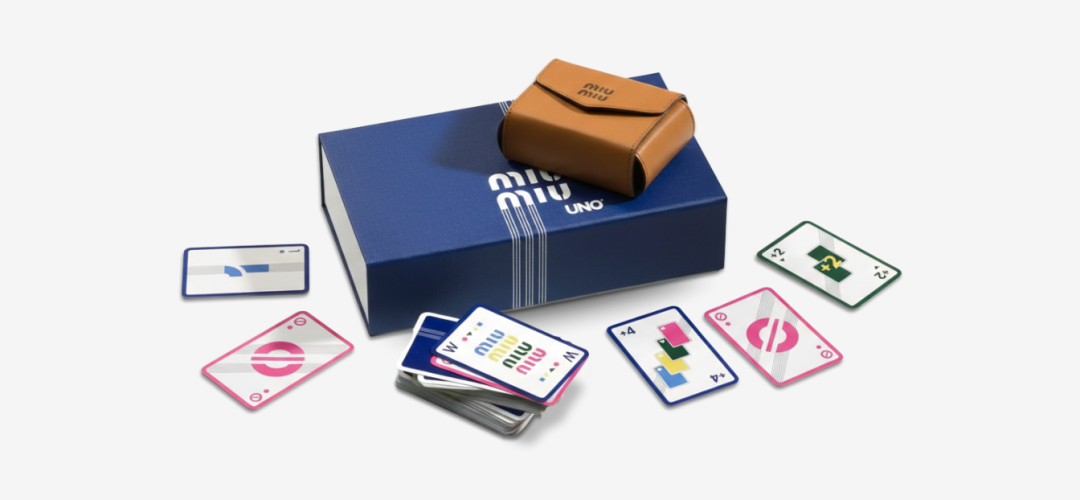
In a year when luxury houses have been racing to colonize every corner of a consumer’s lifestyle, Miu Miu has pulled off a move that is both surprising and strategically precise. The brand’s collaboration with UNO, a €450 to $600 limited-edition card set tucked inside a calfskin leather case, is not just a novelty for holiday gifting but a clear expression of how fashion brands are turning everyday rituals into branded worlds, where even the most ordinary objects are redesigned as markers of taste and cultural fluency.
The launch might seem whimsical at first glance, yet it is exactly the kind of experiment that defines the current phase of luxury: an industry seeking growth not through volume, but through meaning, storytelling, and new touchpoints that extend the brand into the rhythms of daily life.
Turning a Toy Into a Design Artifact
UNO’s familiar visual chaos—loud colors, thick icons, family-night energy—is distilled through the Miu Miu lens into something more restrained and sculpted. The cards display a composed palette, geometric cues, and subtle typography that carries the same graphic clarity seen in the brand’s ready-to-wear. Even before touching the leather case, the deck reads less like a game and more like an art-directed fashion prop.
The transformation feels intentional. Miu Miu leans into craftsmanship, replacing the lightweight nature of a game with the tactile satisfaction of calfskin and rigid gift packaging that imitates the unboxing of a handbag. The object becomes photogenic by design: a coffee-table accessory, a social-media backdrop, a collectible that invites curation rather than casual play.
In aligning UNO’s playful identity with its own intellectual, nostalgic, and coquette-coded world, Miu Miu demonstrates that luxury creativity today expands outward, not upward, by finding elegance in the unexpected.
World-Building as a Marketing Strategy
Beyond aesthetics, the collaboration underscores a strategic evolution in how luxury houses are thinking about relevance. Miu Miu is no longer confined to garments or leather bags; it is constructing an ecosystem where consumers live inside the brand’s worldview. The UNO set becomes a new gateway into that universe, especially for audiences who crave affiliation but cannot easily access runway pieces.
Because of its price point and scarcity, the deck isn’t treated as merchandise but as a cultural conversation starter. It circulates through fashion media, TikTok gift guides, and influencer tablescapes with the same velocity of a viral campaign, without requiring a traditional advertising push. The object markets itself by its sheer improbability, the way luxury sometimes does best.
This shift reflects a broader retail truth: consumers are increasingly buying symbols rather than products. A card game dressed as a luxury collectible signals taste, humor, and insider status all at once. For Miu Miu, that signal strengthens brand desire; for UNO, it elevates a mass-market IP into the realm of high-end collaborations. Both sides gain cultural capital.
Why It Works Now
The timing is not accidental. Games and nostalgia have surged as sources of comfort, community, and content, especially during holiday periods. Luxury brands have been quick to map themselves onto these emotional spaces, understanding that the rituals shaping modern life, such as dinner tables, weekend escapes, and living-room gatherings, are fertile ground for identity-making.
Miu Miu’s UNO operationalizes a strategic shift. The branded deck extends into moments where fashion traditionally had no presence, turning play into a branded behavior. By doing so, it taps into the same logic that drives limited-edition sneakers, collectible toys, and designer homeware: scarcity plus emotional resonance equals cultural relevance.
The result is a product that feels both absurd and inevitable. In a market hungry for novelty with meaning, a €450 leather-wrapped UNO set is pure genius strategy.
A Blueprint for the New Luxury Economy
What Miu Miu demonstrates with this launch is how influence is increasingly built at the edges of a brand. When fashion surrounds consumers with objects that articulate a lifestyle, rather than simply clothing them, it deepens loyalty through immersion. A card deck becomes a chapter in the ongoing story of who the Miu Miu woman is: nostalgic yet ironic, refined yet playful, effortlessly in on the joke.
For brands, the lesson is clear. The future of luxury is not defined by category lines but by cultural elasticity. When a brand can turn something as universal as a game night into an aspirational aesthetic moment, it confirms that the power of identity-driven marketing still rests in the ability to surprise with coherence.
Miu Miu didn’t just redesign UNO. It redesigned what it means for a luxury house to participate in everyday life, and in doing so, it reminded the industry that creativity is most influential when it infiltrates the ordinary.