

A Comeback Designed for the Streaming Era
When a brand returns to Formula 1 after more than two decades, the instinct might be to lean into the sport’s spectacle, celebrating the adrenaline of racing and the star power of its drivers. Ford, however, chose a more deliberate and unexpected path.
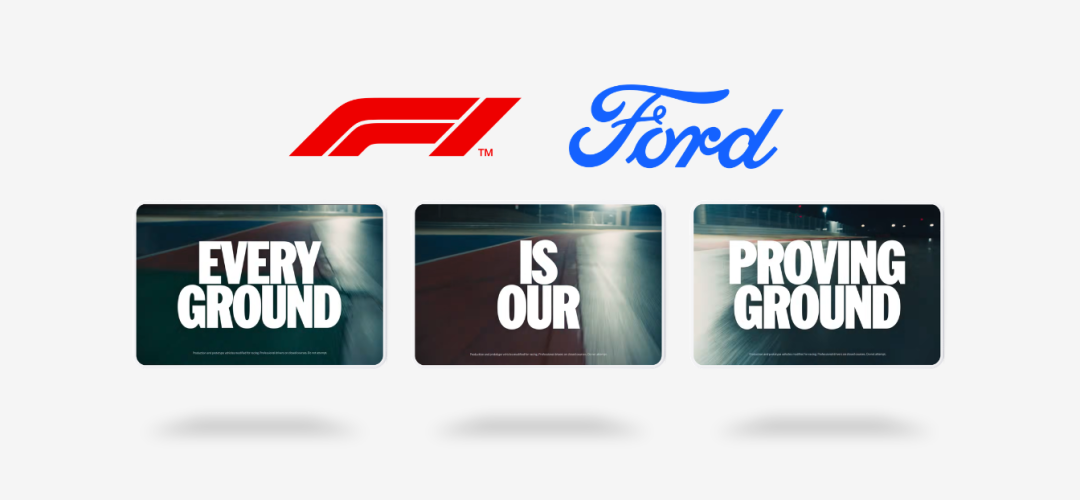
To mark its partnership with Oracle Red Bull Racing, the automaker launched “Every Ground Is Our Proving Ground,” a campaign developed with Wieden+Kennedy New York. Unlike conventional motorsport advertising, this approach moves beyond a single commercial focused on speed and competition. Instead, Ford created a sequence of cinematic films as a micro-docuseries, unfolding gradually across a race weekend and distributed during qualifying and practice sessions on Apple TV. This shift from tradition to innovation signals Ford’s broader intentions.
This approach transforms the role of advertising within the broadcast. Rather than appearing as a repetitive interruption between moments of competition, the campaign becomes a developing narrative embedded in the viewing experience, revealing new layers as the race weekend progresses. Ford turns what could have been a traditional sponsorship into something closer to episodic storytelling, bridging advertising and content into a cohesive experience that aims not only to capture attention but to hold it over time.
Engineers Step Into the Spotlight
Perhaps the most striking creative choice within the campaign is the deliberate absence of Formula 1’s usual protagonists. In a sport where marketing narratives often revolve around celebrity drivers and the spectacle of speed, Ford shifts the lens toward a different group entirely: the engineers responsible for building and refining the machines themselves.
The films follow figures such as Christian Hertrich, who works on Formula 1 powertrains, and engineers involved in Ford’s off-road racing programs in Baja and Dakar. Through carefully composed cinematography and a slower, more contemplative visual rhythm, the campaign captures the intricate choreography of engineers adjusting components, analyzing performance data, and fine-tuning machines in pursuit of marginal gains that define success on the track.
By focusing on these individuals, the campaign reframes Formula 1 not as pure spectacle but as a laboratory for innovation, where technical ingenuity and relentless experimentation converge. The narrative draws a subtle yet deliberate connection between technologies developed in these extreme racing environments and the vehicles that reach consumers, particularly the F-150 Raptor and Bronco Raptor. Ford positions its racing programs not just as competitive endeavors but as proving grounds where its consumer vehicles are shaped and refined.
A Brand Strategy Built Around Extremes
The campaign is not an isolated celebration of Formula 1. Instead, Ford integrates motorsport into a broader message: its vehicles are designed and tested under the toughest conditions, as shown by racing and programs such as TransAmerica Trail mapping and the Search and Rescue initiative. Together, these efforts highlight Ford’s commitment to endurance and engineering resilience.
Across different forms of motorsport, from the precision of Formula 1 to the punishing terrain of Baja and Dakar, the brand reinforces a single message: its vehicles are designed and tested in the most demanding conditions. This philosophy extends beyond racing, echoing initiatives like Ford’s TransAmerica Trail mapping project and Search and Rescue program, both positioning the brand at the intersection of exploration, endurance, and engineering resilience.
Together, these initiatives create a unified narrative where extreme environments serve as laboratories for innovation, places where technology is pushed beyond conventional limits before reaching everyday vehicles. By weaving Formula 1 into this broader ecosystem, Ford ensures its return to the sport contributes not only to visibility but to a cohesive brand identity built around capability and performance.
Why Streaming Changes the Rules of Advertising
The decision to distribute the campaign through Apple TV reflects a deeper shift in how brands approach modern media. Streaming platforms have blurred the boundaries between advertising and content, encouraging marketers to rethink the traditional commercial break.
Ford’s micro-docuseries uses Apple TV’s sequential viewing capabilities, allowing different installments to appear throughout the Australian Grand Prix weekend. Rather than seeing the same advertisement repeatedly, viewers experience a story that gradually unfolds across multiple moments, each piece adding new context and perspective.
This structure acknowledges a fundamental truth about contemporary audiences: viewers accustomed to streaming expect narratives that evolve rather than messages that repeat. By adapting its storytelling to this expectation, Ford aligns the campaign with both motorsport culture and the rhythms of modern media consumption.
Slowing Down the Language of Racing
The camera lingers on mechanical details and the focused preparation of engineers before every race. This perspective uncovers a quieter side of motorsport, defined not by spectacle but by discipline, patience, and meticulous attention to detail.
The camera lingers on mechanical details, the focused expressions of engineers, and the quiet intensity of preparation before each race. In doing so, the campaign reveals a different dimension of motorsport, defined less by spectacle and more by discipline, patience, and obsessive attention to detail.
This aesthetic shift reinforces the campaign’s broader narrative about engineering culture, highlighting individuals whose work often goes unnoticed by fans yet ultimately determines performance on the track.
Racing as a Narrative Platform
Ford’s return to Formula 1 represents more than the revival of a historic presence in the sport. It illustrates how brands are increasingly transforming sponsorships into storytelling platforms that extend beyond traditional advertising boundaries.
By turning its engineers into protagonists and structuring its campaign as a series rather than a single commercial, Ford reframes motorsport not just as a backdrop for brand exposure but as a narrative engine for deeper themes of innovation, endurance, and technological ambition.
In an era defined by streaming media and evolving audience expectations, the campaign offers a glimpse into how advertising is changing. Attention may still be the currency of marketing, but it is increasingly earned through stories audiences are willing to follow rather than messages they are asked to remember.