
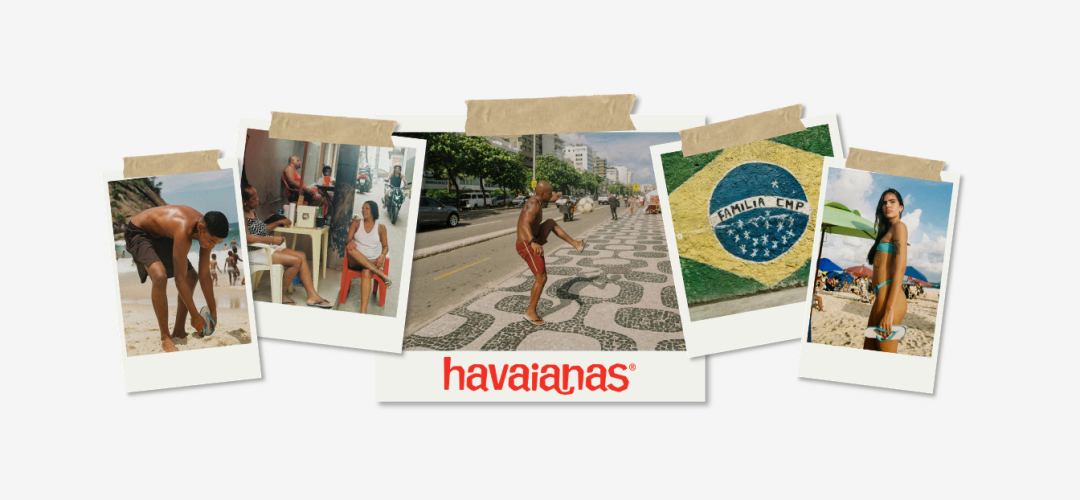
A Campaign That Observes Rather Than Constructs
At a moment when much of advertising continues to rely on heightened visuals and controlled environments, Havaianas moves in the opposite direction, choosing instead to observe rather than construct, to reveal rather than impose. Shot across Rio de Janeiro by Rafael Moura, the campaign unfolds as a collection of moments that appear to have been found, as though the camera simply arrived at the right place at the right time.
Yet this sense of spontaneity is far from accidental. What defines the campaign is precisely this tension between naturalism and intention, where every frame feels unforced while still carrying a clear visual logic. The result is a campaign that does not present an idealized version of reality, but rather heightens the one that already exists, allowing the product to emerge organically within it.
Building Reality Through Visual Decisions
The strength of the campaign lies in its creative direction, which carefully constructs a sense of reality through a series of visual choices that resist overt stylization. Natural light is used without correction, often harsh and direct, creating strong contrasts and irregular shadows that reinforce the sense of immediacy. Instead of flattening these conditions, the imagery embraces them, allowing light to behave unpredictably across surfaces and bodies.
Composition follows a similar logic, often favoring asymmetry and partial framing, with subjects not perfectly centered and environments not cleaned or controlled. This creates an impression that the images were captured in motion, within real spaces that continue beyond the frame. Even the presence of grain and texture contributes to this effect, introducing a tactile quality that distances the campaign from the smoothness of highly retouched visuals.
Together, these elements do not simply depict reality—they reconstruct its rhythm.
Color as Environment, Not Enhancement
Color operates as an extension of place rather than as a tool for visual emphasis, grounding the campaign firmly within Rio’s landscape. The tones are sun-washed and saturated, reflecting the interaction between light, concrete, sand, and sea, while the product itself blends seamlessly into this palette instead of being artificially highlighted.
This integration is essential to the campaign’s visual logic. By allowing the flip-flops to exist within the same chromatic environment as their surroundings, the imagery avoids creating hierarchy between subject and setting. The product is not elevated above the scene; it is part of it, reinforcing the idea that it belongs to the context being portrayed rather than standing apart from it.
Movement as a Visual Language
Another defining characteristic of the campaign is its use of movement, which replaces static posing with a more fluid and observational approach. Subjects are captured mid-action—walking, shifting, interacting with space—resulting in images that feel continuous rather than fixed. This introduces a cinematic quality, where each frame suggests a moment within an ongoing sequence rather than a final, composed shot.
Through this, the campaign avoids the rigidity often associated with fashion imagery and instead adopts a language closer to lived experience, where gestures are incomplete, and moments are transient. The product, in turn, becomes part of this movement, embedded within daily routines rather than presented as an isolated focal point.
Casting as Continuity of Place
The casting further reinforces the campaign’s commitment to realism, presenting individuals who feel intrinsically connected to the environments they occupy. There is no visible performance or exaggeration in expression; instead, subjects appear relaxed, at ease, and fully integrated into their surroundings.
This approach eliminates the sense of distance that often separates viewer and subject in traditional campaigns, replacing it with familiarity. The people depicted do not appear as representations of an idea, but as extensions of the spaces they inhabit, contributing to a visual continuity that strengthens the overall sense of authenticity.
A Timelessness Built From the Present
Although the campaign supports the relaunch of a heritage product, it avoids explicit references to the past, instead creating a sense of timelessness through the present moment. The absence of overt retro cues allows the imagery to exist outside of a specific temporal frame, where textures, light, and composition evoke familiarity without signaling nostalgia in a literal sense.
This approach positions the product not as something being reintroduced, but as something that has remained constant, seamlessly existing across different moments without needing to adapt its identity.
When Reality Becomes the Creative Idea
What ultimately defines the campaign is its refusal to treat reality as a backdrop and instead position it as the central creative idea. Every visual decision—from light and color to movement and casting—works toward constructing a world that feels continuous, coherent, and recognizable, where the product does not interrupt the scene but completes it.
In doing so, Havaianas demonstrates that the most compelling form of visual storytelling may not lie in transforming reality, but in understanding how to frame it, revealing its texture, its rhythm, and its inherent visual power.