
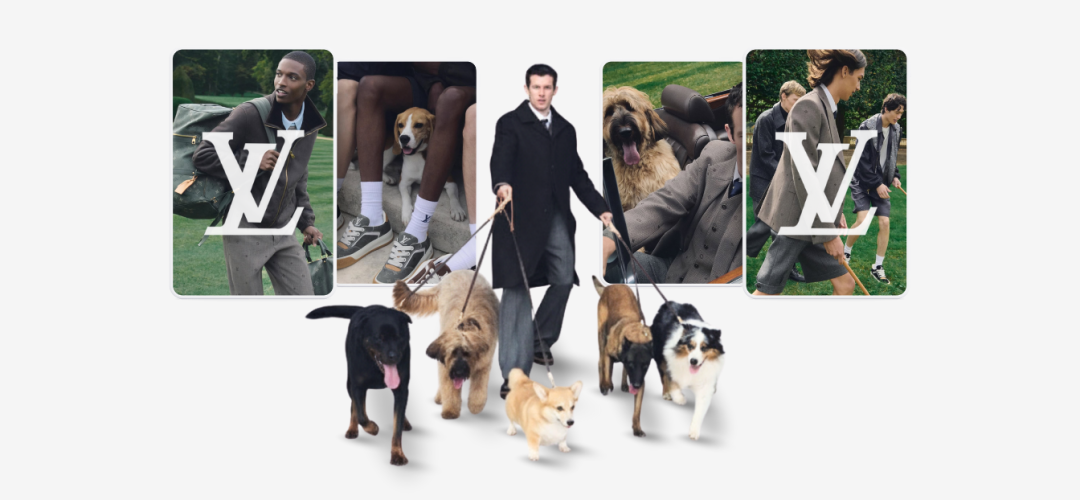
Luxury has long been defined by distance, an aura of untouchable sophistication built on scarcity, silence, and perfection. But Louis Vuitton’s latest men’s spring campaign, globally launched on October 30, 2025, signals a quiet rebellion against that model. The house’s new imagery, featuring actors Callum Turner and Jude Bellingham strolling through the countryside with their dogs, transforms the aesthetic of luxury from something to be admired into something to be felt.
There are no sterile studios or glossy catwalks here. Instead, the scenes are sunlit, textured, and deeply human, flawless tailoring, monogrammed trunks, and meticulous craftsmanship. Luxury, in Vuitton’s hands, becomes less about possession and more about presence.
The Emotional Architecture of Warmth
The decision to center dogs was behavioral science in motion. Dogs are among the most emotionally charged symbols in human culture, triggering oxytocin responses, empathy, and a sense of safety. They are living shorthand for loyalty, trust, and unconditional love.
By introducing dogs into its visual language, Louis Vuitton effectively borrows those emotional associations and transfers them to the brand. The result is a subconscious warmth, as audiences can now feel the collection, meaning emotional marketing at its most elegant, where connection is designed as carefully as the product itself.
The genius lies in contrast as Vuitton doesn’t abandon its codes of luxury; it juxtaposes them with organic emotion. The softness of fur against a tailored coat, the relaxed spontaneity of a walk paired with haute design, brings a conversation between structure and sentiment, and the campaign tells viewers that prestige can still be personal.
When Emotion Becomes Equity
For Vuitton, this campaign is part of a longer strategic narrative, not a one-off charm offensive. Since the launch of its “For Pets” line—leashes, collars, coats, and even a monogrammed kennel trunk—the brand has been quietly building an emotional sub-brand around companionship and care.
That expansion transforms empathy into equity. By aligning itself with one of the most universally beloved emotional bonds, Vuitton embeds itself in a ritual that extends beyond fashion. Pet ownership, after all, is a daily act of love, and the campaign elevates that routine into aspiration. To own Vuitton is to express affection with refinement; to love with taste, which is the essence of emotional marketing, finding a human truth that transcends the product, then expressing it through design and story. Vuitton has identified that truth in the simple act of caring for another being, and it’s turning that emotion into a scalable brand asset.
Rewriting the Luxury Playbook
What makes the campaign particularly resonant is its timing. The luxury sector is moving away from the elitist minimalism of the past decade toward emotional inclusivity and lifestyle storytelling. Audiences today don’t want to buy distance; they want to purchase meaning. Vuitton’s canine narrative bridges that gap by creating proximity without dilution.
It’s also a masterclass in soft power branding. Rather than declaring values, the campaign shows them: tenderness, loyalty, grounded joy. There’s no slogan preaching connection, just imagery that makes you feel it. By letting the emotion do the talking, Vuitton bypasses cynicism and builds genuine affinity.
For younger audiences, especially Gen Z and millennials who prize authenticity and emotional intelligence, this approach repositions Vuitton as more than a heritage house. It becomes a brand that feels alive, empathetic, and self-aware.
The Lesson for Marketers
Louis Vuitton’s dog-led storytelling is not about pets; it’s about people, proving that emotional marketing is strategic. It humanizes prestige without cheapening it, showing that aspiration and affection can coexist.
By embedding its products in an emotional context, Vuitton moves from showcasing luxury to feeling luxury. That emotional resonance lingers longer than any campaign visual, becoming part of the brand’s cultural memory.
The takeaway? In an era of algorithms and attention scarcity, emotion is the ultimate differentiator. And sometimes, the fastest way to a consumer’s heart is on four paws.