
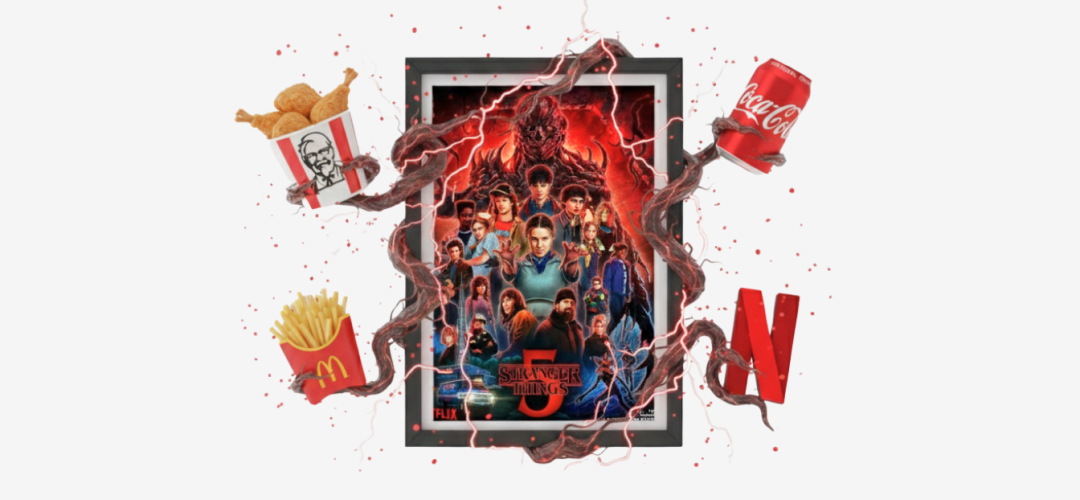
As Stranger Things enters its final season, Netflix is treating the moment less like a series wrap and more like the launch of a blockbuster franchise. The release has been divided into three drops—Thanksgiving, Christmas, and New Year’s Eve—turning the show into a seasonal event that unfolds across nearly six weeks. Wrapped around this staggered rollout is an ambitious network of collaborations that now spans QSR giants, grocery staples, toy makers, retailers, and even city governments. Season Five isn’t just arriving on streaming; it is coming to shelves, drive-thrus, and pop-up experiences globally.
What makes this moment different is how coordinated the ecosystem has become. For years, Stranger Things has relied on nostalgia-driven product placement to ground its storytelling in the late Eighties. But now, the mechanics have flipped, as real brands are building new products, stores, and experiences expressly designed for the show’s fictional world. The “Upside Down” is being manufactured in real time, resulting in the most commercially integrated season the series has ever produced.
The Silent Return of Coca-Cola and McDonald’s
In Season Five, brands such as Coca-Cola and McDonald’s keep slipping back into Hawkins as part of the scenery. Coke surfaces in glowing vending machines, red cups, and contour bottles that quietly anchor the story in late-80s Americana, while McDonald’s appears through fast-food wrappers, signage in wide shots, and diner interiors that echo the brand’s layouts from the era. Nothing about the logo feels staged; it feels staged for the world.
What makes these silent references effective is how they echo the real-world collaborations unfolding outside the screen, from Hawkins-inspired McDonald’s menus to Coke-based floats and desserts. The show and the campaigns reinforce each other without ever breaking character: the brands supply familiar cultural texture, the narrative supplies emotion, and together they turn product placement into world-building rather than a commercial interruption.
When the Show Becomes the Store
Netflix’s most visible collaborations this season sit in fast-food chains, which have embraced the Hawkins aesthetic with unusual confidence. McDonald’s launched an entire Stranger Things menu across several markets, offering inverted burgers, Hawkins-themed desserts, and a Coca-Cola float that mirrors the brand cues already familiar in the series. The campaign goes far beyond limited-time items; restaurants have been redesigned with arcade-style décor, upside-down signage, and in-app ordering challenges, transforming a simple meal into a participatory viewing ritual.
KFC followed a similar path with its Upside Down Double and a fully built “Hawkins Fried Chicken” pop-up inside Sydney’s abandoned Wynyard Tunnels. Guests could walk through a retro diner, order a special-edition item, and experience the show’s eerie visual language in a place that already feels trapped between worlds. These experiences aim to create the kind of social content fans want to share, compounding reach far beyond paid media.
This fusion of setting and commerce pulls Stranger Things further into everyday life, creating a brand fans can taste, touch, and explore. The show becomes a physical destination, and for QSRs, it becomes a turnkey way to reach younger audiences who treat content, food, and social currency as a single cultural layer.
Building a Watch-Party Economy
Away from the scenes and restaurants, the grocery aisle has become an extension of Hawkins. Chips Ahoy released a new soft-chew cookie with a strawberry core, aligning its flavor innovation with the show’s dark, neon-red imagery. Doritos launched a Stranger Things Collisions bag with dual flavors engineered for late-night binge-watching. Eggo reintroduced strawberry waffles as a direct nod to Eleven’s legacy, while Gatorade revived vintage flavors to tap into nostalgia that feels native to the Stranger Things universe.
This configuration of snacks, desserts, and drinks forms a watch-party economy activated each time new episodes drop. It is an old advertising dream, owning the at-home moment, made newly relevant through limited flavors, collectible packaging, and retailer exclusives. The products are engineered for scarcity, social sharing, and quick replenishment, giving brands both volume and visibility during a compressed window of cultural attention.
Retailers are seizing the opportunity as well. Target has positioned itself as the physical hub for the season, rolling out more than 100 Stranger Things items across apparel, home goods, toys, and food. By turning stores into Hawkins-inspired mini-destinations, Target converts fandom into foot traffic while giving the show a material presence throughout the holiday shopping cycle.
The Rise of the Immersive Launch
Another point that distinguishes Season Five is the breadth of experiential activations surrounding it. Los Angeles hosted a massive cycling event themed around the show’s signature bikes. Paris unveiled a Hawkins Christmas market. Sydney built subterranean eateries. Tokyo launched a month-long program with themed cafés and merch drops. Even the Macy’s Thanksgiving Day Parade joined in, placing Stranger Things in front of more than 25 million viewers at the start of the retail season.
These experiences produce the kind of earned impressions that rival major film releases. They extend the binge window, create a shared cultural rhythm, and provide free amplification from participating brands. More importantly, they transform Stranger Things into something closer to a lifestyle platform than a piece of scripted entertainment. Fans don’t simply watch the final season; they enter it.
Why the Strategy Works for Brands
For brands, Stranger Things offers an immediate credibility boost. The series bridges nostalgia and Gen Z taste, mixing 1980s familiarity with the digital-first aesthetics that dominate modern marketing. Meanwhile, collaborations let companies align with that dual resonance, and the economics follow naturally. In that sense, Limited-time products drive trial and urgency; pop-ups generate PR; retail exclusives boost basket sizes; and the halo of being part of a global cultural moment, released during the most commercially charged weeks of the year, offers visibility that would be prohibitively expensive to buy outright.
As the final episodes arrive, the question is no longer how Stranger Things will end, but how far its world can spread. The Upside Down has slipped into supermarkets, restaurants, and shopping districts. And in doing so, it has shown how entertainment franchises can translate storytelling into global commerce.