
When a brand is called Rains, the obvious brief is to keep people dry; yet, scroll through the label’s recent social content, and it becomes clear that the company is trying to own something bigger than outerwear. It is methodically designing what a rainy day feels like – the rituals, the idle minutes, the small joys – and then turning that mood into formats that behave more like editorial franchises than standard advertising.
Instead of AR filters or AI-generated spectacles, Rains is leaning into an almost old-fashioned media toolbox. A “Guess Who” game built around “icons”, a sticker magazine that invites followers to dress paper avatars in the latest collection, and a crossword-style puzzle booklet all appear as focal points in its content. Together, they form a creative strategy that is low-tech, high-concept, and surprisingly sophisticated.
From rainwear label to rainy-day worldbuilder
For years, Rains was known primarily for its clean, utilitarian raincoats and rubberised bags. The aesthetic was already distinct, with the Scandinavian minimalism, desaturated palettes, and city streets glistening after the storm. What is changing now is how the brand applies that language.
Instead of treating social media as a catalogue, Rains is building what feels like a magazine franchise about life “for when it rains”. The feed moves from products to people to print artefacts, with a consistent emotional through-line that builds curiosity, calm, and a subtle sense of play. The Guess Who video, the sticker mag, and the puzzle booklet may look unrelated at first glance, yet all encourage a kind of analog interaction that stands in contrast to the endless scroll.
In practice, this shift has two effects. First, it pulls Rains out of the crowded “nice raincoats” category and into a more defensible position as a lifestyle brand that owns the rainy-day experience. Second, it gives the marketing team a library of narrative devices they can reuse season after season, instead of inventing one-off campaigns that vanish after a week.
Guess Who and the art of low-friction engagement.
The Guess Who video is a good example of how Rains handles digital play without sacrificing its calm tone. The premise is simple: “Same game, new icons.” The format echoes the classic board game, inviting viewers to guess which character, collaborator, or look is being teased before the reveal.
What makes this interesting strategically is how lightly it sits atop the brand. There is no screaming typography, no frenetic editing, no desperate grab for virality. The content relies on a familiar mechanic – guessing – and pairs it with the brand’s usual visual restraint. The game becomes a recurring hook that can introduce new faces, highlight styling details, or humanise the people behind the brand.
From a marketing perspective, this does several useful jobs at once. It generates comments as followers share their guesses; It encourages full-viewing and rewatch behaviour, since the reveal lands at the end; And it slowly builds a cast of “icons” around Rains, turning staff, models, or recurring characters into recognisable figures in the brand universe. Instead of pushing discounts, the brand is accruing something harder to measure and easier to remember: familiarity.
The sticker mag that turns a collection into a toy
If Guess Who turns people into recurring characters, the sticker magazine does the same for product. Under the line “Getting dressed should be fun”, Rains packages its collection in the form of a nostalgic sticker book. Coats, knitwear, and accessories become peel-off pieces that can be layered, swapped, and recombined into outfits.
On social, that object is endlessly photogenic. Close-up shots of hands peeling stickers, overhead views of page spreads, and short clips of new looks being assembled all behave like tiny styling tutorials disguised as play. Fashion can be intimidating or overly serious; here, the brand positions layering and outfit-building as more like a childhood game.
The strategic value goes beyond aesthetics. As Rains expands further into categories like knitwear and even homeware, it needs to educate its audience about the breadth of the offer without confusing them, and the sticker book elegantly solves that problem. It shows range without clutter, teaches layering visually, and frames everything within a single, memorable concept. It is also a Trojan horse for public relations: a physical object that editors and brand friends will want to photograph, flip through, and share, in return feeding the social content engine.
Puzzles for slow moments in a fast-scroll world
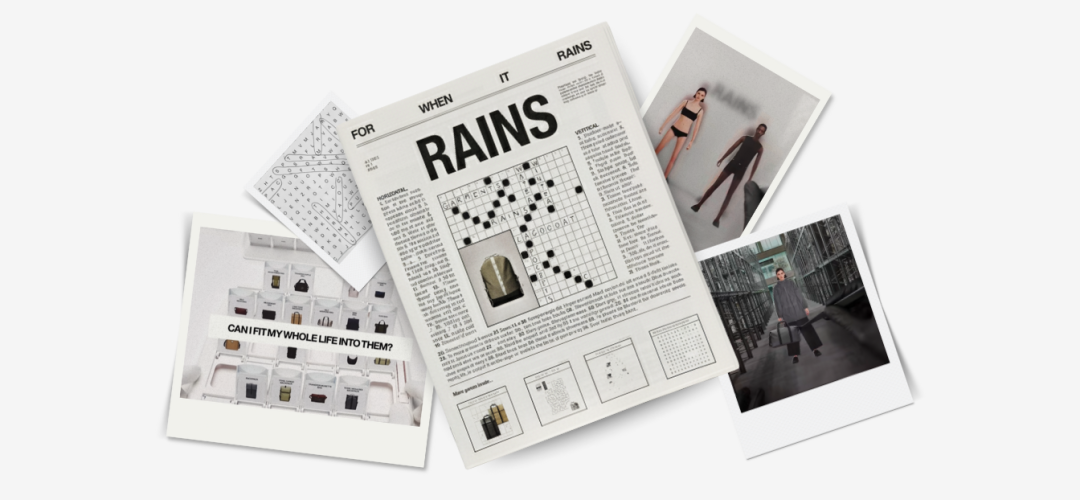
Following the sticker mag and the dressing-up code, the crossword and puzzle booklet is about what happens once you step inside, shrug off your coat, and wait out the weather. Designed to look like the kind of puzzle magazines you might find at a corner kiosk, it’s filled with crosswords, word searches, and join-the-dots built around the Rains universe.
This is arguably the most radical of the three ideas, precisely because it is so unflashy. In a year when many brands are scrambling to attach themselves to AI tools and virtual experiences, Rains is shipping a booklet of word games; yet the logic is sound. Rainy days are defined by pauses on trains, in cafés, and between meetings. By giving customers a branded way to fill those pauses, the company is essentially aligning itself with the rhythm of their day.
Visually, the booklet dovetails with the brand’s established codes. The grids, succinct clues, and tightly edited design make the pages feel like an extension of the clothing: functional, unfussy, quietly distinctive. On social, each puzzle or clue can be cropped into a standalone asset, prompting followers to solve it in the comments or screenshot it for later. The booklet becomes both a physical companion and a long-tail content source.
A print-led content strategy in a digital landscape
What ties these experiments together is an inversion of the usual process and the expansion of the brand’s use not as a cloth itself but as a rainy-day routine. Many brands start with a social idea and then, if it performs, adapt it into something physical. Rains appears to be doing the opposite: starting with considered print artefacts, which are mainly used on rainy days, then slicing them into digital pieces.
This approach has several advantages. It forces coherence because every photo and clip must relate to a tangible object, not just an abstract moodboard. It offers a built-in way to differentiate: a puzzle booklet or sticker mag is more likely to stick in memory than yet another CGI-heavy campaign. And it aligns with the brand’s positioning as a thoughtful, design-driven company rather than a trend-chasing one.
For marketers, the lesson is that format can be as strategic as the message. Rains is betting that in an attention economy dominated by speed, there is room—and value—for content that feels slower, more tactile, and more deliberate.
What other brands can learn from a rainy-day universe?
There are three clear takeaways from Rains’ recent moves. First, owning a specific emotional context – in this case, the rituals of rainy days – can be more powerful than competing purely on product claims. Second, nostalgic, analog formats still have currency, especially when they are executed with a modern aesthetic and distributed digitally. Third, a small number of strong, repeatable concepts can generate more distinctive content over time than a constant churn of disconnected ideas.
In an industry where many social feeds blend into a single stream of polished sameness, Rains is quietly building something more idiosyncratic. Its Guess Who games, sticker sheets, and puzzle pages are not loud. They don’t hijack trends or rely on celebrity shock value. Instead, they ask a simpler, more enduring question: what if getting dressed for bad weather – and the hours spent under grey skies – could feel like play?
For a brand built on rain, that answer is its most valuable asset.