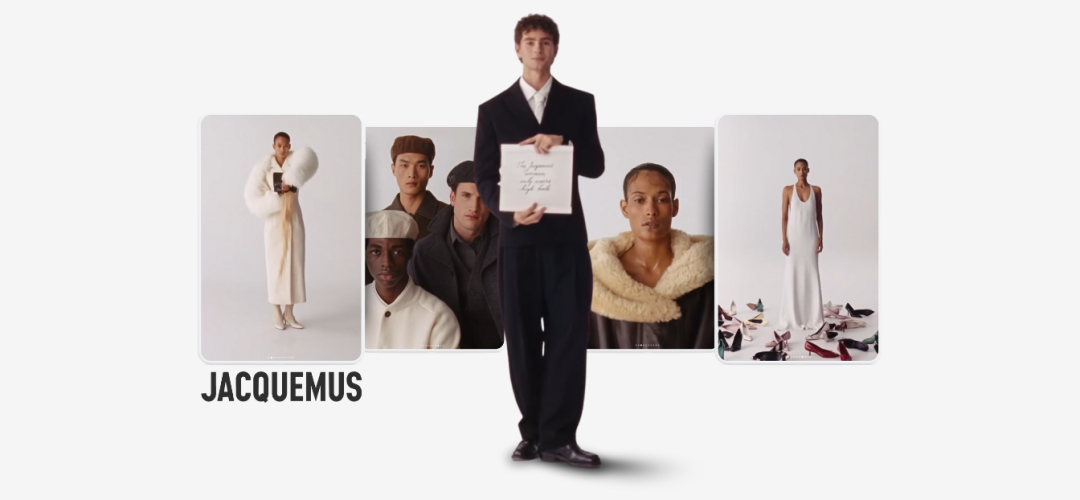
The new Jacquemus “Clichés” campaign used a self-parody as a formal design tool. The premise is to say out loud what people already say about the brand—sun-washed minimalism, tiny bags, dramatic props—and then rebuild those tropes on camera with restraint and control. The humor lives in the writing, pacing, and edits, while the visual language stays luxury-grade, including clean frames, sculpted light, and compositions that maintain product hierarchy. The result is a campaign that feels confident rather than defensive, less a clap-back than a calm declaration of identity.
From Meme to Method
The campaign is built for Instagram’s attention mechanics, including short beats, saves over likes, and rewatchable loops. Shots resolve quickly and cleanly, so viewers can quote them in stories, duet them, or recreate them. The brand is effectively designing UGC templates, including poses, framing, and lines that are easy to imitate. That “designed for imitation” strategy is how luxury can achieve cultural reach without paying influencer armies, as creators amplify because the format invites it.
What makes the creative land is the discipline of the images. Negative space acts like a spotlight; the grade is warm but not sugary; camera movement is deliberate, almost architectural. Props nod to past Jacquemus spectacles without collapsing into stunt, big enough to be recognizable, minimal enough to feel collectible. Crucially, the product never becomes a punchline. Bags and silhouettes sit at the center of each frame so the joke travels, but the desire remains, building entertainment, never cheapening.
The captions and on-screen text are doing heavy lifting. Statements that mirror fan commentary (“too small,” “too staged,” “too Jacquemus”) are delivered with a straight face, then subverted by the next cut. It’s a rhythm—setup, understatement, reveal—that reads natively in the scroll. Because the joke is linguistic, not slapstick, the work is easy to localize, trim, and remix without losing tone. In social media, that matters more than a hero film; a caption matrix can scale farther than a single manifesto.
By naming and owning the clichés, the brand preempts predictable takes and reduces reputational volatility. In recent years, Jacquemus has blurred the line between spectacle and reality, part practical production, part digital mythmaking. This campaign uses transparency as a shield, telling the audience, “We know what you think, and here’s why we do it.” That stance sharpens trust even as it fuels conversation.
The Creative System Behind the Single Idea
The machinery here is modular, using hero edits for top-of-funnel, cut-downs for feed and stories, stills that carry the joke in copy alone, windows/OOH that echo a single line, and retail content that ties the gag back to craft details (stitching, scale, materials). When the same meta voice shows up in-store, in press notes, and in posts, the audience experiences a brand, not a campaign.
In addition, topline reach is table stakes. The meaningful signals live elsewhere, with save rate and shares on the core assets; volume and quality of UGC recreations (not just mentions); search lift on hero products featured in the edits; dwell time on campaign landing and lookbook pages; and earned-media sentiment specifically using “confident,” “self-aware,” or “clever,” not merely “viral.”
Lastly, luxury is crowded with high-concept films and cryptic moodboards; clarity is scarce. Jacquemus distinguishes itself through legibility and elevation. Where some houses chase shock or lore, this work is conversational without surrendering mystique. That’s a strategic lane of approachable minimalism that knows it’s being watched and uses the gaze as material.