
Minimalism has been helding a near-unquestioned dominance across fashion, branding, and social media, evolving into what became widely understood as “quiet luxury,” a visual language built on neutral tones, careful restraint, and the suggestion of sophistication without excess; yet, as this aesthetic proliferated across platforms and industries, it gradually shed the very depth that had once made it compelling, transforming from a philosophy rooted in intention into a formula that could be endlessly reproduced without context.
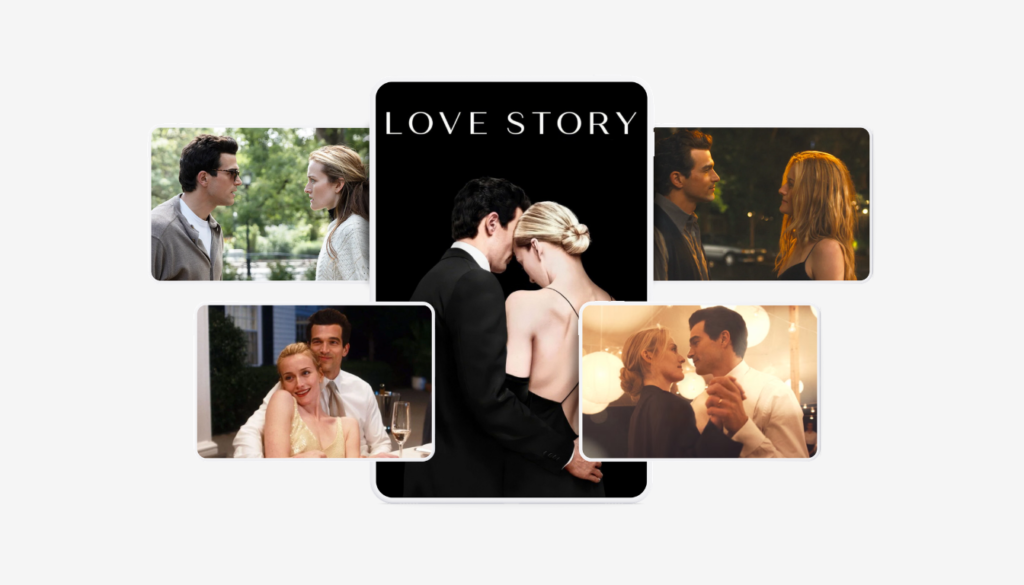
Minimalism became so common that it lost its original message, serving as little more than recognizable shorthand. At this point, Love Story—Ryan Murphy’s series about Carolyn Bessette-Kennedy and John F. Kennedy Jr.—appeared. Instead of just recreating the past, it redefined the importance of minimalism and showed why it can matter again.
The Reframing of Minimalism as Narrative
What distinguishes Carolyn Bessette-Kennedy’s style, as reintroduced through the series, is not simply its visual clarity or disciplined simplicity, but the context that gives it meaning, transforming each understated choice into an extension of character rather than a calculated aesthetic decision. Her wardrobe does not appear assembled for attention or optimized for public consumption, but instead unfolds as a natural expression of identity—private, deliberate, and resistant to the performative logic that defines contemporary visibility.
This distinction, while subtle at first glance, carries significant cultural weight, as it repositions minimalism from something that can be imitated into something that must be understood, inviting audiences to engage not only with how it looks, but with what it represents. As a result, the resurgence of interest that has followed the series does not manifest merely as replication, but as reinterpretation, with digital platforms filling with references that feel less like trends to be copied and more like atmospheres to be inhabited, suggesting a shift in how aesthetic influence operates in a landscape increasingly driven by meaning rather than surface.
The Rise of Character-Driven Branding
This recalibration is already beginning to reshape the logic of branding, particularly as companies confront the limitations of aesthetics that exist without narrative support, recognizing that visual coherence alone is no longer sufficient to sustain attention in an environment saturated with content. In its place, there is a growing emphasis on character, on constructing identities that feel inhabited rather than assembled, and on creating brand worlds that extend beyond appearance into something closer to lived experience.
The cultural resonance of Love Story lies, in part, in its demonstration that audiences are drawn not simply to images, but to the stories that give those images weight, prompting a shift toward campaigns that feel less declarative and more observational, less concerned with perfection and more invested in suggestion. In this emerging framework, branding becomes less about presenting a finished image and more about inviting interpretation, allowing consumers to locate themselves within a narrative rather than positioning them as passive viewers of a carefully controlled aesthetic.
The Return of Mystery
At the same time, the renewed fascination with Carolyn Bessette-Kennedy introduces a dimension largely absent from contemporary digital culture: the value of distance. In an era defined by constant exposure, where visibility is often equated with relevance and participation is expected as a condition of influence, her presence—simultaneously public and inaccessible—feels almost countercultural, offering a model of visibility that does not rely on performance.
She existed within the public eye without submitting to its demands, maintaining a degree of opacity that allowed intrigue to flourish, and it is precisely this balance that now resonates with audiences increasingly fatigued by the relentless transparency of social media. As a result, there are early indications of a shift toward what might be described as “unspoken branding,” in which less frequent communication, minimal textual explanation, and restrained visual storytelling begin to signal a new form of confidence, one that derives its power not from what is revealed, but from what is intentionally withheld.
Platforms in Transition
This evolving sensibility is beginning to surface across digital platforms, where the mechanics of attention are subtly adjusting in response to changing audience expectations. On TikTok, long associated with rapid cycles of content and highly visible trends, there is a growing presence of slower, more atmospheric storytelling, in which mood, pacing, and narrative continuity take precedence over immediacy, suggesting a recalibration of what engagement looks like.
Meanwhile, Instagram appears to be rediscovering an editorial rhythm, with feeds that feel less like continuous streams of performance and more like curated sequences of images that build meaning over time, echoing the structure of traditional publishing rather than the logic of algorithmic output. In both cases, the emphasis shifts away from volume and toward cohesion, reinforcing the idea that influence is no longer measured solely by frequency, but by the clarity and consistency of a broader narrative identity.
The Commercial Tension
Yet, embedded within this shift is an unavoidable tension, as the very qualities that make this renewed interpretation of minimalism compelling—its authenticity, its restraint, its resistance to overt performance—are inherently difficult to reproduce at scale without losing their integrity. As brands move to engage with this cultural moment, there is a risk that the language of understated elegance will once again be detached from its underlying meaning, reduced to a set of visual cues that can be quickly adopted but easily exhausted.
The challenge, therefore, lies not in adopting the aesthetic but in understanding the conditions that gave it relevance, recognizing that its power emerges from coherence between identity and expression rather than from surface-level imitation. Those brands that succeed in navigating this balance will likely be the ones that resist over-articulation, allowing their narratives to unfold with subtlety and patience, aligning themselves not only with the visual codes of the moment but with its deeper cultural logic.
A Shift Beyond Aesthetics
Ultimately, the influence of Love Story extends beyond the boundaries of fashion or style, pointing instead to a broader recalibration in how culture defines value and relevance in an era of constant visibility. It suggests that audiences are increasingly drawn to what feels considered rather than constructed, and that the most enduring forms of influence may emerge not from amplification, but from restraint.
In this context, minimalism returns not as a revival but as a reinterpretation, placing meaning at the center of expression and reasserting the importance of narrative in shaping perception. For marketers, the implication is both simple and demanding: in a landscape saturated with content, the ability to say less, while meaning more, may well become the defining advantage.