
Polaroid’s new campaign arrives at a moment when cultural fatigue with artificial content has reached a visible threshold. The brand introduces the Polaroid Flip not as a technological innovation but as an emotional counterpoint to the acceleration of AI and the hyper-production of digital imagery. This approach feels both defiant and perfectly aligned with the mood of a generation navigating the psychological overload of infinite feeds and flawless synthetic visuals. Rather than ignore the tension between real and artificial, Polaroid places it at the center of its message and, in doing so, reframes analog photography as a modern form of authenticity.
Where Analog Meets a Rising Cultural Anxiety
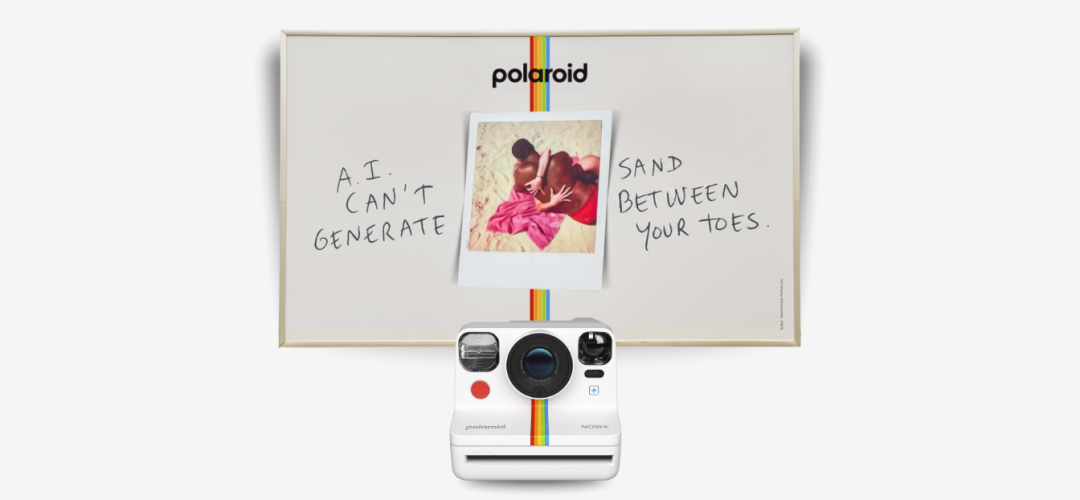
One glance at Polaroid’s OOH installations reveals the clarity of its intention. Against wide, white spaces, the brand displays a single instant photograph accompanied by handwritten lines that draw a line between the sensory and the synthetic. Messages like “AI can’t generate sand between your toes” capture a growing unease documented in multiple studies. Adobe’s State of Creativity Report 2024 found that more than half of Gen Z feel overwhelmed by the amount of AI-mediated content they consume daily. Ipsos’ Global Trends Survey 2025 similarly reports that nearly 70% of global consumers believe AI-generated visuals lack emotional depth. In this context, Polaroid’s insistence on physicality becomes more than nostalgia; it becomes a response to an emotional void that digital systems have not been able to fill.
The power of these ads lies in how they mirror a conversation already underway in culture. People are not rejecting technology outright, but they are increasingly seeking refuge in experiences that feel untouched by automation. By directly addressing this desire, Polaroid’s campaign shifts the brand from a retro relic into a symbol of intentional living.
Why the Strategy Resonates Now
Polaroid’s approach works because it reframes analog photography as a solution rather than a sentiment. Consumers who feel digitally saturated are looking for practices that slow them down, ground them, and create a sense of presence. McKinsey’s Consumer Pulse Study from late 2024 highlighted that younger audiences, despite being the most digitally native, express the highest levels of “screen burnout” and actively seek moments of tactile or offline engagement. These desires align perfectly with the inherent mechanics of instant photography. The limitations of the device, such as finite film, imperfect exposure, and the inability to overedit, become virtues in a world where everything else can be endlessly optimized.
This shift is not theoretical; according to Deloitte’s 2024 Digital Consumer Report, there has been a steady rise in “retro tech purchasing,” with instant cameras ranking among the fastest-growing categories among millennials and Gen Z. In parallel, Polaroid benefits from these currents because it positions itself not as a competitor to smartphone cameras, but as an alternative to the logic that governs digital life.
The Visual Confidence of Doing Less
A defining element of Polaroid’s campaign is its visual restraint. Where most brands compete for attention through color, motion, and density, Polaroid chooses space, silence, and simplicity. The sparse white backgrounds and small handwritten notes work precisely because they feel like a pause amid overstimulation. Their minimalism is not aesthetic alone; it is narrative. The ads embody the stillness the brand promises, transforming public spaces into visual interruptions that remind viewers of what analog feels like.
Placed in dense urban areas, where speed, noise, and phone fixation dominate, creating a symbolic juxtaposition. The real world becomes the gallery, and the analog print becomes the artifact that interrupts it. In these settings, the ads do not simply promote a camera; they assert a point of view about how to move through the world.
How Polaroid Converts Tension Into Commercial Advantage
Beyond their emotional resonance, these campaigns operate as a strategic repositioning. Polaroid no longer competes in the traditional photography category but enters a broader cultural conversation about authenticity, connection, and intentional living. The Real vs AI framing places the brand at the heart of a societal shift documented across multiple consumer studies. What makes this powerful commercially is that Polaroid transforms what once seemed like technological limitations into new forms of value. The absence of digital manipulation becomes a promise of truth. The inability to endlessly retake becomes a celebration of the moment. The analog print shifts from being a nostalgic object into a tool for meaning-making.
In a moment when consumers increasingly trust brands that embrace transparency, imperfection, and human-made craft, Polaroid’s positioning as a safeguard of the real aligns with a perception already shaping purchase decisions across lifestyle, fashion, and creative industries. What appears subtle is, in reality, a precise diagnosis of cultural mood, and the brand’s resurgence reflects how strongly that mood is turning.
What Other Brands Can Learn From Polaroid’s Playbook
Polaroid’s success offers valuable lessons for marketers navigating the rise of AI. The first is that cultural tensions are fertile ground for differentiation. Brands that identify a collective concern — like the absence of the “real” in everyday life — can respond with narratives that feel both relevant and needed. The second insight is that authenticity now requires tangible proof. With AI increasingly blurring the boundaries of what is real, consumers seek experiences anchored in physicality or human touch, a trend supported by McKinsey’s 2024 findings on the value of sensory experiences in brand loyalty. The third, perhaps most important, is that strategic limitation has become a new form of luxury. When everything can be generated instantly, what takes time, effort, or presence gains new power.
Polaroid succeeds not because it resists technology, but because it reframes the conversation around what technology cannot replace. In an age of synthetic abundance, the real becomes rare, and, in that rarity, Polaroid finds momentum, meaning, and its most compelling competitive edge in years.