
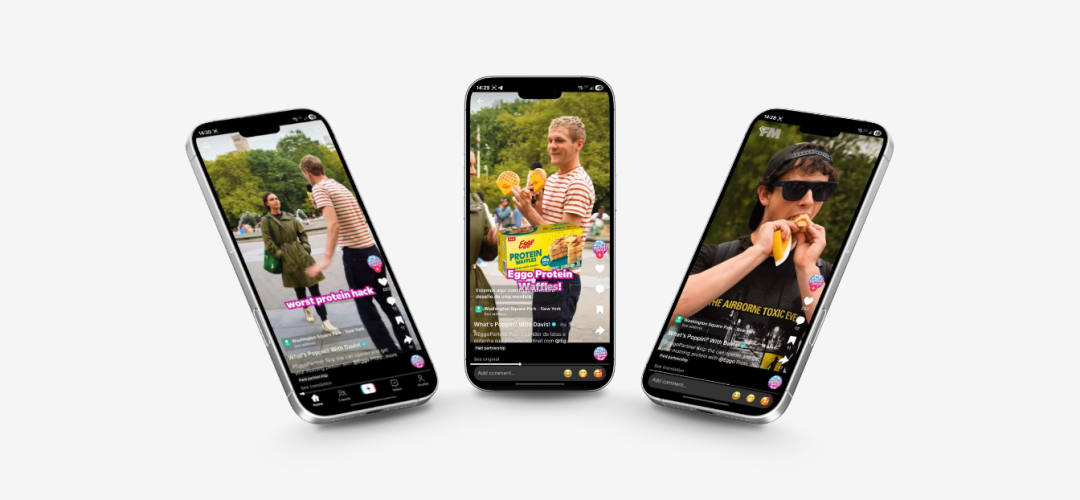
On any given afternoon in New York, the camera points not at models or influencers but at whoever happens to be passing by. A bottle cap twists open, a question lands mid-stride, and a stranger decides, on camera, whether to sniff, sip, or shrug. What looks effortless in the feed is, in practice, the hardest new genre in advertising: the street-interview ad. This format swaps scripts for serendipity and trades studio control for the volatility of real life.
For the companies leaning in, the appeal seems obvious. Social platforms have trained audiences to prefer the cadence of conversation over the sheen of a commercial. As generative AI floods timelines with immaculate faces and perfect lighting, the value of a messy, unscripted reaction has climbed. Brands want proof of feeling, not just proof of production. Agencies that specialize in intercepts have stepped into the gap, turning city parks and busy sidewalks into repeatable stages for reaction-driven creative.
Why “Real” Suddenly Wins
The first tailwind is fatigue; viewers are scrolling past creative that looks like advertising on contact, such as immaculate b-roll, caption fonts they’ve seen a thousand times, and voiceovers that sound like a sales deck. Street interviews are engineered to dodge that reflex. In that sense, the opener is a question, not a claim; the product appears as a prop, not a hero, and the arc is genuinely uncertain. Second is the algorithm; short videos favor hooks, faces, and tension, like someone deciding in real time whether a body wash smells like “clean gym” or “first date.” That ambiguity pulls comments and rewatches, the two currencies platforms reward.
There’s also a trust dividend. Paid creator posts still work, but audiences know the dance. A clip with a stranger, secured by consent and lightly edited, signals a different kind of authenticity. It’s closer to retail sampling than to endorsement, with social proof gathered in public, and the crowd as witnesses.
What This Format Is (and Isn’t) Good For
What transforms a one-off viral clip into a repeatable engine is endurance. Most people, after all, don’t want a camera in their face, and shoot days swing from moments of effortless charm to hours of polite rejection, turning a cold approach into something usable demands interviewers who can read social cues instantly, win trust in seconds, and recover smoothly when a conversation collapses after three words. The work is as physical as it is psychological, with long walks, endless retakes, and constant recalibration. Over time, the grind wears down even the most extroverted crews, making turnover less a risk than a certainty.
Street interviews punch above their weight when the core value proposition is sensory or immediately demonstrable. Fragrance, texture, sound, are small but meaningful product details- these are notoriously hard to sell on a static product page and perfect for an instinctive human read. Direct-to-consumer brands have jumped in because the clips are shareable at the top of the funnel and measurable down the line, along with audiences discovering, reacting, and then clicking into a product detail page with a moment from the video still echoing in their heads.
Where they underperform is in complex categories that require explanation, not reaction. If the purchase depends on warranties, specs, or multi-step comparisons, the charm of spontaneity fades, because the street can open the door, but it rarely closes the sale on its own.
The Creative Discipline Behind the “Chaos”
By that, successful teams focus on script moments and not just lines. They move with a palette of open-ended prompts, following one provocation, one comparison, one myth to test, and abandoning any phrasing that feels rehearsed. Their focus is on the opening instant, when a question is already mid-air, a bottle is already uncapped, or a laugh is already breaking through. Editors follow the rhythm of each platform, cutting for grammar and pace: captions large enough to scan, quick cuts back to faces, products visible but never worshiped. The interviewer becomes part of the performance because a theater kid with fast empathy will always outshine a junior producer glued to a script.
The strongest clips also honor the audience. Selection bias is a silent trap; if only the extremes are cut—whether it’s the ecstatic praise or the exaggerated disgust—viewers will sense the manipulation. A sequence of ordinary reactions may feel quieter, yet it builds trust, and in the end, credibility is the real currency.
Measuring More Than Clicks
The key metrics sit between pure awareness and direct response. The hook rate, which is the share of impressions that convert to three-second views, tells you whether the opening line works. Average watch time and rewatches reveal whether the question paid off. Saves and shares suggest cultural currency, and comments, when guided by the on-screen question, double as qualitative research. Downstream, view-through revenue and product page conversion validate whether the curiosity transferred to intent. Teams that sequence creatively should follow the street interview first, the comparison ad second, and the offer ad third. This approach can lead to compounding gains, especially when the later units reference the exact line viewers remember from the sidewalk.
The AI Shadow
Ironically, the biggest long-term risk to the format’s authenticity edge is the very technology it was meant to counter. Synthetic “street interviews” are now easy to produce, featuring realistic faces, natural backgrounds, and scripted spontaneity. Even if brands avoid that route, some viewers will start to doubt the provenance of every clip. The counter is proof, meaning behind-the-scenes stills, subtle watermarks, and consistent interviewer identities help build a breadcrumb trail of real production. Moreover, platforms may eventually reward verified capture; until then, credibility is a brand choice.
For marketers, the decision is pragmatic. Buying from a specialist yields faster learning and fewer legal missteps. Building in-house creates a tone you can sustain and evolve, a small “vox-pop unit” that understands your product, your audience, and your risk tolerance. Either path benefits from a steady cadence rather than sporadic bets. The format works like an ongoing lab, meaning many small variants, quick reads, and continuous calibration.