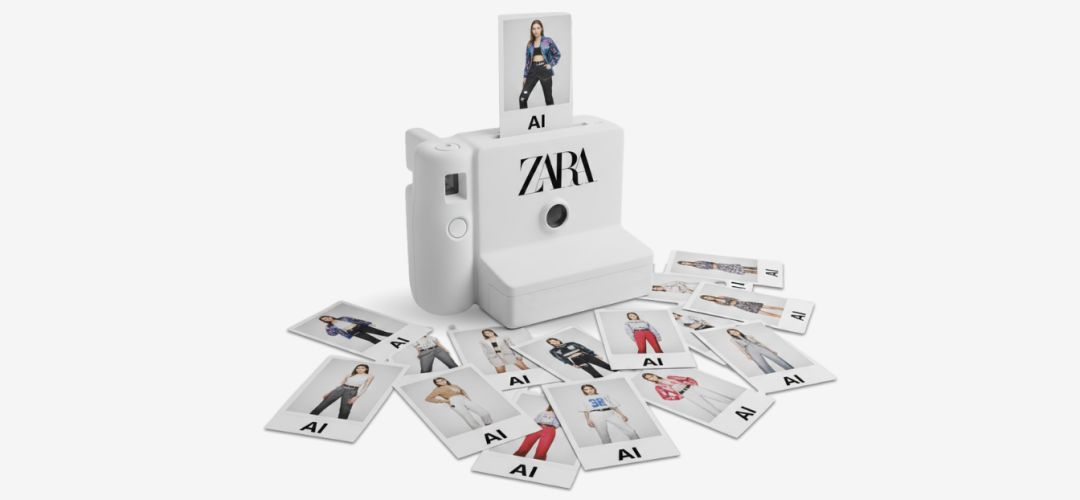
Zara’s latest experiment with artificial intelligence does not look radical at first glance. The images remain polished, the models familiar, the aesthetic consistent with the brand’s visual codes. Yet behind the apparent continuity lies a profound change: instead of reshooting models for each new garment, the company now uses AI to generate new images based on existing photographs of real people, effectively multiplying visual outputs from a single session.
Inditex, Zara’s parent company, insists the technology is a complement rather than a replacement, preserving consent, contracts, and compensation. That framing is deliberate, reflecting an understanding that the disruption here is not only technological, but cultural and economic. Because what is being transformed is not just how fashion looks, but how fashion’s entire visual economy operates.
Speed Becomes the Real Luxury.
It’s well known that Fashion today competes not only on design but on velocity. Drops are more frequent, collections are increasingly fluid, and e-commerce demands endless variations of the same product, combining different angles, stylings, formats, and campaigns for different platforms. Traditional image production, with its reliance on studios, crews, logistics, and scheduling, has become one of the slowest and most expensive parts of the machine.
By turning a single photoshoot into a reusable dataset, Zara effectively converts imagery into software. Variations can be generated in days rather than weeks. In that context, production costs shrink and launch timelines accelerate. In a sector where speed increasingly defines competitiveness, AI becomes less a creative experiment and more an operational necessity.
Zara is not alone, though. H&M and Zalando have already adopted similar practices, using AI to generate visual variations and digital twins to expand campaigns without new shoots. What once sounded futuristic is now becoming table stakes among large fashion platforms. Once one major player proves the efficiency gains, the rest are compelled to follow.
The Creative Ecosystem Feels the Pressure
Nevertheless, the industry language remains reassuring: AI is framed as a tool that supports creativity, not one that replaces it. Yet the practical implications tell a more complicated story. If one shoot can now produce the output of five, demand inevitably falls for photographers, stylists, set designers, assistants, and especially for emerging professionals who rely on high-volume commercial work to build careers.
The risk is not that AI eliminates creativity, but that it automates the most repetitive layers of creative labor. E-commerce imagery, catalogue photography, and routine campaign adaptations are precisely the tasks most vulnerable to substitution. Over time, this may reshape the industry into a more polarized structure with fewer opportunities in the middle, greater emphasis on elite, high-concept creative work at the top, and a growing reliance on synthetic production at the base.
Even under a discourse of complementarity, volume matters. And volume is where livelihoods are built.
A Strategy that Mirrors Zara’s Broader Repositioning
This technological shift does not exist in isolation, aligning closely with Zara’s recent strategic transformation. Over the past few years, the brand has reduced its store count while investing in larger, more sophisticated locations. Physical retail has become more curated, experiential, and controlled. At the same time, cost discipline has intensified across operations.
AI-generated imagery fits perfectly into this logic. It allows Zara to preserve its aesthetic consistency while scaling output and protecting margins. It supports a model in which brand control is tightened, variability is minimized, and efficiency becomes a strategic advantage. In that sense, the stores become fewer but more impactful, while the images become more abundant but cheaper to produce. In conclusion, the brand surface becomes both more curated and more industrialized.
The Regulatory Debate is Only Beginning
Perhaps the most consequential aspect of this shift lies ahead. When brands begin manipulating the likeness of real people at scale, questions of rights, consent, remuneration, and disclosure become unavoidable. Who controls a digital replica? How long can it be used? What constitutes fair compensation? Where is the line between a licensed adaptation and an unauthorized derivative?
These are actually legal, ethical, and reputational fault lines that regulators are already beginning to address, particularly in Europe and the United States. As 2026 approaches, debates around synthetic media, transparency obligations, and digital labor rights are expected to intensify. Zara’s careful emphasis on preserving agreements suggests that the company understands this terrain is as strategic as the technology itself.
When Imagery Becomes Infrastructure
The deeper story here is not about aesthetics, but about infrastructure. Fashion imagery is no longer treated as a series of creative projects. It is being reengineered as a system: modular, scalable, optimized, and increasingly automated. Just as supply chains were industrialized decades ago, content pipelines are now undergoing the same transformation.
For brands, the advantages are compelling, including faster execution, lower costs, greater flexibility, and more experimentation. For the industry’s human ecosystem, the consequences are more ambiguous. Creativity does not disappear, but its economics shift. The value migrates upward to conceptual authorship and downward to machine-enabled production, hollowing out the middle ground where much of the industry’s labor once lived.
Zara’s move, therefore, marks more than a technological update. It signals that fashion is entering a new phase, one in which the image itself becomes a manufactured asset, endlessly reproducible, strategically controlled, and increasingly detached from the physical moment of creation. The question is no longer whether AI belongs in fashion, but who benefits most from its current deployment.