
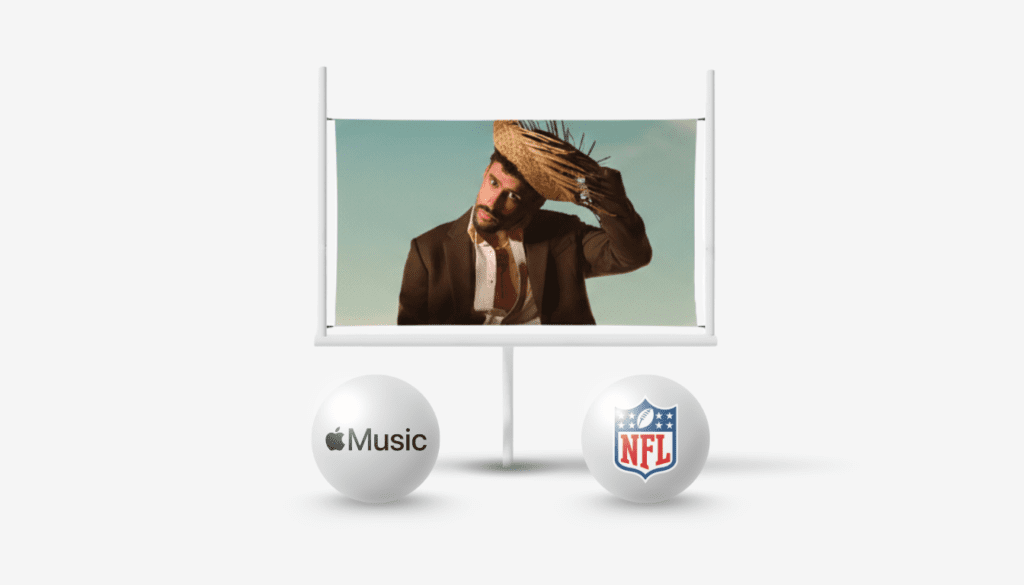
The first and most deliberate choice in Apple Music’s new Super Bowl trailer is not visual spectacle but narrative restraint, a decision that feels almost radical in a media environment conditioned to treat the halftime show as an escalating arms race of noise, speed, and excess. Instead of opening with stadium shots, flashing edits, or celebrity overload, the film situates Bad Bunny beneath a flamboyant tree in Puerto Rico, moving with quiet confidence to “Baile Inolvidable,” while a rotating cast of strangers step into the frame to dance beside him. The result is intimate rather than explosive, emotionally grounded rather than performative, and precisely because of that, far more culturally resonant than a conventional teaser would be.
By choosing to film entirely on the island, the campaign places origin before global reach, and identity before scale. Puerto Rico is not reduced to an aesthetic backdrop, nor is it treated as a symbolic accessory to star power; instead, it functions as authorship, as a declaration that this moment belongs first to a cultural context before it belongs to the global entertainment machine. In an era in which brands relentlessly claim authenticity while packaging culture into exportable formats, this choice reads as both creative clarity and strategic intelligence.
From Spectatorship to Participation
What unfolds throughout the film is not a performance constructed for admiration at a distance, but a choreography built around inclusion, with each new dance partner subtly repositioning the viewer’s role from passive spectator to potential participant. The narrative device is simple, yet powerful: anyone can step into the moment, anyone can belong inside the rhythm, anyone can be part of what is happening rather than merely witness it.
This shift is not cosmetic; it is philosophical. For years, entertainment marketing has chased scale through spectacle, assuming that bigger visuals, louder moments, and faster edits automatically translate into greater cultural impact, even as audiences grow more detached and less emotionally invested. This campaign takes the opposite approach, betting that emotional proximity travels further than spectacle, and that the feeling of being welcomed into a cultural moment is more powerful than being impressed by one. The trailer works not because it demands attention, but because it earns it through warmth, clarity, and intention.
Apple Music’s Real Objective Behind the Poetry
Beneath the film’s lyrical tone, however, sits an unusually disciplined strategic architecture. Apple Music did not inherit the Super Bowl halftime sponsorship from Pepsi to collect brand impressions; unlike a beverage company, a streaming platform must justify this scale of investment through measurable behavioral outcomes. The platform does not need audiences to remember its logo; it needs them to listen, engage, return, and build habits inside the product.
That is why the campaign extends far beyond the trailer itself. The invitation to dance becomes a functional experience through curated playlists built around Bad Bunny’s catalog and Puerto Rican artists, through features like Apple Music Sing that encourage users to perform rather than simply consume, and through editorial programming that reframes the halftime show not as a single-night event but as the culmination of a longer cultural journey. The trailer serves as the emotional ignition point, while the surrounding ecosystem is engineered for continuity.
What makes the campaign particularly strong is the coherence between idea and behavior. The creative message is participation, and the product is designed for participation. The narrative says everyone is invited, and the platform experience gives users tangible ways to accept that invitation. Few brand-sponsored moments achieve this level of alignment.
Why Cultural Specificity Scales Better Than Universality
For decades, global marketing operated on the assumption that universality was achieved by smoothing differences, reducing cultural texture, and designing campaigns that could offend no one and therefore deeply move no one. This campaign quietly argues the opposite. By leaning unapologetically into Bad Bunny’s Puerto Rican identity, by centering Spanish-language music without translation, and by using local symbols without over-explaining them, Apple Music and its artists create something that feels grounded enough to travel.
The appeal does not come from dilution but from confidence. Viewers across cultures do not need to decode every reference to understand the emotion, the pride, the openness, or the energy of the moment. They understand rhythm, invitation, and presence. In a fragmented media environment increasingly defined by identity, community, and belonging, cultural specificity no longer limits scale; it enables it.
The Super Bowl as Ecosystem, Not Event
Perhaps the most revealing signal in the campaign is how little it treats February 8 as the sole destination. Nothing in the film feels like a countdown clock, and nothing in the narrative suggests a singular moment of consumption. Instead, the campaign positions the halftime show as part of a broader continuum, a cultural season rather than a cultural spike.
This reflects a fundamental shift in how platforms now approach attention. The Super Bowl is no longer valuable only for what happens on the night; it is valuable for the extended ecosystem of discovery, engagement, and participation that can be built before and after the broadcast. Apple Music is not merely sponsoring a moment; it is constructing infrastructure around that moment, turning fleeting attention into an ongoing relationship.
When Marketing Stops Interrupting Culture And Starts Hosting It
What ultimately distinguishes this campaign is its tone. It does not feel like Apple Music is borrowing Bad Bunny’s cultural capital for brand lift; it feels as though the platform is offering space for that culture to expand, to be seen on its own terms, and to invite others in. That distinction is subtle, but it is precisely where contemporary audiences draw the line between exploitation and collaboration.
At a time when advertising increasingly struggles to feel welcome in cultural spaces, the campaigns that succeed tend to behave less like interruption and more like facilitation. This trailer works because it does not announce its sponsorship loudly; rather, it earns its presence through respect, clarity, and creative discipline.
If the Super Bowl has long rewarded the brands willing to be the loudest in the room, this campaign suggests a different model for relevance. Sometimes, the most powerful move is not to amplify the spectacle, but to soften the tone, widen the circle, and let the world step into the frame.