
Shein’s rise comes not just from its clothes, but the machinery behind them. The company built a sophisticated, responsive supply chain that could turn online trends into garments within days. Now, rather than keeping that system exclusive, Shein is inviting outside brands in.
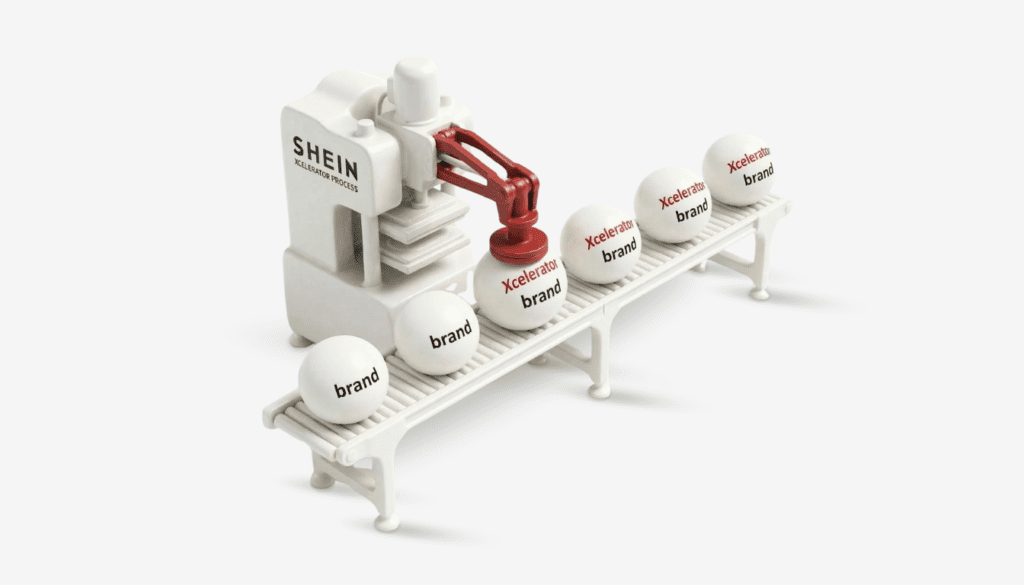
Through its Xcelerator programme, Shein has begun opening its production infrastructure, logistics capabilities, and e-commerce marketplace to independent labels, effectively offering the operational engine behind its business-as-a-service model. For smaller fashion companies navigating a fragmented, competitive industry, the proposal offers obvious appeal: faster production, streamlined operations, and access to a massive global audience. Yet beneath that promise lies a more complicated strategic question: the shifting balance of power in fashion—and what happens when brands begin relying on the infrastructure of a company that also competes directly for their customers.
From Fast-Fashion Retailer to Fashion Infrastructure
Shein’s expansion into supply-chain services represents a subtle but significant evolution in its strategy. For most of the past decade, the company’s competitive advantage rested on a model that blended real-time data analysis with highly flexible manufacturing, enabling it to produce small batches of garments, test demand rapidly, and scale only the products that resonated with consumers.
This system, coordinated across thousands of partner factories and tightly connected to Shein’s digital storefront, allowed the company to operate at a pace that traditional apparel brands struggled to match. New designs could move from concept to production within days rather than months, while inventory risks remained relatively low thanks to small initial production runs.
By opening this network to external labels, Shein is attempting to transform what was once a proprietary operational advantage into a new business layer altogether. In effect, the company is positioning its supply chain not merely as an internal capability but as a platform—one that other brands can plug into to design, manufacture, and distribute products through the same system that powers Shein’s global retail machine.
The Promise of Speed, Simplicity, and Reach
For emerging brands, particularly those operating with limited resources, the attraction of such a model is easy to understand. Building a reliable manufacturing network, coordinating suppliers, and managing global logistics are among the most complex challenges in fashion, often requiring years of relationships and significant financial investment.
The Xcelerator programme promises to remove much of that friction. Designers can move from concept sketches to finished garments with remarkable speed, allowing them to respond more directly to fast-moving cultural and social media trends. Meanwhile, the operational layers that often burden young brands—production management, warehousing, and fulfillment—can be handled within Shein’s existing infrastructure.
Equally compelling is the scale of Shein’s marketplace itself. With a vast global customer base and distribution capabilities spanning dozens of markets, the platform offers independent labels immediate exposure that might otherwise take years to achieve through traditional retail channels. For many smaller brands, particularly those attempting to break through internationally, the possibility of reaching such an audience without building a global logistics network from scratch is difficult to ignore.
The Tension of Entering a Competitor’s Ecosystem
However, those same attractive qualities also introduce tension. Shein is a leading fast-fashion retailer that constantly launches its own lines and reacts quickly to trends.
When brands choose to operate within the company’s ecosystem, they are effectively integrating their operations into a system controlled by a competitor that shares the same consumers, monitors similar trend signals, and faces the same commercial pressures.
Reliance on such a platform can gradually reshape the balance of power between brands and the infrastructure they depend on. As production, distribution, and marketplace visibility become intertwined with a single ecosystem, brands may find themselves increasingly reliant on rules, fees, and algorithms that they do not control.
Even more sensitive is the role of data. Shein’s supply chain is deeply informed by real-time performance insights, pricing dynamics, and demand signals gathered from its digital storefront. When outside brands operate within this environment, they indirectly contribute to the broader flow of market intelligence circulating through the system—a dynamic that could ultimately strengthen the platform’s competitive positioning.
Fashion’s Platform Moment
Shein’s strategy also reflects a broader transformation unfolding across multiple industries, in which companies that once competed as standalone businesses are increasingly evolving into platforms that enable entire ecosystems.
Amazon did this with logistics, making its fulfillment network a service used by millions of merchants. Shopify adopted a similar e-commerce model, enabling independent brands to use its digital infrastructure. Technology companies have long shown how powerful such ecosystems can be when businesses rely on shared systems.
Shein appears to be exploring a comparable model for fashion manufacturing, positioning its supply chain as the backbone for a new generation of brands that prioritize speed, data, and global digital distribution.
If this model gains traction, it could reshape the apparel industry’s structure. Rather than maintain independent production networks, many brands might operate in centralized supply-chain ecosystems optimized for rapid experimentation and global reach.
The Strategic Choice Ahead
For brands considering Shein’s offer, the decision goes beyond efficiency. It’s about positioning within a fashion economy ruled by platforms.
Younger labels seeking rapid growth may use Shein’s infrastructure to scale production and reach global consumers—without the heavy investments once needed to build those capabilities.
For more established brands, however, the calculus becomes more complex. The efficiencies offered by the system may be significant, but so too are the potential trade-offs in autonomy, brand control, and long-term strategic independence.
In an industry where speed equates to competitiveness, Shein now offers brands access to the platform that enabled its fast fashion dominance. As the roles of retailer, manufacturer, and platform blur, companies considering participation must assess how much control they are willing to yield to Shein’s system, potentially affecting their brand independence and operational decisions. Ultimately, embracing Shein’s model demands both agility and caution.