When Publishing Is No Longer the Final Step
Publishing on Instagram used to carry an implicit sense of closure, as if the moment a carousel went live marked the end of a creative process rather than the beginning of its reception. Once shared, its sequence was fixed, leaving little room for reconsideration or refinement, and forcing creators to choose between preserving engagement or correcting mistakes through deletion and reposting, often at the cost of momentum and reach.
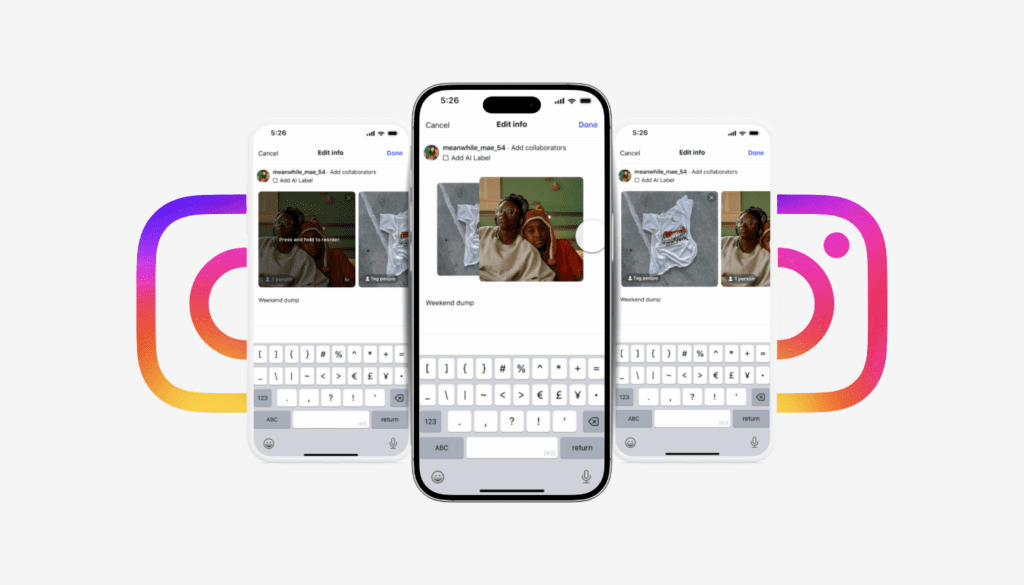
That long-standing rigidity is now beginning to soften. With the gradual rollout of a feature that allows users to rearrange carousel slides even after publication, Instagram introduces a quiet but meaningful shift in how content is expected to function. What was once treated as a static artifact begins to take on a more flexible, almost provisional quality, suggesting that publishing is no longer a definitive endpoint but rather the first step in an ongoing process of adjustment and interpretation.
From Static Posts to Living Content
The ability to edit a carousel’s sequence after it has been published subtly transforms the nature of the post itself, moving it away from the idea of a finished composition and closer to that of a living structure that can be reshaped over time. In this new context, content becomes less about getting every detail right at launch and more about responding to how it performs once it enters the feed.
This shift is particularly evident in the role of the opening slide, which has long functioned as the decisive hook determining whether a user pauses or scrolls past. With the possibility of rearrangement, that initial frame is no longer fixed; it can be replaced, repositioned, or reimagined in response to audience behavior, allowing creators to recalibrate their narrative without forfeiting the engagement already accumulated.
As a result, the creative process extends beyond publication, embracing a more iterative rhythm in which storytelling evolves in dialogue with performance rather than preceding it entirely.
A Platform Moving Toward Iteration
In enabling this kind of flexibility, Instagram appears to be aligning itself more closely with a broader performance-driven logic that has long shaped other areas of digital communication, particularly advertising, where campaigns are routinely launched, monitored, and refined in real time. By bringing a similar dynamic into organic content, the platform subtly encourages creators to adopt a mindset that privileges experimentation over perfection.
The pressure to produce a flawless sequence at the moment of posting begins to give way to a more fluid approach, in which content can be tested, observed, and adjusted as it circulates. This not only alters creative workflows but also redefines the relationship between creators and their audiences, as posts become less like finalized statements and more like evolving exchanges, shaped by patterns of attention and engagement.
What It Means for Brands and Editorial Storytelling
For brands, publishers, and media platforms, whose presence on Instagram increasingly relies on carousel formats to convey layered narratives, this development introduces a new level of strategic nuance. Content can now be structured with the expectation that it may be refined later, allowing teams to experiment with different narrative entries, reorder sequences to enhance clarity or impact, and adapt messaging as contexts shift.
In practice, this transforms editorial storytelling into a more modular exercise, where each slide functions as part of a system that can be reorganized without dismantling the whole. Headlines can be rethought, visual hierarchies adjusted, and narrative pacing recalibrated, all while preserving the engagement history that would previously have been lost in a repost.
Such flexibility encourages a convergence between storytelling and performance, dissolving the boundary that once separated creation from optimization and inviting a more continuous, responsive approach to content strategy.
A Shift With Lasting Impact
At first glance, the ability to rearrange carousel slides after publication may appear as a modest improvement, addressing a familiar frustration among users who have long navigated the platform’s constraints. Yet, beneath its practical utility lies a more consequential transformation, one that challenges the assumption that published content is immutable.
By loosening that constraint, Instagram is not merely refining a feature but reconfiguring the temporal nature of content itself, suggesting that what is shared need not remain fixed, and that meaning, structure, and impact can continue to evolve after the moment of release.
In an ecosystem increasingly defined by adaptability, performance, and sustained attention, this shift points toward a future in which publishing is less about finality and more about continuity, where the life of a post unfolds not in a single moment but across an ongoing process of refinement.