
A Stock Chart That Feels Like a Flashback
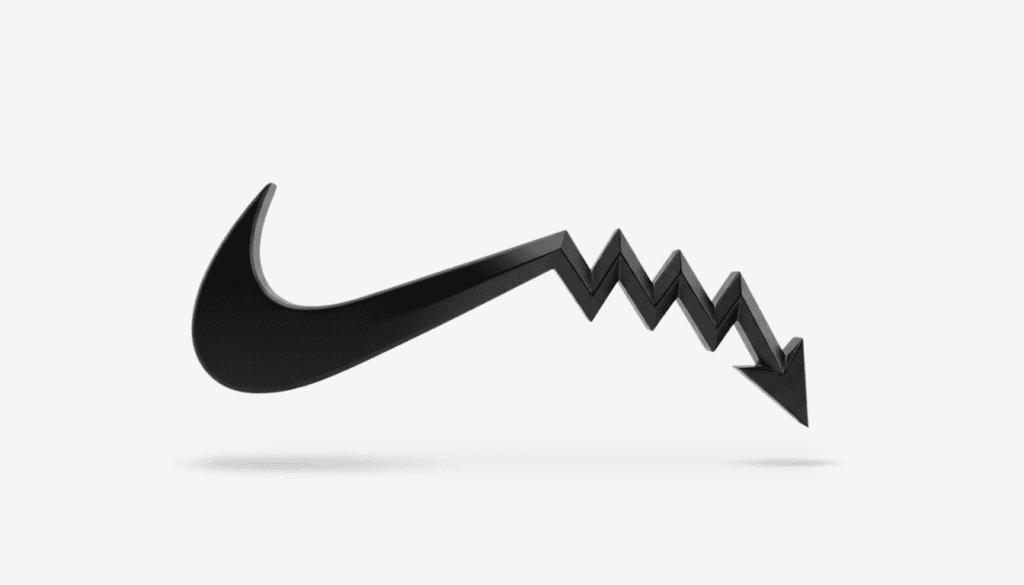
There are moments in the market when a chart stops behaving like a simple financial indicator and begins to read more like a narrative, and Nike’s recent trajectory increasingly feels like one of those cases, as the company’s shares, after climbing above $80 within the past year, have steadily retreated toward the low-$50 range, hovering just above a 52-week low near $52 and, in doing so, revisiting territory that has not been meaningfully touched since 2017.
What makes this movement particularly striking is not only the level itself, but the path taken to get there, as the decline has unfolded gradually yet persistently, erasing roughly a quarter of the stock’s value over the past twelve months and extending a longer arc of contraction from its 2021 peak above $165, a period during which Nike has seen both its valuation and market capitalization compress in ways that suggest not a momentary correction, but a more structural reassessment of its position.
Even in the short term, the pattern reinforces this sense of sustained pressure rather than episodic volatility, with recent weeks showing consecutive declines that pushed the stock from the high-$50s into the mid-$50s in a matter of days, a movement that, while not dramatic in isolation, becomes more telling when understood as part of a broader and uninterrupted downward rhythm.
The Pattern Beneath the Price
To understand why this chart resonates so strongly, it is necessary to look beyond the numbers themselves and consider the historical parallel they evoke, because what we are seeing today bears a notable resemblance to Nike’s position in 2017, when the brand, still powerful but increasingly challenged, found itself navigating a market that had begun to fragment, with competitors gaining both cultural traction and physical shelf space while Nike leaned heavily on familiar product franchises to maintain stability.
The similarity, however, lies less in the specific competitors and more in the underlying dynamic, as the current landscape is no longer defined by a single rival or even a dominant pair, but rather by a dispersed and increasingly specialized field of brands—ranging from Adidas to On, New Balance and Brooks—each of which has established a distinct and credible claim over particular segments of the category, whether performance running, lifestyle comfort or technical expertise.
In such an environment, market share is no longer lost in dramatic shifts, but instead erodes gradually across multiple fronts, creating a quieter yet more persistent form of pressure that is reflected not in sudden collapses, but in the slow recalibration of expectations that the stock now appears to embody.
When Growth Slows, and Doubt Accelerates
This recalibration becomes even more apparent when viewed through the lens of Nike’s financial performance, which, while far from catastrophic, reveals a business operating with diminishing efficiency, as modest revenue growth in the low single digits has been accompanied by a decline in earnings, suggesting that the company’s ability to translate scale into profitability has weakened at a moment when competition has intensified.
At the same time, Nike’s valuation remains relatively elevated, with a price-to-earnings ratio still above 30, a level that implies that, despite the decline, the market has not fully abandoned its expectations for recovery, thereby creating a tension between current performance and future belief that leaves the stock suspended in an ambiguous space—neither convincingly undervalued nor comfortably justified.
This ambiguity is precisely what amplifies volatility in sentiment, as evidenced by recent trading periods in which billions of dollars in market value were erased within days, not necessarily because of a single defining event, but because of a broader erosion of confidence that makes the stock more sensitive to incremental signals, both positive and negative.
The Real Crisis Is Not Financial
Yet to interpret Nike’s situation purely through financial metrics would be to miss the more consequential dimension of its current challenge, which is fundamentally creative and strategic, rooted in how the brand is perceived rather than simply how it performs, as its prolonged reliance on retro franchises—while undeniably effective in sustaining revenue—has gradually shifted its center of gravity away from innovation and toward preservation.
This shift is subtle but significant, because Nike’s historical authority has always been built on its ability to define what comes next in sport and culture, not merely to reintroduce what once worked, and as consumer preferences have increasingly favored brands that feel specialized, forward-looking and technically credible, the balance between heritage and progression has become more delicate, and, at times, more visibly tilted in the wrong direction.
What emerges, then, is not a brand in decline, but a brand in search of clarity, caught between the strength of its past and the uncertainty of its future, and operating in a market that is less willing than before to grant it the benefit of the doubt.
Belief at a Discount
And yet, even within this uncertainty, there remains a compelling counter-narrative, one that interprets the current moment not as a definitive turning point, but as a phase of peak skepticism, in which negative sentiment may have extended beyond the underlying fundamentals, thereby creating the conditions for a potential rebound should the company succeed in realigning its strategy.
There are early indications of such an effort, visible in renewed emphasis on performance categories, a recalibration of distribution through stronger wholesale relationships, and a broader attempt to restore coherence to the brand’s positioning, all of which suggest that Nike is not unaware of the challenges it faces, nor passive in responding to them.
Historically, the company has demonstrated an ability to navigate similar periods of doubt, leveraging its scale, cultural influence, and operational capabilities to reassert leadership. While those advantages remain intact, their effectiveness will ultimately depend on how convincingly Nike can translate them into a renewed sense of relevance.
Should We Still Believe in Nike
What the stock chart ultimately captures is not simply a decline in price, but a shift in perception, a movement from certainty to conditional belief, in which Nike is no longer assumed to lead, but instead required to prove that it still can.
This does not mean that belief should be abandoned, but rather that it must be reframed, as confidence in Nike today rests less on its historical dominance and more on its capacity to redefine itself within a market that has evolved beyond the structures that once secured its position.
In that sense, the answer to whether we should still believe in Nike is neither a straightforward affirmation nor a definitive rejection, but a recognition that belief itself has changed, becoming more measured, more contingent, and, ultimately, more demanding.
Because if Nike is to rise again, it will not be by default, but by demonstrating—once more—that it knows where sport, culture, and consumer desire are heading, and that it can lead them there.