
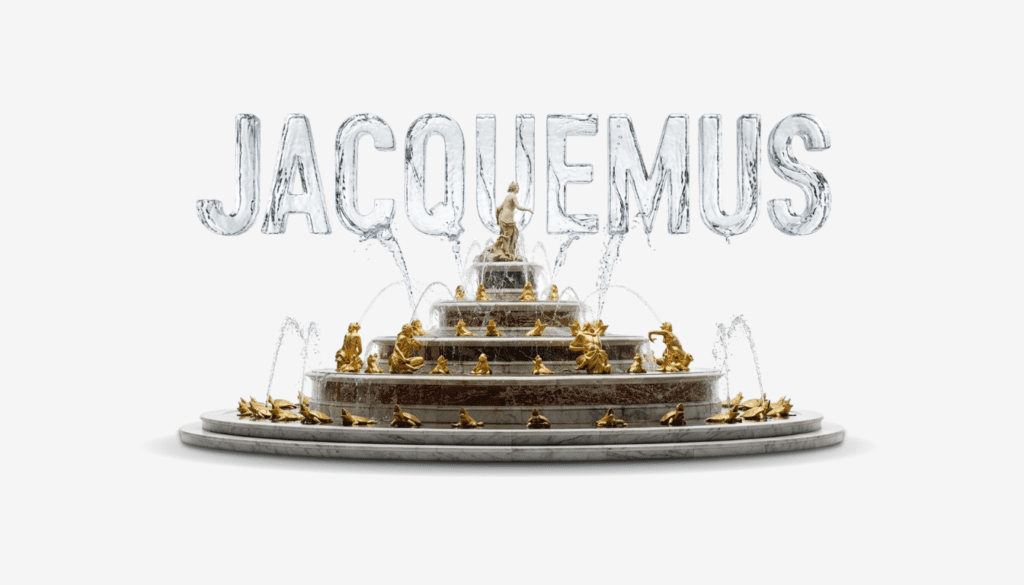
At a time when fashion marketing is increasingly defined by immediacy, spectacle, and the constant pursuit of relevance, Jacquemus has chosen a markedly different path—one that resists the urgency of the present in favor of something far more enduring. Its decision to finance the restoration of a historic fountain at the Château de Versailles does not conform to the familiar logic of campaigns; there is no product to anchor the narrative, no direct call to action, and no immediate return to quantify. Yet it is precisely within this absence of urgency that the move gains its significance.
Rather than seeking attention, the brand appears to be investing in permanence, shifting the role of marketing from a tool of visibility to an instrument of positioning. In doing so, Jacquemus signals that it is no longer interested solely in being seen, but in being situated—carefully, deliberately—within a broader cultural and historical continuum.
From Presence to Participation in Cultural Heritage
Versailles has long functioned as more than a setting; it is a symbol, deeply embedded in the imagination of luxury as an expression of power, artistry, and national identity. For decades, brands have been drawn to its visual authority, using its grandeur as a backdrop to elevate their own narratives, if only momentarily. Jacquemus, however, is extending that relationship beyond the ephemeral.
Having already staged shows within the palace grounds, the brand now moves into a more embedded role, contributing to the restoration of the site itself. This transition—from staging moments within culture to actively participating in its preservation—redefines the nature of the association. It transforms Versailles from a borrowed symbol into a shared project, allowing Jacquemus to position itself not merely alongside history but within its ongoing construction.
In the language of luxury, this distinction carries weight, as proximity may generate attention, but participation cultivates legitimacy.
Expanding the Identity of a Modern Brand
Jacquemus has, until now, been defined by a distinctive sensitivity to contemporary culture, blending personal storytelling with a visual language that oscillates between intimacy and spectacle. Its references to rural life, to memory, and to the landscapes of the South of France have been consistently filtered through a lens that feels both accessible and sharply attuned to the digital age.
Yet as the brand continues to grow—expanding its global reach, refining its distribution, and moving steadily upmarket—it faces a familiar challenge: how to retain its immediacy while acquiring the depth traditionally associated with luxury. The investment in Versailles suggests an answer not through reinvention, but through accumulation.
Rather than abandoning its identity, Jacquemus appears to be layering it, adding a dimension that speaks not only to cultural relevance but to cultural continuity. In doing so, it begins to bridge the gap between a brand of the moment and a brand that aspires to endure.
Patronage as an Assertion of Power
Throughout the history of luxury, patronage has long served as a discreet yet powerful form of communication, allowing brands to convey influence and permanence without resorting to overt messaging. By funding the restoration of a historical monument, Jacquemus aligns itself with this tradition, adopting a language that is less about declaration and more about implication.
This gesture does not operate as a campaign in the conventional sense, but as a signal—one that suggests stability, seriousness, and a capacity to exist beyond the cycles of fashion. It is a form of quiet power, where the absence of commercial intent becomes, in itself, a statement of confidence.
In this context, the act of restoration becomes symbolic, not only preserving the past but positioning the brand as an entity capable of contributing to its future.
A Narrative Shaped by Contrast and Continuity
What gives this move its particular resonance is the way it amplifies rather than disrupts Jacquemus’s core narrative. The brand has long cultivated an identity rooted in simplicity, personal history, and a sense of place that feels far removed from the formal codes of traditional luxury. Its imagery has often been defined by openness, light, and a certain rural intimacy.
To place this narrative in dialogue with Versailles—an emblem of opulence, structure, and historical grandeur—creates a tension that is both deliberate and generative. The designer who draws from the countryside now contributes to the preservation of one of France’s most iconic symbols of aristocratic power, and it is within this contrast that the brand finds a new dimension of meaning.
Rather than resolving this tension, Jacquemus appears to embrace it, allowing authenticity and aspiration to coexist and shape its evolving identity.
Investing in Time Rather Than Attention
Perhaps the most revealing aspect of this strategy lies in its temporal dimension. Unlike traditional marketing efforts, which are designed to capture attention within increasingly compressed cycles, this investment unfolds over years, aligning itself with the slow, cumulative nature of heritage.
By associating its name with the restoration of Versailles, Jacquemus anchors itself to a timeline that extends far beyond the lifespan of any single collection. This creates a form of symbolic permanence, reinforcing the idea that the brand is not simply reacting to culture but contributing to its longevity.
For a relatively young house, this approach carries particular significance, as it offers a way to construct a sense of heritage not through age, but through proximity—by embedding itself within institutions that embody continuity.
Toward a Strategy of Permanence
In the end, the restoration of a fountain serves as a gesture that transcends its immediate context, pointing instead to a broader shift in how Jacquemus conceives of its role within the industry. It suggests a brand that is no longer defined by its ability to capture the moment, but by its ambition to extend beyond it.
Through this move, Jacquemus signals that its trajectory is not oriented solely toward growth, but toward permanence, positioning itself as a participant in the cultural landscape rather than a transient presence within it. And in doing so, it reframes marketing not as a tool for visibility, but as a means of inscription—writing the brand, quite literally, into history.