
The Vocabulary That Lost Its Grip
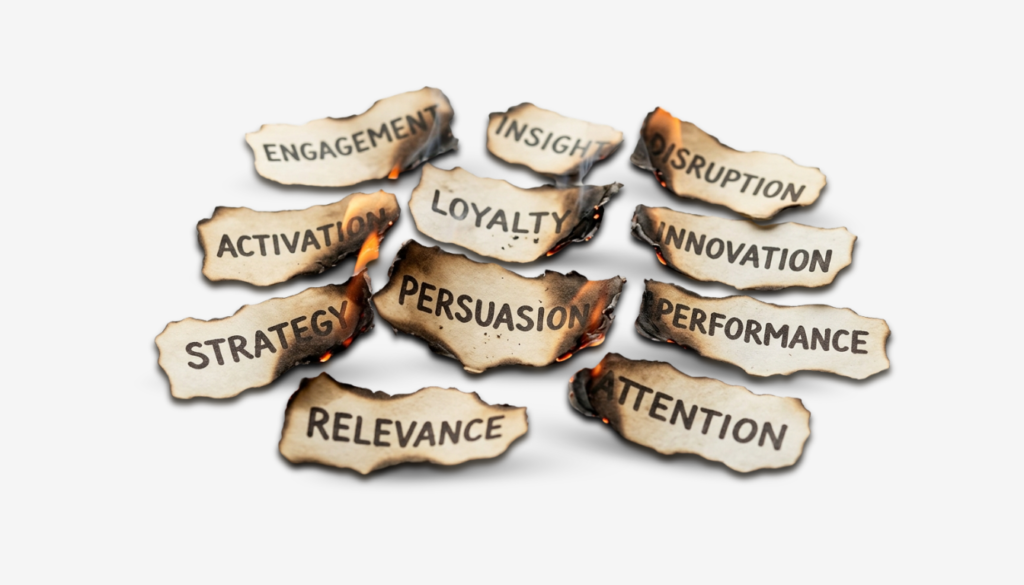
There was a time when the language of marketing functioned as a tool of precision, carefully shaped to describe how growth is generated, how people behave, and how brands influence decisions at scale; today, however, that same vocabulary increasingly feels untethered from the realities it was designed to capture, having been gradually reshaped not by accuracy but by aspiration, and in the process, transformed into a form of professional shorthand that sounds convincing in presentations while often obscuring the dynamics it claims to explain.
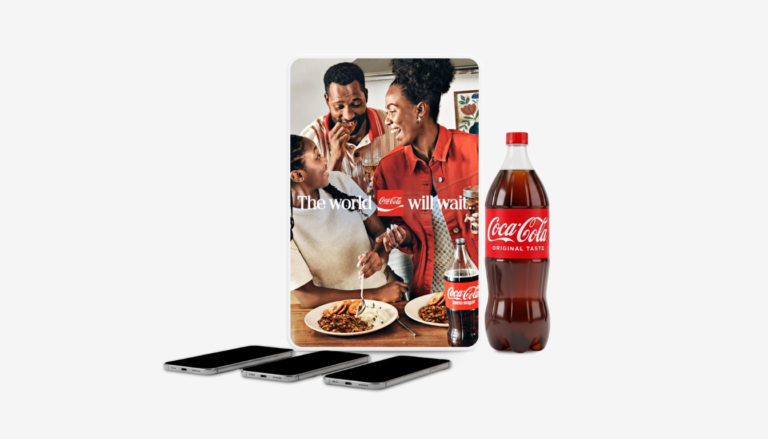
This shift becomes particularly evident in the way the industry has elevated its own outputs, most notably in the growing tendency to refer to advertisements as “films,” a choice of language that does more than signal creative ambition, as it subtly redefines the audience itself; a film is chosen, anticipated, and willingly consumed, while advertising, in most contexts, is encountered reluctantly, filtered through distraction, avoidance, or indifference, and it is precisely this difference that risks being overlooked when the terminology begins to blur the boundaries between entertainment and interruption.
Attention Is Not Guaranteed
The consequences of this linguistic drift extend far beyond creative positioning, shaping the very way attention is valued and measured across media, where the notion of an “ad break” continues to imply a moment of passive reception, despite longstanding evidence that viewers disengage precisely when commercials begin, turning what is priced as exposure into something far closer to absence.
Yet the industry continues to operate as if visibility equates to attention, assigning value to impressions without adequately accounting for whether they are seen, processed, or simply ignored, and in doing so, reinforces a system in which media investment is calibrated against a version of audience behavior that exists more in theory than in practice.
This same misalignment becomes even more pronounced in digital environments, where “engagement” has evolved into a central metric of success, despite the fact that likes, comments, and shares capture only a narrow and highly unrepresentative slice of audience behavior, often driven by a small minority whose actions are amplified far beyond their actual contribution to sales, while the overwhelming majority of buyers remain invisible within these frameworks, even as they continue to drive the outcomes that matter most.
The Performance of Activity
A similar pattern emerges in the growing prominence of “activation” as a strategic concept, where the emphasis on creating visible, tangible moments—whether through experiential installations, cultural partnerships, or social media executions—has led to a subtle but consequential conflation between activity and effectiveness, allowing the act of doing something to stand in for the achievement of something.
In this environment, campaigns are increasingly designed to signal momentum, relevance, and cultural participation, often generating internal validation and industry recognition, yet without necessarily translating into meaningful shifts in consumer behavior, as the visibility of effort becomes an end in itself, rather than a means to an outcome.
What begins as an attempt to make brands more dynamic ultimately risks reinforcing a performative model of marketing, in which success is measured by presence rather than persuasion, and where the optics of action take precedence over its impact.
The Myth of Emotional Bonds
At the same time, some of the most deeply embedded narratives within marketing continue to rely on assumptions that are far more aspirational than empirical, particularly in the case of “brand love” and “loyalty,” concepts that suggest a level of emotional attachment that, while intuitively appealing, rarely manifests at scale in real-world behavior.
Research developed over decades by institutions such as the Ehrenberg-Bass Institute has consistently demonstrated that purchasing patterns are less defined by devotion than by availability, habit, and context, revealing a marketplace in which consumers move fluidly between brands rather than committing to a single choice, and where loyalty, in its strictest sense, is the exception rather than the rule.
Within this framework, the role of marketing shifts in a fundamental way, moving away from the pursuit of deep emotional bonds toward the more pragmatic objective of ensuring that a brand is mentally and physically available at the moment of purchase, a goal that may appear less romantic but proves far more aligned with how growth actually occurs.
When Insight Becomes Assumption
Few terms better illustrate the erosion of meaning than “insight,” once reserved for rare, non-obvious observations capable of unlocking disproportionate growth, but now routinely applied to statements so broad and self-evident that they offer little in the way of strategic direction, effectively transforming what should be a moment of clarity into a procedural step.
As generalized observations are elevated to the status of insight, the consequences ripple through the entire creative process, shaping work that feels directionally aligned yet lacks the sharpness required to influence behavior, and ultimately contributing to campaigns that underperform while still appearing coherent within the internal logic that produced them.
In this way, language does not merely describe strategy—it begins to dictate it, creating a feedback loop in which weak premises generate weak outcomes, all while being reinforced by the same terminology that obscures their limitations.
The Misuse of Strategy Itself
Even foundational frameworks have not remained immune to this dilution, as concepts such as “full funnel” and “disruption” have gradually shifted from precise strategic tools into broadly applied descriptors, often used to signal comprehensiveness or ambition rather than to guide decision-making with discipline.
The theory of disruption, originally articulated with specificity by Clayton Christensen, has been expanded to encompass nearly any form of differentiation, while “full funnel” has come to imply simultaneous presence across every stage of the consumer journey, encouraging a dispersion of resources that can undermine focus rather than enhance it.
In both cases, the loss of definition weakens the frameworks themselves, replacing clarity with generality and making it harder for organizations to identify where and how growth can be unlocked effectively.
Rediscovering the Human Behind the Consumer
Beneath these shifts lies a more fundamental issue, rooted in the way the industry conceptualizes its audience, reducing individuals to “consumers” and, in doing so, narrowing its perspective to a single dimension of behavior, while overlooking the broader context of human experience in which decisions are actually made.
Consumption represents only a small fraction of people’s lives, yet marketing often treats it as the primary lens through which to understand them, producing profiles that focus disproportionately on brand interaction while neglecting the routines, motivations, and constraints that shape attention and choice.
A more grounded approach would begin by recognizing individuals as people first, whose engagement with brands is incidental rather than central, and whose decisions are influenced by a complex interplay of factors that extend far beyond the moment of purchase.
When Words Shape Outcomes
What ultimately emerges from this analysis is not simply a critique of terminology but a broader reflection on how language shapes the way marketing operates, influencing what is measured, what is valued, and what is ultimately optimized.
As words become more aspirational, they risk drifting away from the realities they were intended to describe, creating a system in which strategies are built on interpretations that feel coherent internally but fail to align with external outcomes, and where success is increasingly defined by the language used to describe it rather than by the results it delivers.
The challenge, then, is not to abandon these concepts, but to restore their precision, ensuring that they once again serve as tools for understanding rather than as substitutes for it, because when marketing loses sight of what its words actually mean, it does more than confuse its practitioners—it begins to operate within a version of reality that no longer reflects how growth truly happens.