
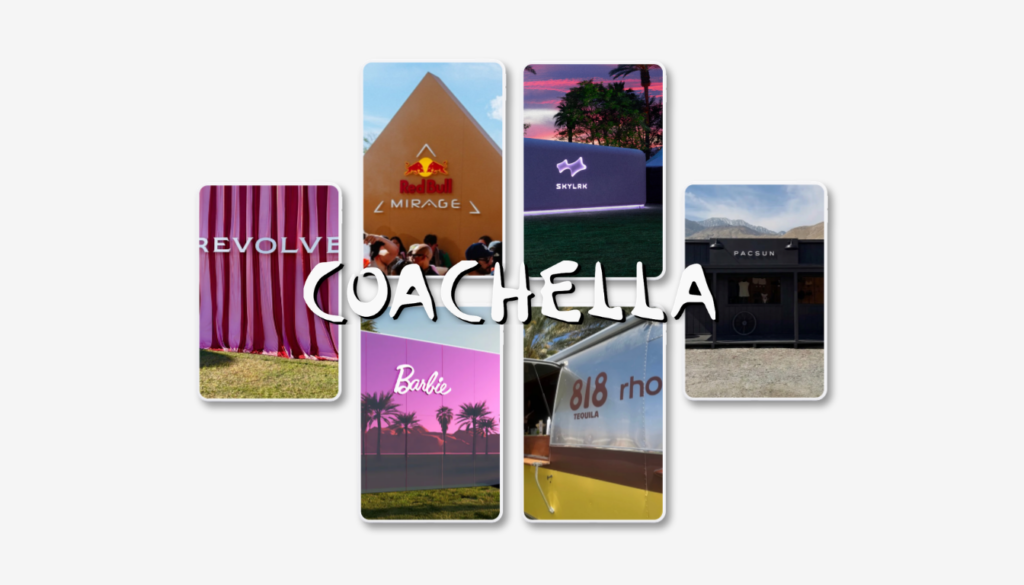
Coachella has long existed at the intersection of music and fashion, yet in 2026 that relationship evolved into something far more deliberate, as brands began treating clothing not as a complement to the experience but as a central mechanism for distribution. Across the desert, capsule collections replaced traditional merchandise with a more strategic ambition, designed to be worn but also to move fluidly across feeds, appearing in transitions, outfit reveals, and cinematic edits that extended the life of the festival well beyond its physical limits.
In this context, the most relevant question was no longer what brands built on-site, but what people chose to wear, because in a content-driven environment, visibility is increasingly determined by participation, and participation begins with what can be carried into the frame.
Revolve Designed the Festival Before It Happened
Among the brands present, Revolve offered perhaps the clearest illustration of this shift by defining the Coachella aesthetic in advance. Through a tightly orchestrated festival capsule composed of flowing silhouettes, metallic textures, cut-outs, and desert-toned ensembles, the brand effectively established a visual template that would later dominate social media, long before the first performances began.
By dressing a dense network of influencers attending its private festival, Revolve ensured that content was not only abundant but consistent, allowing “get ready with me” videos and outfit transitions to proliferate across TikTok in the days leading up to the event. What followed was less a spontaneous trend than a coordinated amplification, in which the aesthetic had already been normalized, and the broader audience simply adopted what had been predefined.
In doing so, Revolve demonstrated that in a landscape shaped by creators, controlling the wardrobe is, in many ways, controlling the narrative.
PacSun Won by Being Easy to Copy
If Revolve operated through aspiration and scale, Pacsun achieved visibility through a different, yet equally effective mechanism, rooted in accessibility and replication. Its capsule, built around relaxed streetwear staples such as oversized tees, coordinated sets, and desert-ready layering, was designed to be interpreted rather than followed, offering a flexible aesthetic that could be easily adapted by a wide range of creators.
This adaptability was reinforced by the brand’s activation, where details such as tooth gems, flash tattoos, and informal styling moments became recurring visual cues that extended far beyond the festival itself. On TikTok, these elements reappeared in countless variations, often recreated by users who had not attended Coachella, yet were nonetheless participating in its visual language.
Pacsun’s success, therefore, did not depend on exclusivity but on its ability to invite imitation, transforming a localized drop into a distributed cultural pattern that continued to evolve long after the weekend ended.
Barbie Turned Color Into a Content Shortcut
In contrast to both approaches, the Barbie capsule relied on an entirely different form of clarity, leveraging a highly recognizable visual identity that required little explanation. By centering its collection around saturated pink tones and playful accessories, the brand created a visual shorthand that performed exceptionally well in the fast-paced environment of TikTok, where recognition must occur almost instantly.
What made the strategy particularly effective was its balance between uniformity and personalization: attendees could adapt the aesthetic through charms, accessories, and styling choices while remaining within a cohesive framework. This allowed content to feel both individual and collectively aligned, reinforcing the brand’s presence with each variation.
In a setting dominated by neutral palettes, Barbie’s color-driven approach ensured that it was not only visible but memorable, illustrating how simplicity, when executed with precision, can outperform complexity.
SKYLRK Built an Aesthetic People Wanted to Live In
While other brands pursued immediacy, SKYLRK adopted a more restrained and atmospheric strategy, positioning its capsule within a broader narrative of calm and escape. Unlike competitors focused on instant trends, SKYLRK’s unique angle centers on evoking serenity and introspection, using earth-toned hoodies, minimal silhouettes, and understated branding. This approach aligns the label with a softer, more cinematic content style that has gained traction on TikTok, where slower pacing and mood-driven storytelling increasingly coexist with high-energy formats.
Worn during its Oasis activation, these pieces became part of a visual language defined by muted colors, ambient environments, and deliberate movement, offering a counterpoint to the festival’s intensity. Rather than competing for attention through volume, SKYLRK cultivated a sense of aspiration, producing content that invited viewers not just to observe, but to imagine themselves within the scene.
Although less immediately viral, this approach generated a different form of value, characterized by higher engagement depth and a stronger emotional connection.
818 Tequila Turned Merch Into Status
For 818 Tequila, Kendall Jenner’s brand, the capsule operated as an extension of exclusivity, where Western-inspired apparel and limited accessories became markers of access to one of the most sought-after social spaces of the weekend. Unlike more accessible collections, these pieces derived their appeal not only from their design but from the context in which they were worn, often appearing in content featuring celebrity appearances and tightly curated environments.
On TikTok, this translated into aspirational visibility, where the scarcity of both the product and the experience amplified curiosity and engagement. The value of the capsule was thus inseparable from the narrative surrounding it, reinforcing the idea that in certain contexts, desirability is driven as much by proximity as by aesthetics.
Red Bull Made Merch Part of the Moment
Even outside the traditional fashion space, Red Bull demonstrated an acute understanding of how capsules can function within a live environment, introducing limited merchandise tied to specific moments within its Mirage activation. By linking drops to DJ sets and time-based experiences, the brand transformed its products into temporal artifacts, each item carrying with it the memory of a particular event.
This approach added a layer of immediacy to the consumption process, encouraging attendees not only to acquire the product but also to document the moment they obtained it. The resulting content, often centered around crowd energy and real-time reactions, reinforced the connection between presence and participation.
In this way, Red Bull extended the concept of a capsule beyond design, embedding it within the festival’s rhythm.
Why These Capsules Drove the Most Buzz
These diverse strategies reflected a shared understanding of digital culture: products must act as both objects and signals. Each successful capsule played a unique role—establishing an aesthetic, enabling replication, simplifying recognition, cultivating aspiration, reinforcing exclusivity, or embedding itself in live moments.
Rather than competing directly, these approaches complemented one another, collectively shaping the visual and narrative landscape of Coachella 2026. In doing so, they revealed that a capsule’s effectiveness is not determined solely by its design, but by its ability to integrate seamlessly into the behaviors that drive content creation and consumption.
The Future of Festival Marketing
As the festival continues to evolve, it becomes increasingly evident that fashion, particularly in the form of capsule collections, has moved from the periphery to the center of cultural influence. By placing products directly in attendees’ hands, brands have transformed audiences into active participants, allowing them to express, adapt, and amplify their identities across platforms.
Coachella 2026 demonstrated this shift, showing that the most powerful marketing does not interrupt but equips the experience, providing tools for culture to be created and shared. In a landscape where every moment can travel, brands that succeed will understand not only how to be seen, but how to be worn.