
The Day Ferrari Shares Fell
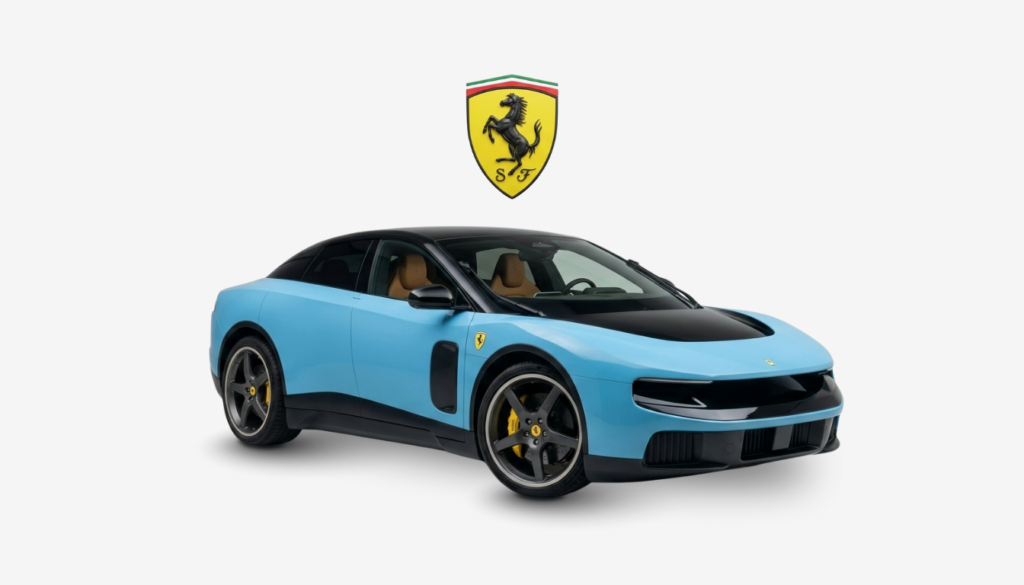
On May 25, Ferrari unveiled the Luce — its first fully electric vehicle. A liftback sedan designed by Jony Ive, priced at $640,000, powered by quad motors producing 1,113 horsepower. Five years in development. CEO Benedetto Vigna called it “a very, very important day.”
The market’s verdict arrived almost immediately. Ferrari shares fell sharply. One analyst described it as “the furthest deviation from the brand’s ethos we’ve ever seen.” On social media, the consensus crystallized around a single observation: it looks like a vacuum cleaner.
Stock markets do not typically crater over design choices. They crater when they sense potential brand damage. And what the Luce’s reception signals — before the car has been driven, before a single unit has been delivered, before any long-term data exists — is that investors and consumers read the same thing in the car’s design and reach the same conclusion. The Luce is not a Ferrari. And that is a problem that 1,113 horsepower cannot fix.
What Made It Wrong
The specific failures of the Luce’s launch are worth enumerating because they accumulate into something larger than any single misstep. The car is a liftback — a five-seater, Ferrari’s first. Its silhouette is gentle, with none of the low-slung aggression that has defined the brand’s visual language across decades. It was presented in light blue. The Prancing Horse logo is barely visible. The name itself — Luce, Italian for light — carries the weight of poetry and philosophy rather than the declarative force of Ferrari’s historical naming conventions: F40, F430, 812 Superfast, Superamerica. Those are names that announce themselves. Luce is a name that reflects.
Vigna argued that the new technology required that the design “must be different.” This reasoning is backward. When a brand enters new territory — a new product category, a new technology platform, a new audience — the case for leaning harder into its established visual codes becomes stronger, not weaker. The brand’s distinctive assets are exactly what give the audience a bridge between what they know and what they are being asked to accept. Strip those assets away at the moment of maximum novelty, and you leave the audience with nothing familiar to anchor the new thing to. The result is confusion, and confusion in a brand built on absolute clarity of identity is experienced as a threat.
The Brands That Got This Right
The contrast with how other prestigious brands have handled category expansion is instructive. When Hermès moved into ready-to-wear decades ago, the temptation to soften its equestrian heritage and appeal more broadly to mainstream fashion audiences must have been real. Instead, it leaned into that heritage with unusual force — hosting runway shows at the Garde Républicaine, the historic barracks of the French military cavalry, sending models down the runway in jodhpurs and harnesses, and keeping the Camargue as a visual organizing principle. The result was clothing that was unmistakably Hermès, sold to people who valued that specificity precisely because it had not been diluted.
Apple’s Watch launch in 2015 offered a similar test. An entirely new product category, designed for an audience broader than Apple’s established base, with every reason to drift toward generic wearable aesthetics. Instead, the Watch emerged as a minimalist object with clean display design, careful typography, and thoughtful attention to reduction — undeniably Apple in its every detail, sold in an Apple box. Burberry brought the trench coat and the Nova check into Minecraft rather than stripping its digital activations of heritage. Each of these brands understood the same principle: when you are doing something new, your distinctive assets matter most. They are what anchor your existing audience to the unfamiliar.
The Jaguar Parallel
The comparison that has followed the Luce since its unveiling is to Jaguar, which in late 2024 announced an electric-first future and simultaneously shed nearly every visual element that had made Jaguar immediately, unmistakably Jaguar: the distinctive silhouette, the established logo, the design language that had accumulated meaning over nearly a century. The reasoning was the same as Ferrari’s — a fresh start for a new era, unburdened by heritage. The response was also the same: widespread confusion and contempt, a rebrand that read as erasure rather than evolution.
Ferrari has made the same error. The Luce should have screamed Ferrari even as it communicated something new about batteries, range, and the brand’s relationship to the electric future. The silhouette should have been instantly lean and recognizable. The presentation should have been drenched in red. The Prancing Horse should have been impossible to miss. The name should have carried the declarative confidence of a brand that has nothing to prove and everything to affirm. And the first fully electric Ferrari, above all, should have been a sports car.
Instead, it is a five-seat liftback named after light. The consumers who rejected it did not reject the fact of electrification — that would be an absurd position for a luxury buyer in 2026. They rejected the fact that the car doesn’t look or feel like what Ferrari is. And when a brand as codified, as iconic, as emotionally loaded as Ferrari produces something that fails that test, the market notices before the focus groups do.