
The Announcement That Rewrites the Social Contract
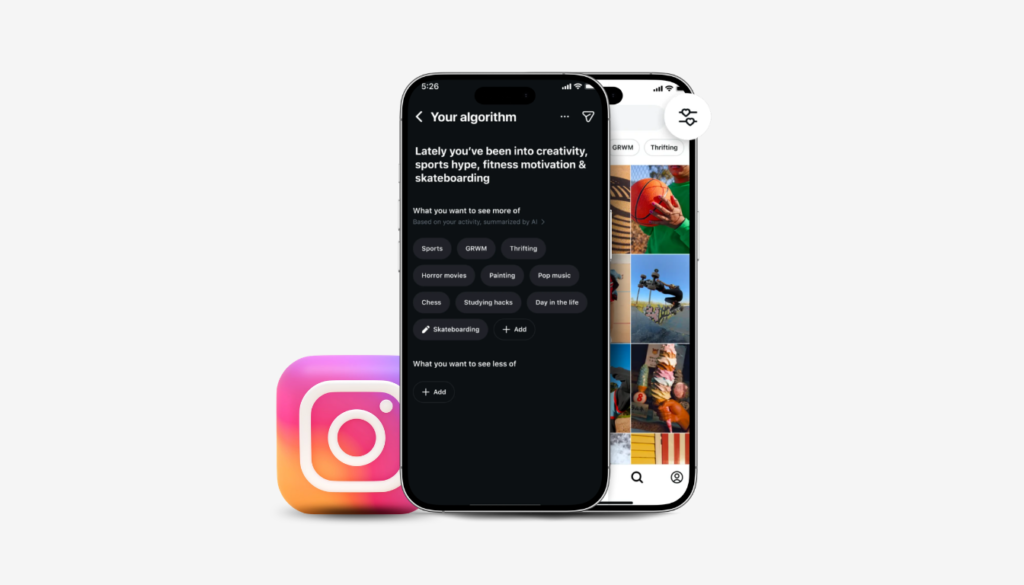
In October 2025, Adam Mosseri posted on Threads with an unusually direct acknowledgment embedded in it: Instagram was starting to test a feature that would let users tune their own algorithm by adding and removing topics based on their interests. “We want people to have more control over their Instagram experience,” he wrote, “and hope this will be a meaningful new way to shape what you see.” The feature launched for Reels first, expanded to Explore in April 2026, and is now rolling out to the main feed — completing a journey that began as a beta test and has become one of the most structurally significant changes Instagram has made to its recommendation architecture in years.
The feature is called “Your Algorithm,” and its mechanics are simple in design and consequential in implication. A dashboard — accessible through Settings, then Content Preferences, or through the controls button in the Reels tab — shows users the topics that Instagram has inferred they care about based on their behavior on the platform. Film photography. Skincare. AI tools. Architecture. Each topic is displayed with a toggle. Users can turn off any topic they are tired of seeing, add topics they want more of, and prioritize up to three areas as their primary interests. The result is a feed shaped by explicit preference rather than purely by behavioral inference — by what users say they want, not only by what the algorithm has decided they respond to.
Why This Is a Bigger Deal Than It Sounds
Social media platforms have, since their inception, operated on a fundamental asymmetry: the platform decides what you see, and your behavior — what you click, how long you watch, what you share — is the signal it uses to refine that decision. Users have had no direct input into the logic. They have influenced it indirectly, by engaging more with some content and scrolling past other content, but they have never been able to tell the platform what they want in explicit terms. The platform has always inferred. It has never asked.
“Your Algorithm” is the first time Instagram has meaningfully broken from that model — and Mosseri’s own framing of it reveals something about what prompted the shift. In public statements accompanying the feature’s rollout, he acknowledged that AI-driven recommendations had “quietly eroded users’ sense of control” over what they were seeing. That admission is notable for a platform executive. It is a concession that the optimization logic that has driven Instagram’s recommendation system — maximize engagement, maximize time spent — produced outcomes that users experienced as loss of agency rather than gain in relevance. The feature is, in part, a correction.
The correction also responds to a regulatory environment that has been moving aggressively toward mandating user control over algorithmic content. The EU’s Digital Services Act, which came into full effect in 2024, requires major platforms to provide users with at least one recommendation option that is not based on profiling. Australia’s online safety legislation has focused attention on algorithmic influence over minors. The UK’s Online Safety Act has similar provisions. Instagram’s decision to build a user-facing topic control system is commercially rational in this environment — giving users explicit control is preferable to being mandated to do so on regulatory terms.
What It Changes for Creators and Brands
The implications of “Your Algorithm” for anyone creating content on Instagram — whether an individual creator, a brand account, or a media publisher — are structural and immediate. The most significant shift is that Instagram is now surfacing content based on a combination of behavioral inference and explicit user preference, and the explicit preference layer can override the behavioral signal. A user who has been algorithmically associated with fitness content because they watched several workout videos while procrastinating can now actively remove that topic and replace it with something that more accurately reflects their actual interests. Their feed shifts accordingly — and the content that had been reaching them through the old inference is no longer reaching them at all.
For creators, the consequence is that niche clarity has never mattered more. A creator whose content spans multiple unrelated topics is now at direct risk of being turned off by users who are interested in only one of those topics — and with “Your Algorithm,” those users now have a direct mechanism to do exactly that. Mosseri himself has pointed to this in his public guidance: the accounts that will thrive in the topic-control era are the ones whose content is specific enough to be clearly categorized, and whose audience knows exactly what to expect when they open the app. The premium on niche definition is not new, but the mechanism that enforces it has become more explicit.
For brands, the opportunity embedded in the feature is that users who add a topic category to their preferences are, effectively, raising their hand. They are telling Instagram — and therefore telling advertisers operating through Instagram’s ad system — that they want content in that category. A user who adds “sustainable fashion” or “home renovation” or “specialty coffee” to their topic preferences is a pre-qualified audience whose interest has been stated, not inferred. The advertising signal quality of that explicit preference is substantially higher than behavioral inference, and brands whose categories align with the topics users are actively adding will benefit from the enriched targeting data the feature generates.
The Honest Tension Underneath the Feature
The comments on Mosseri’s October 2025 Threads announcement were instructive about where the feature falls short of what users actually want. “A chronological feed seems to be the big item everyone wants,” read one of the most-liked replies. “I want to be able to turn off all AI content,” read another. The appetite for user control that “Your Algorithm” is responding to is real and deep — but the specific form of control the feature provides is not the same as the control users are most consistently requesting, which is the ability to see content from the accounts they follow, in the order it was posted, without algorithmic mediation.
“Your Algorithm” does not provide that. It adjusts the topic weighting of the recommendation system without changing the fundamental logic of the recommendation system itself. Users who want to see less fitness content and more architecture content will get that. Users who want to see their friends’ posts in chronological order will not. The feature is a meaningful improvement in the user experience of an algorithmically curated feed. It is not, and was never intended to be, an alternative to algorithmic curation.
That distinction matters for how the feature will ultimately be received and used. The users most likely to actively engage with “Your Algorithm” are the ones who have developed a sophisticated enough relationship with Instagram to understand how the algorithm shapes their experience and who want to refine rather than replace it. For the broader user base, the feature may remain largely invisible — one more settings option that exists but is never opened. The challenge Instagram faces is the same one it has always faced with privacy and control features: making the tools legible and accessible enough to be genuinely useful to the users who would benefit from them, rather than leaving them buried in menus that most people encounter only by accident.