
A Final With Only One Winner Off the Pitch
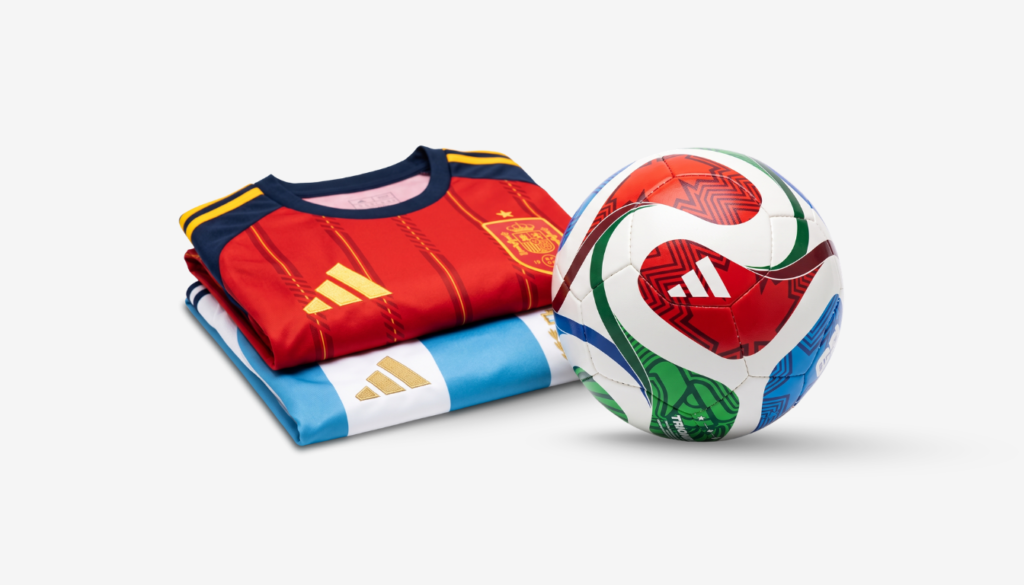
Spain defeated Argentina 1-0 at New York New Jersey Stadium on July 19, with substitute Ferran Torres striking in the 106th minute to give La Roja its second World Cup title. For Adidas, the scoreline was decoration. Both teams walked onto the pitch wearing the three stripes, an outcome the German company had been positioning toward for years and one that removed sponsorship risk from the most-watched match in world sport.
That structural advantage deserves examination. Adidas outfitted 14 federations at this tournament, including co-host Mexico, Argentina, Spain and Germany. Nike supplied a larger share of individual players through boot deals, covering roughly 43% of athletes on the pitch, but the shirt is where the money sits. Jerseys are what fans buy, and jerseys carry federation logos rather than footwear logos. By reaching the final with two of its own federations, Adidas guaranteed the retail moment regardless of the result.
The Numbers Behind the Stripes
Chief executive Bjørn Gulden now expects World Cup-related revenue of roughly €1.5 billion, about $1.7 billion, landing at the top end of the company’s earlier guidance. Jersey sales across the tournament ran four times higher than at Qatar 2022. Official match ball sales, led by the Trionda, doubled over the same comparison.
Those figures land against a first quarter in which Adidas already reported Performance revenues up 29% on a currency-neutral basis, with football, running and training each growing double digits. The World Cup did not create the momentum. It compounded it.
Market share data tells the same story in sharper terms. According to M Science, Adidas footwear market share climbed from 16% to 19.2% during June alone, the tournament’s opening month. Nike shares have lost roughly a third of their value since the start of the year.
The Best-Selling Shirt Was Not a Finalist
Here is the detail marketers should sit with. The top-selling jersey among the 14 Adidas federations was neither Argentina nor Spain. It was Mexico, the co-host, with Gulden estimating sales above three million units. Argentina and Germany are each projected to clear three million as well, and German shirt sales ran roughly three times higher than in 2022 despite the team’s early exit.
That distribution undercuts a common assumption about sponsorship value. Deep tournament runs matter, but proximity to the audience matters more. Mexico sold because tens of millions of fans across North America had a home team, not because Mexico won. Germany sold because Adidas is a German company selling into a German market with a national ritual attached, even after elimination. Adidas loses the German federation to Nike in 2027, which makes this cycle the last one where that particular asset works in its favor.
Portfolio Beats Star Power
Nike concentrated its football marketing around individual talent, leaning on Kylian Mbappé, Erling Haaland and Cristiano Ronaldo. Adidas countered with Lionel Messi and Lamine Yamal but built its position on federation contracts rather than athlete contracts.
The difference is exposure. An athlete deal delivers value only while that athlete plays and performs. A federation deal delivers value to every fan of that country whether the team advances or not, and it survives injury, poor form and elimination. Adidas held 14 of those contracts and needed only a handful to convert. Spain and Argentina both converting was the ceiling outcome; Mexico’s numbers show the floor was already high.
Combined, Nike and Adidas supplied more than 92% of players at the tournament, leaving little space for challengers. Even so, Skechers gained visibility through Harry Kane, while New Balance and Mizuno held narrow positions among specialist audiences. The category is concentrated, and concentration favors whoever can guarantee presence rather than bet on outcomes.
What This Means for Brands Without a Federation
Most marketers will never buy a World Cup kit deal. The transferable principle concerns how sponsorship risk is structured, not football.
Adidas built a portfolio wide enough that no single result could damage the return. Nike built one deep enough that a single Mbappé or Ronaldo moment could dominate the conversation, though any one of those moments could also fail to arrive. Both are legitimate strategies. Only one of them removes variance.
The second principle concerns product readiness. Adidas flagged supply and transportation problems before the tournament and stated in April that it had most product in market. Demand spikes during live sport are measured in hours, not weeks, and inventory that arrives after the final whistle earns nothing. During Qatar 2022 the company ran short on Argentina shirts at precisely the moment demand peaked. This cycle it did not repeat the error.
The third is that the tournament is not the campaign. Adidas is already channeling the result into a broader media overhaul, and Gulden’s guidance suggests the company treats this as a share-taking window against a weakened competitor rather than a one-quarter revenue event. Sponsorship pays when the brand has somewhere to send the attention afterward.