
A Volume Quarter That Ended a Long Argument
Unilever posted underlying sales growth of 5.8 percent in the second quarter, with 5.5 percentage points of that coming from volume rather than price. The company has not recorded a quarterly volume figure that strong since 2010. For the first half, underlying sales rose 4.8 percent to 25.6 billion euros, and management raised its full-year volume target to roughly 3 percent from 2 percent, telling investors it now expects to finish inside its 4 to 6 percent growth range rather than at the bottom of it.
Markets responded within hours. Shares climbed as much as 6.8 percent to 49.43 pounds in early London trading on Tuesday, on pace for the stock’s strongest single session in two years after a 16 percent slide since the start of the Iran conflict.
The split between volume and price is where the marketing lesson lives. Price-led growth is borrowed from the consumer, who eventually notices the shelf and trades down. Volume-led growth means more units leaving more stores, which is the only reading that confirms demand rather than pricing power. Unilever delivered the harder version at a moment when household budgets across its largest markets are under visible strain.
The Line Item Behind the Number
Unilever spent 16.1 percent of its second-quarter turnover on marketing. Chief Financial Officer Srinivas Phatak told investors on the earnings call that the era of underinvesting in the business was over.
That statement carries history. The supply chain crunch and raw materials inflation that followed Russia’s invasion of Ukraine compressed Unilever’s ability to fund brand building, and volumes eroded for years as a direct consequence. The company has spent the period since rebuilding the budget rather than optimizing around its absence. This quarter is the first clean read on what that money bought.
Marketers arguing for budget protection now have an unusually clean data point. Unilever did not grow by cutting support and harvesting equity. It grew by putting a sixth of its revenue behind fewer, larger brands and letting the investment compound.
Concentration Beat Proliferation
Power brands now account for 78 percent of turnover and grew 6.9 percent in the quarter, with 6.8 points of that from volume. Fifteen of the thirty brands in that group posted double-digit growth. The portfolio is doing more with fewer names, which is the opposite of the long-tail logic that governed consumer goods for a decade.
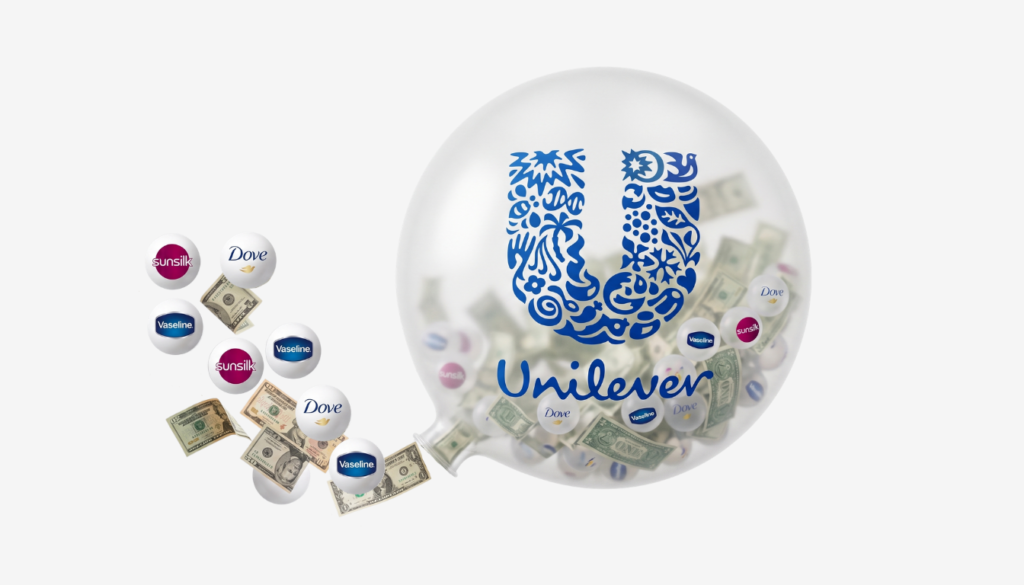
Beauty and Wellbeing rose 5.9 percent to 6.5 billion euros, carried by double-digit growth at Dove, Sunsilk and Vaseline alongside strength in the prestige portfolio that includes Dermalogica, Paula’s Choice and Tatcha. Personal Care grew 4.8 percent to 6.8 billion euros, with 4.1 points from volume. Home Care advanced 7.6 percent, almost entirely on volume, led by India and Brazil.
The pattern repeats across divisions. Where Unilever concentrated spending and innovation, volume followed. Where it spread thin, growth stayed flat. Europe was the clearest laggard, and the company attributed that to subdued market conditions rather than execution, though the contrast with emerging markets is hard to ignore.
The World Cup Was a Distribution Play
Unilever served as the official personal care sponsor of the 2026 FIFA World Cup, and the company credited World Cup campaigns and activations for part of the mid-single-digit growth in skin cleansing and deodorants during the second quarter.
The structure of that sponsorship matters more than its existence. Unilever tied the property to specific product launches, notably Dove premium innovations, and to retail activation in the markets where the tournament commanded the most attention. The logo purchase was the smallest part of the investment. Brands that treat global sports rights as awareness media rather than as a distribution and merchandising trigger tend to report reach and little else. Unilever reported units.
For any marketer weighing a cultural moment, the test is whether the property connects to a shelf. A sponsorship that ends at the broadcast is an expense. One that arrives with new products, in-store presence and market-specific creative becomes a sales channel.
What the Result Does Not Prove
Currency worked against the company all half. Turnover rose only 0.5 percent to 25.6 billion euros despite 4.8 percent underlying growth, which means the reported figures flatter the operating story less than the underlying ones do. Chief Executive Fernando Fernandez, appointed last year to accelerate the turnaround, acknowledged that the macroeconomic environment remains uncertain even while raising guidance.
The portfolio is also mid-surgery. Unilever has spun off its ice cream division and is working toward a pure-play home and personal care structure, with a proposed combination of its foods business with McCormick still in progress. Comparisons over the next several quarters will be noisy for reasons that have nothing to do with brand performance.
Still, the direction is legible. Unilever expects underlying sales growth of 4 to 5 percent in the second half and a modest improvement in operating margin against the 20 percent it recorded in 2025. Margin expansion alongside a 16 percent marketing ratio undercuts the standard finance argument that brand investment and profitability trade against each other. In this half, they moved together.