
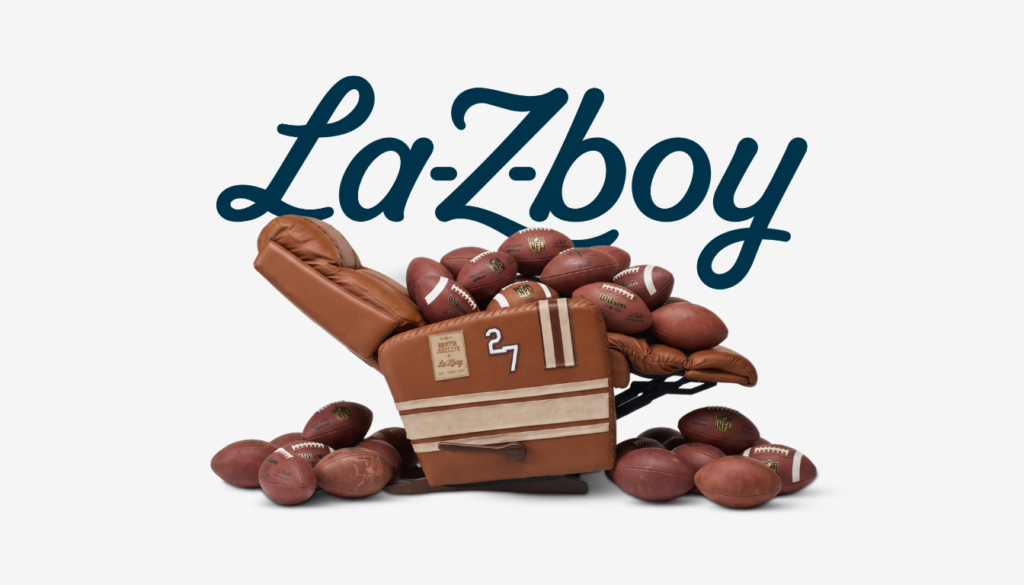
A Chair Made of Jerseys
La-Z-Boy launched a campaign on Tuesday built around a single object. The Jer-Z-Boy is a bespoke recliner upholstered in a football fan’s own jerseys, designed by Kristin Juszczyk, the fashion designer whose hand-cut NFL apparel became a fixture of game-day coverage after Taylor Swift wore one of her pieces.
Three winners will receive a custom chair and 1,000 dollars in La-Z-Boy store credit. Entries close September 14, five days after the NFL season opens. Entering online counts once. Visiting a participating store counts five times.
At the center of the work is a 60-second film directed by Mick Kelleher and produced by Spark and Riot, in which Juszczyk searches for the perfect game-day chair, fails to find one, and builds her own out of her jerseys. The story continues across social with behind-the-scenes footage and close looks at the upholstery. Colle McVoy, La-Z-Boy’s agency of record and part of the DonerColle alliance within Stagwell, built the campaign.
The Insight Is Behavioral, Not Demographic
Most category-entry campaigns start with an audience. This one started with a habit.
A survey of sports superstitions found that half of football fans wear their team’s jersey while watching, 44 percent do not wash it all season, and 42 percent have to sit in the same place. The campaign takes the second and third findings and welds them together. If the jersey is sacred and the seat is sacred, the product is the seat made of the jersey.
That is a sharper starting point than the standard sports marketing brief. La-Z-Boy did not buy a league sponsorship or a broadcast package. It identified a ritual its product already participates in and made the participation literal. Fans were already sitting in the same chair every Sunday. The brand named the chair.
The commercial logic underneath is the newer part. Women now make up 47 percent of the NFL fanbase, and more than 78 percent of avid NFL households include a woman watching over 18 hours of games a season. Furniture purchasing decisions in those households are not incidental. A brand chasing younger buyers found an audience that is growing, underserved by football marketing, and already making the category decision.
Timing Is Doing Half the Work
The campaign launched July 28, ahead of National Lazy Day on August 10, and runs through a Labor Day promotional window closing September 7, with the sweepstakes deadline landing a week into the season.
That calendar is not decoration. Furniture retail lives on holiday weekends, and Labor Day is among the largest. Football season delivers the longest annual stretch of hours Americans spend sitting still. La-Z-Boy has aligned a cultural campaign, a manufactured brand holiday and a promotional retail period into one continuous window, with the sweepstakes acting as connective tissue across all three.
The five-bonus-entries mechanic for in-store visits is the part most worth copying. It converts a social-first campaign into measurable foot traffic, which is the metric that matters for a retailer operating its own gallery network. Brand campaigns that end at engagement leave that value on the table, and the fix costs nothing beyond a line in the entry rules.
Borrowing Relevance Without Borrowing Trouble
La-Z-Boy invented the recliner in 1927. It carries the recognition and the baggage of a brand that old, which is why its recent marketing has worked so hard on the age problem. A 2025 identity refresh by the same agency, the brand’s first in 22 years, repositioned comfort as a lifestyle rather than a product feature. Before that, a campaign built around Kristen Bell aimed at introducing the company to younger furniture shoppers.
The Juszczyk collaboration extends that arc using a mechanism older brands frequently get wrong. Rather than adopting the aesthetic of a younger culture, La-Z-Boy invited a practitioner of that culture to apply her craft to its product. The chair remains a La-Z-Boy recliner. The upcycled construction and the jersey sourcing are hers. Neither party pretends to be the other.
That distinction separates a collaboration from a costume. Heritage brands that reskin themselves in borrowed visual language tend to read as anxious. Brands that hand their actual product to someone with cultural authority and let the result be unusual tend to read as confident.
What Limits It
The campaign is a sweepstakes for three chairs. Nothing in it is purchasable, which caps the direct commercial return and places the full weight on earned attention and store visits. Whether the in-store entry mechanic converts browsing into buying is the question the results will answer, and it is the only question that matters for a retailer with this much fixed square footage.
There is also a repeatability problem. The idea works because the jersey carries emotional weight almost no other garment does. La-Z-Boy has found a durable annual platform in football, but the specific insight does not port to another season or another category. The follow-up will be harder than the launch.
Still, for a 99-year-old furniture company, entering the most crowded marketing season on the American calendar with an object people want to photograph is not a small result.