

The Promotion Nobody Prepares For
The career path in creative work has a structural flaw that the industry has never fixed. People enter it to make things. If they make things well enough, they are promoted into a job that consists mostly of not making things, and instead of building the work, they build the conditions for other people to build it. Almost nobody receives training for that transition.
Glen Scott, chief creative officer and Seattle office lead at VML, described the shift in ADWEEK as the hardest pivot in advertising outside of landing a first job, and noted that the industry does a poor job preparing creatives for it. His own approach was to observe managers around him, learning as much from the poor ones as the good ones, and then to read his way through the gap.
The honesty in that account is worth pausing on, because the alternative narrative is more common. Agencies tend to treat the creative director promotion as recognition rather than as a career change, which allows everyone to avoid the fact that it requires a different skill set entirely.
The Cost Shows Up in the Data
The pattern extends well past advertising. DDI’s Global Leadership Forecast 2025, based on responses from 10,796 leaders across more than 50 countries, found that 71 percent of leaders report significantly higher stress since taking their current role, up from 63 percent in 2022. Of those under elevated stress, 40 percent have considered stepping away from leadership entirely.
The mechanism behind that number is instructive for creative organizations specifically. Only 19 percent of managers in the study reported strong delegation skills, the capability most directly associated with reducing burnout. Delegation is precisely the behavior that a promoted maker finds hardest, because handing work to someone who will execute it less well than you would feels, in the moment, like a failure of standards rather than an act of leadership.
The organizational consequence is a pipeline that thins from the middle. Senior creatives who cannot delegate become bottlenecks, junior creatives stop growing because the interesting decisions never reach them, and the agency loses both groups within a few years of each other.
A Reading List That Functions as a Curriculum
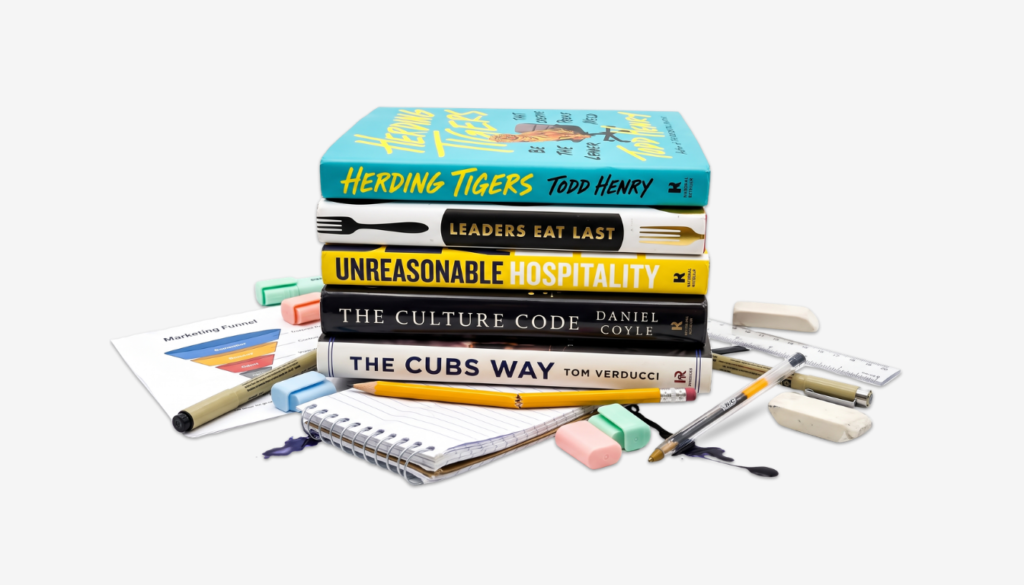
Scott’s answer was a shelf, and the five titles he returns to form a coherent progression rather than a random stack.
Todd Henry’s Herding Tigers addresses the identity problem directly, which is what happens when a maker becomes the person responsible for other makers. Simon Sinek’s Leaders Eat Last covers the psychological contract underneath a team, and why people produce their strongest work for leaders who absorb risk on their behalf. Will Guidara’s Unreasonable Hospitality is not a management book at all, but a book about service, which turns out to describe the largest part of the job once the making stops.
Daniel Coyle’s The Culture Code deals with the environment rather than the individual, and its central argument is that culture is produced by small repeated behaviors instead of by stated values. Tom Verducci’s The Cubs Way, ostensibly a baseball book, is a case study in assembling a roster where individual strengths are matched to specific assignments and where good outcomes take longer than anyone finds comfortable.
Read in sequence, they move from self, to team, to service, to culture, to composition. That is a reasonable curriculum for a job most people learn by improvisation.
From Making to Enabling
The deeper difficulty is not skill acquisition. It is a change in where satisfaction comes from. A creative who has spent a decade deriving professional identity from the quality of their own output has to start deriving it from the quality of other people’s output, and there is no obvious feedback mechanism for the second one. Awards go to the work. Credit goes to the team. The manager’s contribution is visible mainly in its absence.
That reorientation takes longer than any training program allocates, and it explains why so many creative leaders default to one of two failure modes. Some never let go, rewriting their team’s work at midnight and calling it craft. Others let go completely, becoming administrators who protect calendars and stop having a point of view. Both are recognizable in every agency.
Building the Manual Internally
For agencies and brand teams unwilling to wait for individuals to read their way out of the problem, the interventions are not expensive. Pairing every newly promoted creative lead with a manager one level above them, on a fixed schedule rather than an open invitation, addresses the isolation that makes the first year difficult. Making delegation an explicit performance criterion rather than an assumed byproduct of seniority forces the behavior that the data identifies as protective.
Giving new creative directors a budget for their own development, including books, signals that the promotion was a beginning rather than a reward. Scott mentioned buying a copy of Herding Tigers for every new creative director on his team, which is a cheaper retention program than any of the alternatives.
No reading list produces a leader. But an industry that promotes its best makers into management and then hands them nothing is choosing, year after year, to lose some of them. The books are a start. The absence of anything else is the problem.