
A Record Quarter Met a Record Selloff
Adidas closed the second quarter with net sales of €6.74 billion, roughly $7.7 billion, a 14% increase in currency-neutral terms and the largest quarterly figure in the company’s history. Operating profit rose 5% to €574 million, about $658 million, well below the €623 million analysts had modeled. Shares fell 17% on July 30, the steepest single-day decline the company has recorded since its 1995 listing.
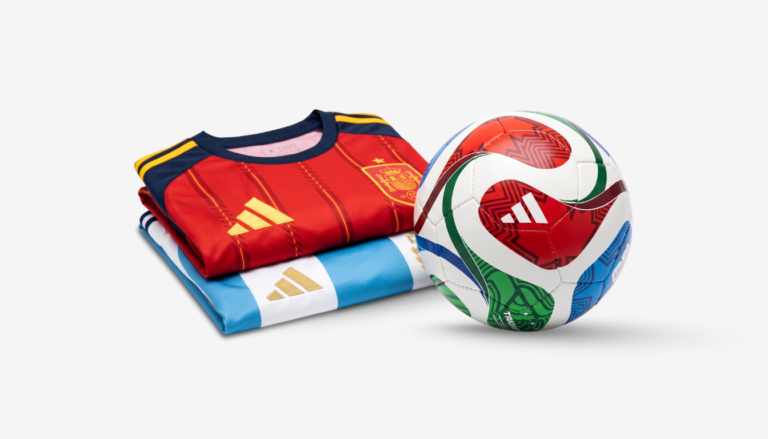
The explanation sat on a single line of the income statement. Marketing and point-of-sale spending reached €924 million in the quarter, more than $1 billion, equal to 13.7% of sales against 12.0% a year earlier. The incremental €212 million, a 30% year-on-year increase, went almost entirely into the FIFA World Cup, funding the Timothée Chalamet-fronted “Backyard Legends” campaign, jersey sponsorships for 14 national teams, the Trionda match ball, and the first tournament in which referees wore the three stripes.
Nothing about the spending was hidden. Adidas had signaled the investment for more than a year. Investors still treated it as a surprise, which says less about disclosure than about how the market reads marketing on a balance sheet.
What the Money Actually Bought
By any operational measure, the campaign worked. Adidas sold four times more jerseys and twice as many balls as it did during the 2022 tournament in Qatar, generating around €1.5 billion, or $1.7 billion, in event-related sales. Mexico’s shirt became its best-selling national jersey. Both finalists, Argentina and Spain, wore the brand.
Set the figures side by side and the arithmetic is favorable. Roughly €212 million in incremental marketing produced about €1.5 billion in attributable revenue. Chief executive Bjørn Gulden called the tournament a fairy tale and said the quarter underlined the strength of both brand and product.
The performance division, led by football and running, grew 39% on a currency-neutral basis. Apparel revenue climbed 35%. Direct-to-consumer sales rose 25%, with e-commerce up 27%, meaning much of the demand landed in channels Adidas owns rather than in wholesale accounts where margin leaks away.
The Regions Tell a Second Story
Growth was double-digit almost everywhere. North America rose 17%, Latin America 28%, Greater China 15%, Japan and South Korea 18%. Europe, the largest and most mature market, grew 6%.
That gap matters more than it first appears. A global tournament staged in North America produced its strongest lift in markets where soccer is still gaining commercial ground, and its weakest in the region where the sport is already saturated. The upside of a cultural moment concentrates where the category has room, not where the fandom is deepest. Marketers planning around the next global event should note which map they are actually buying.
Footwear told a colder story, growing 1%, while lifestyle rose 2%. The World Cup moved jerseys and balls. It did not resolve the sneaker problem that has occupied Adidas since the Yeezy split.
Investors Priced a Campaign as a Cost
Adidas raised full-year revenue growth guidance to 9-10% from a high-single-digit forecast, and left profit guidance unchanged at roughly €2.3 billion. The market read that pairing exactly as stated. More revenue, same earnings. Extra sales are not converting into extra profit.
Gulden moved to reassure analysts that marketing spending would return to normal levels over the next two quarters. Two other disclosures added noise to the release. Chief financial officer Harm Ohlmeyer will leave after nearly three decades, with Birgit Kretschmer named as his successor. And the guidance excludes €250 million to €300 million in potential U.S. tariff refunds the company has not yet booked.
The Argument Marketers Keep Losing
The Adidas quarter is a clean illustration of an old asymmetry. Marketing spend lands inside a single reporting period. The brand equity it builds pays out across years that no quarterly statement captures. A campaign returning roughly seven euros of attributable revenue for every euro of incremental investment still read as a miss, because the profit line is measured in ninety-day increments and a fairy tale is not.
There is a harder point buried in Gulden’s promise to normalize spending. By framing the World Cup budget as an exception, Adidas conceded the market’s premise, that the elevated investment was a deviation rather than a new operating level. Rivals listening to that call learned something about the price of ambition, and the lesson was not encouraging.
The counterargument deserves weight. McDonald’s and Unilever both credited the tournament for stronger sales and marketing returns without a comparable hit to profit. Sponsorship at the FIFA level is a different order of commitment than activation around it, and only one of those requires outfitting fourteen national teams.
For marketers, the practical takeaway is about framing rather than spending. Adidas built a defensible case and presented it as a fairy tale. Finance heard a story when the market wanted a model. When a campaign budget expands by a third, the case has to be built in the language of payback periods, incremental margin, and channel mix before results arrive, not celebrated after them.