
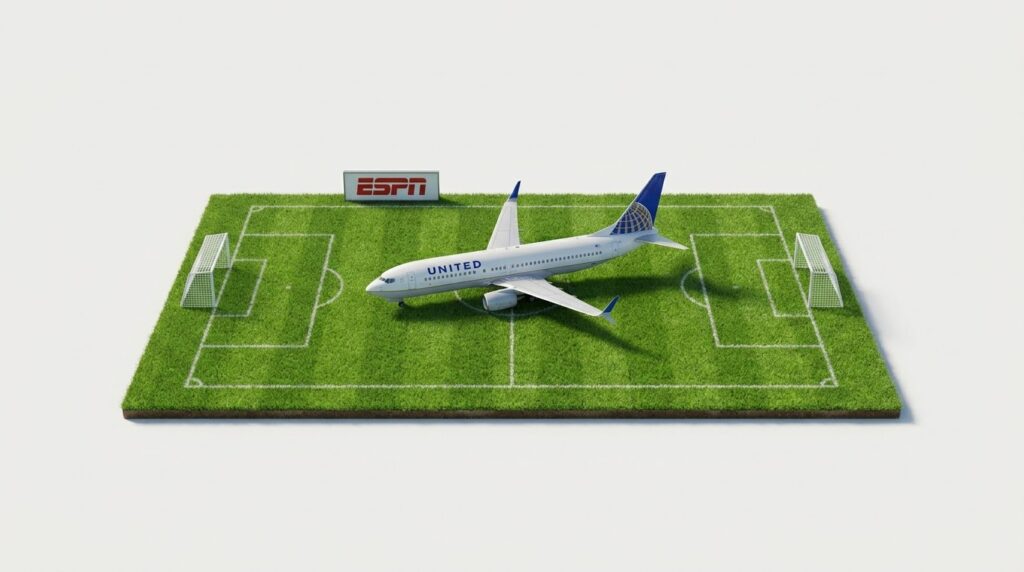
The advertisement, in this case, is the airplane. For its 2026 fantasy football draft, ESPN put one of its drafters on a United flight and had him make live picks from 35,000 feet, connected by Starlink, the satellite internet service United has been installing across its fleet. Disney Advertising built the collaboration, ESPN host Tyler Fulghum flew with the broadcast while analysts Field Yates, Mike Clay, and Liz Loza drafted from the network’s Bristol studio, and the whole thing aired on August 25 as part of ESPN’s televised draft special. The stunt sold no product directly. It demonstrated one.
Turning Infrastructure Into a Story
Airlines have competed on Wi-Fi for years, but connectivity is an invisible upgrade, the kind of improvement a passenger only notices when it fails. United’s problem was making an infrastructure investment feel like a benefit worth choosing the airline for. Running a live national broadcast segment from a cabin at cruising altitude solves that problem by turning the invisible into the unmissable. If the Wi-Fi is good enough to power a live fantasy draft on television, the reasoning goes, it is good enough for anything a traveler needs to do. The medium is the proof. United is not telling flyers its internet is fast. It is showing them, under conditions that leave no room for an asterisk.
Why Fantasy Football Was the Right Vehicle
Fantasy football is uniquely suited to the demonstration. A draft is live, time-sensitive, and unforgiving, a moment where a dropped connection means a missed pick and real consequences for the participant. That pressure is exactly what makes the stunt persuasive. Choosing an activity that cannot tolerate lag stress-tests the product in front of an audience that understands the stakes. Fantasy is also a community ritual with tens of millions of participants, which gives the segment a built-in, emotionally invested audience rather than a general one. The passion around draft night does the work of making a Wi-Fi test feel like appointment viewing.
The Disney Advertising Angle
For Disney and ESPN, the collaboration is a product in its own right. Rather than sell United a batch of standard commercial spots, Disney Advertising sold it a piece of co-branded live content woven into ESPN’s own programming, distributed across the ESPN broadcast, the NFL on ESPN YouTube channel, and social platforms through correspondent Omar Raja’s behind-the-scenes coverage. That is the shape of premium advertising now, a custom experience integrated into the editorial event rather than interrupting it. The airline gets a story instead of an interruption, ESPN gets a sponsor that deepens its marquee moment, and both sides get content engineered to be shared rather than skipped.
Experiential Marketing Moves From Spectacle to Proof
The stunt marks a shift in what experiential marketing is for. The classic brand stunt existed to be watched, a spectacle that generated coverage and goodwill without necessarily saying anything about the product. This one exists to prove a claim. Its entire value rests on demonstrating that United’s connectivity performs under the hardest conditions the brand could stage. That move, from spectacle to proof, is where experiential work earns its keep, because a demonstration a skeptic cannot easily dismiss does more for a functional benefit than any adjective in a script. Proof travels further than promise, especially for a benefit customers have learned to distrust.
The Limits of the Stunt
The caveats are real. This was one flight, one draft, one carefully managed broadcast, and a single controlled demonstration is not the same as a guarantee that every passenger on every route will get the same experience. The gap between a staged proof and everyday reality is where stunts like this can lose credibility if the ordinary product fails to live up to the show. There was also genuine risk in the execution, since a live segment built entirely on the Wi-Fi working would have become a very public embarrassment had the connection dropped on air. That the brand accepted that risk is part of what makes the demonstration convincing, but it is also a reminder that the tactic does not scale into a promise on its own.
What Marketers Should Take
The lesson for marketers is to find the version of a product claim that cannot be argued with and stage it where an audience already cares. United did not describe its connectivity. It set up a situation in which the connectivity had to perform or fail publicly, then attached that test to a cultural ritual with a devoted following. The result works on three levels at once, as a brand demonstration for United, as premium advertising inventory for Disney and ESPN, and as shareable content for social feeds. For any brand selling a benefit customers have grown numb to, the takeaway is to stop asserting and start proving, ideally somewhere the audience is already watching.