
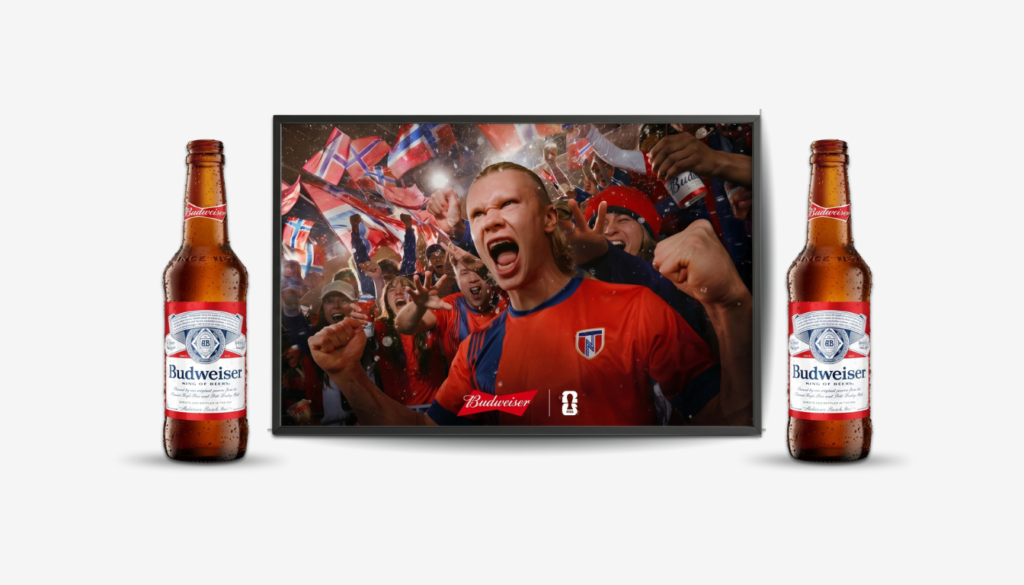
Every four years, the World Cup quietly reorganizes the emotional rhythm of everyday life, drawing millions into a shared cadence of anticipation, tension, and release that transcends geography, language, and routine, and it is precisely within this rare collective atmosphere that Budweiser situates its “Let It Pour” campaign, not as a conventional piece of advertising, but as a narrative that seeks to echo, and in some ways amplify, the psychological intensity of the tournament itself. Rather than focusing on the mechanics of the game or the technical brilliance of its players, the campaign turns its attention to what surrounds football, capturing the restless moments before kickoff, the communal electricity of watching, and the unfiltered reactions that unfold in living rooms, bars, and streets across the world, thereby positioning the product less as a focal point and more as a silent companion to an experience that already carries profound emotional weight.
Casting Emotion as Credibility
The choice to center the campaign around Erling Haaland and Jürgen Klopp reveals a carefully calibrated understanding of contemporary sports culture, where credibility is no longer derived solely from performance but from emotional authenticity, with Klopp’s expressive, almost theatrical presence offering a narrative voice that feels inherently aligned with the volatility of football, while Haaland represents a new generation of athletes whose global appeal is shaped as much by personality and symbolism as by achievement. The inclusion of Alfie-Inge Haaland adds a further layer of meaning, subtly reinforcing the idea that fandom is not merely experienced in the present but inherited across generations, passed down through stories, memories, and shared rituals, much like the World Cup itself, which exists as both a recurring event and an evolving archive of collective emotion.
The Art of Amplifying the Irrational
If the campaign’s tone occasionally drifts into the surreal, incorporating unexpected elements such as a celebratory Godzilla, it does so not for spectacle alone but as a deliberate reflection of the way fans actually experience the World Cup, where logic often gives way to imagination and where moments of intensity blur the boundaries between reality and fantasy. This creative exaggeration serves to elevate the narrative beyond simple relatability, allowing it to occupy a more memorable, almost dreamlike space that mirrors the heightened emotional states associated with the tournament, and in doing so, it ensures that the campaign does not merely depict fandom but intensifies it, transforming familiar scenes into something more vivid and enduring in the viewer’s memory.
A Global Strategy With Local Sensitivity
Although “Let It Pour” is designed to run across 40 countries, its deliberate absence from the United States signals a more nuanced and increasingly prevalent approach to global brand strategy, wherein scale is balanced with cultural specificity, and under the umbrella of Anheuser-Busch InBev, the decision to deploy alternative brands such as Michelob Ultra and Stella Artois within the U.S. market reflects an understanding that even universally recognized events like the World Cup require differentiated narratives to resonate effectively. In markets where football occupies a central cultural role, Budweiser leans into its longstanding association with the tournament, reinforcing a positioning cultivated over decades, while allowing other brands within the portfolio to interpret the moment through lenses that better align with local audience expectations.
Memory as a Product
Extending beyond the film, the campaign finds tangible expression through limited-edition bottles and a dedicated fan store, both of which function not merely as commercial extensions but as physical embodiments of the campaign’s central thesis, namely that the World Cup is as much about memory as it is about the present. By featuring designs drawn from past tournaments, the bottles become vessels of nostalgia, inviting fans to reconnect with specific moments that have shaped their personal and collective histories, whether a long-awaited victory, a defining goal, or a shared celebration that transcends the boundaries of the game itself. In this way, the act of consumption is reframed, transforming a simple purchase into an opportunity to engage with the emotional residue of past experiences.
Where Commerce Meets Culture
The introduction of the Bud Fan Store further extends this interplay between narrative and materiality, offering apparel and collectibles that allow fans to carry the emotional resonance of the campaign into their daily lives, thereby blurring the distinction between experience and ownership. What emerges is a cohesive ecosystem in which storytelling, product, and identity are interwoven, with the advertisement igniting emotion, the product sustaining it, and the merchandise giving it a tangible form, ultimately creating a cycle in which participation in the campaign feels less like a transaction and more like an extension of belonging.
The Brand as Part of the Experience
At its core, “Let It Pour” reflects a broader evolution in the logic of event marketing, where the objective is no longer simply to capture attention but to embed the brand within the emotional architecture of the moment itself, aligning its presence with the way the event is felt rather than merely how it is consumed. By positioning itself as an integral part of the World Cup experience, Budweiser moves beyond visibility and into relevance, suggesting that the most effective campaigns are those that do not attempt to dominate the narrative but instead understand it deeply enough to exist naturally within it, allowing the brand to be remembered not as an interruption, but as a participant in one of the world’s most emotionally charged cultural rituals.